

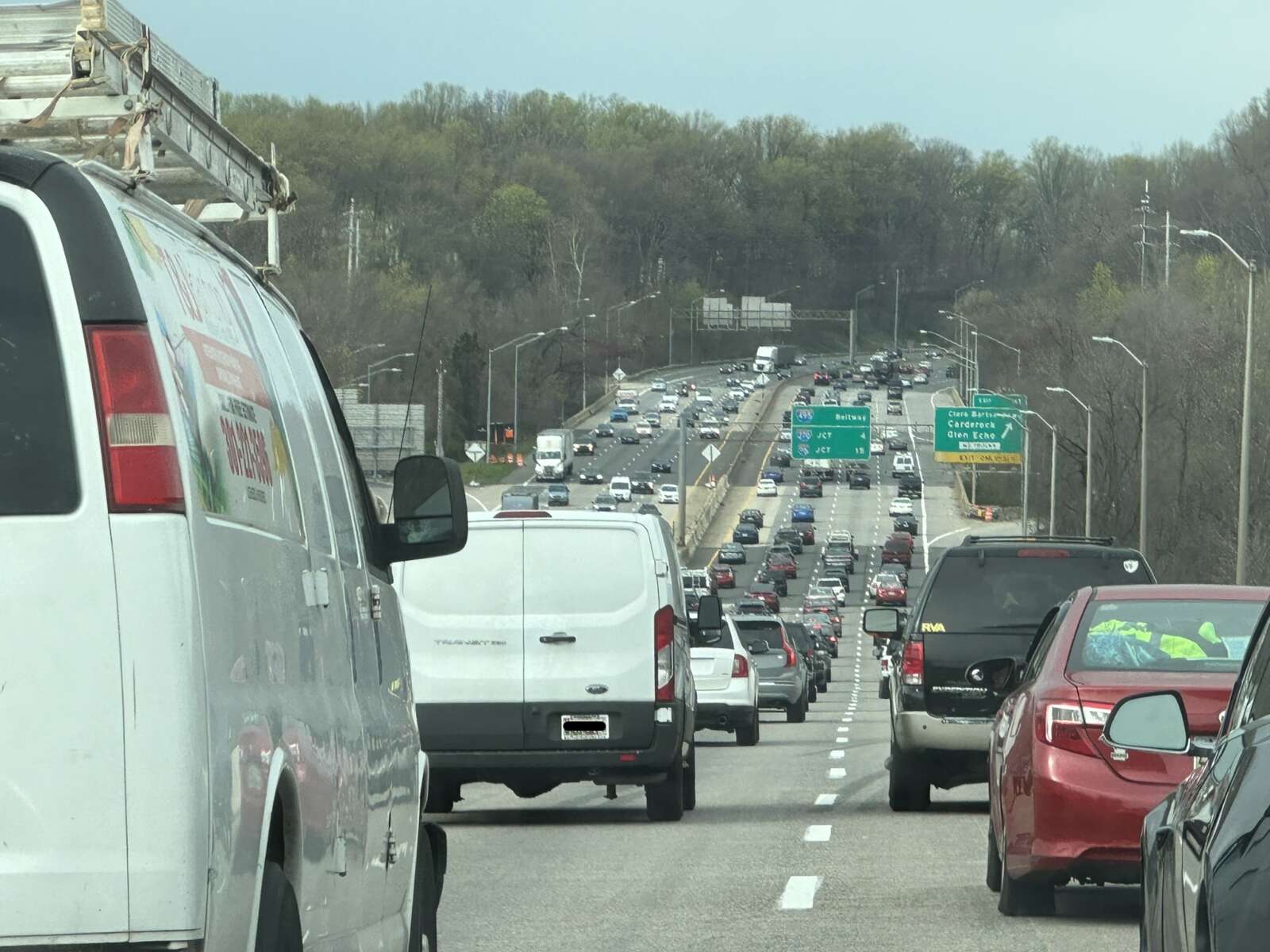
Virginia leaders plan to keep prodding their Maryland counterparts in the direction of revitalizing the American Legion Bridge to both ease existing congestion and provide additional transit options.
At a Dec. 5 forum sponsored by the Dulles Area Transit Association (DATA), Northern Virginia leaders acknowledged being irked by Maryland’s more cautious approach to addressing the transportation bottleneck.
“The bridge has to be rebuilt. It’s way overdue. We’re in a clock that is already ticking,” Fairfax County Board of Supervisors Chairman Jeff McKay said during the 90-minute roundtable.
Beyond just addressing congestion, Maryland leaders need to be concerned from a safety standpoint, McKay said, pushing back on Maryland’s contention that the fiscal issues may make moving forward quickly on a project to replace and widen the bridge impossible.
“If something happens with this bridge, their fiscal problems are going to get a whole lot worse,” McKay said.
While Virginia is now widening its side of the Capital Beltway (I-495), extending express lanes from Tysons to the GW Parkway in McLean, drivers will still have to merge back into regular traffic at the bridge.
Until the bridge and Maryland’s side of the Beltway expand, the 495 NEXT project is merely pushing an existing bottleneck farther north, some Fairfax County officials and irritated residents of McLean and Great Falls, who have to contend with traffic spillover on local roads, have argued.
Federal officials approved plans in 2022 to add toll lanes to I-495 and I-270 in Maryland, but private toll lanes operator Transurban extricated itself from the project in 2023, citing concerns about delays related to environmental issues and the “changing political landscape” in the state.
The move was a blow to the 2019 agreement signed by the then-governors of the two states — Virginia’s Ralph Northam and Maryland’s Hogan — to replace the bridge, which opened in 1962 and remains the only direct connection between Fairfax and Montgomery counties.
Maryland has made some moves toward restarting its efforts, applying for a federal grant and conducting field surveys in McLean. However, the project is one of several that state officials proposed delaying this fall due to budget constraints.
Any replacement or refurbishment project likely would rely on hundreds of millions of dollars in federal government support. Where the incoming Trump administration and a Republican Congress will stand on the topic remain to be seen.
“Hopefully we can get what we can get,” said Suhas Subramanyam, a Democrat who was elected on Nov. 5 to succeed Rep. Jennifer Wexton (D-10) in the House of Representatives. He takes office in early January.
While it would seem that Prince William County is far removed from the American Legion Bridge debate, Board of County Supervisors Chair Deshundra Jefferson threw her political weight behind McKay’s position.
“In Northern Virginia, we have to stick together,” she said at the Dec. 5 forum. “What affects other counties does affect me; it does affect my constituents.”
McKay expressed hope that the current governors, Glenn Youngkin and Wes Moore, will work collaboratively to craft a solution in 2025. He also said the American Legion Bridge matter should be front and center when Virginia’s next governor takes office in January 2026.
In an effort to ease congestion in the short term, and provide more options for travelers, Fairfax County recently launched express Fairfax Connector bus service between Tysons and Bethesda via the bridge. But without express lanes, “our buses are stuck in the same traffic as everyone else,” McKay said.
Improving connectivity in the corridor has been a priority for some for more than a quarter-century.
According to the Northern Virginia Transportation Alliance, a 1997 Greater Washington Board of Trade study concluded that constructing a new crossing linking Route 7 in Virginia with I-270 in Maryland was “the single most important transportation infrastructure investment the region could make.”
The American Legion Bridge is operated by the Maryland State Highway Administration. One reason why: Since 1632, when the boundary between Virginia and Maryland was fixed by England’s King Charles I, Maryland has laid claim to virtually the entire Potomac River up to the Virginia shoreline.
