


Housing advocates used last week’s Fairfax County budget hearings to press for local leaders to turn their affordable housing aspirations into reality through increased funding.
“The market on its own … is not building near enough affordable homes,” said Reston resident John Dister, one of several housing advocates to address the Board of Supervisors on April 15, one of three days of public hearings on the fiscal year 2027 budget.
Dister noted that county leaders have set a goal of dedicating two cents of the county’s real estate tax rate — currently $1.225 per $100 of assessed valuation — to housing initiatives, which would bring in approximately $70 million annually for housing programs.
Currently, the budget for housing represents about 1.25 cents of the tax rate after the current fiscal year 2026 budget dedicated an additional quarter-cent.
“It’s still about $25 million short,” Dister said.
“Every year in its budget guidance, the Board reiterates its goal of two pennies, explains why it did not meet that goal and promises to do it next year,” he added.
Another organization advocating for the two-cent funding level is the Fairfax County NAACP.
“The county has fallen behind its 10,000 affordable-unit goal by 2034,” said Les Shockley, the NAACP branch’s budget committee chair and second vice president. “We are concerned that the county is not meeting its development targets, and we are concerned that continued underfunding will make these goals unattainable.”
While some advocated for more, other speakers said the county government deserved praise for making housing a top priority.
“This Board has moved beyond rhetoric, and you’ve moved into the realm of making things reality,” said Lenore Stanton, who chairs the Fairfax County Redevelopment & Housing Authority.
Still, Stanton urged leaders to continue the momentum, encouraging supervisors to have “the vision to see the community we want to be and having the resolve to build that community.”
John Boylen, a member of the Affordable Housing Advisory Council, expressed a similar sentiment.
“Now is the moment to align resources to that vision,” he said.
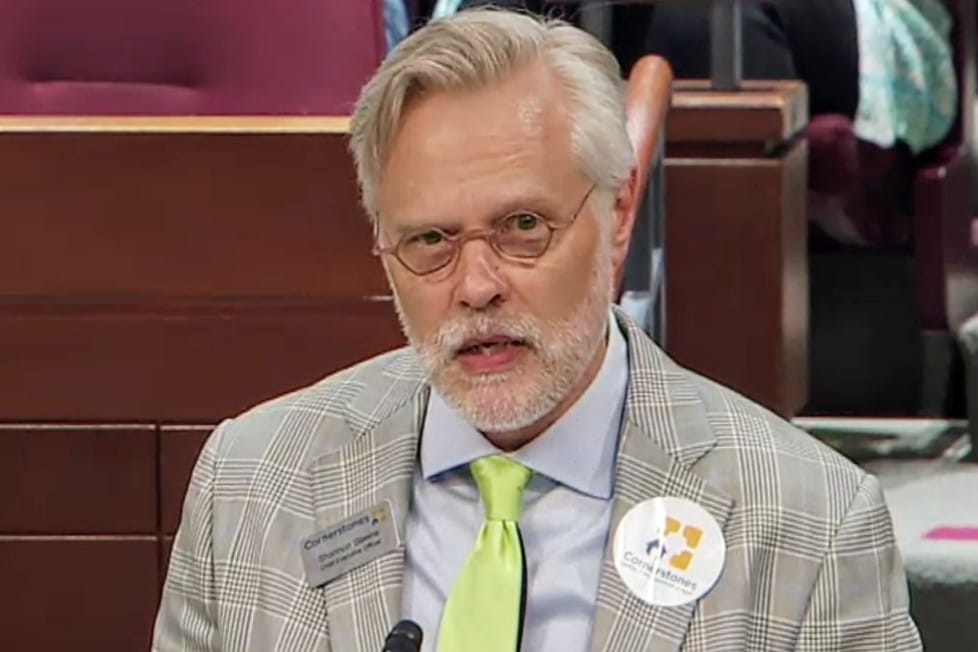
Among those speaking on April 15 was Shannon Steene, who had started work two days earlier as the new CEO of the Reston-based safety net nonprofit Cornerstones.
Steene, who previously served as executive director of Carpenter’s Shelter, praised County Executive Bryan Hill’s proposed budget for funding housing, food assistance and legal aid to support local residents facing economic or other challenges.
Having comprehensive wrap-around services “helps them get back on their feet when life knocks them down” and “prevents a crisis from becoming a catastrophe.”
Mitchell Crispell, director of real estate development for the Arlington-based nonprofit True Ground Housing Partners, said the county could bolster its support for housing without adding significant costs.
He suggested three improvements: streamlining the permit review process, making more public land accessible for housing, and approving site-specific amendments to the county’s comprehensive plan that include affordable housing components.

Donald Booth, a volunteer team leader for Rebuilding Together, asked supervisors to maintain or, if possible, increase the $350,000 in annual funding for the organization, which helps low-income residents with home repairs.
“I’ve seen firsthand the very real hazards” some homeowners face, Booth said. Spending a little money on repairs is the most cost-effective way to preserve existing affordable housing, he said.
Hill’s budget stripped out the $350,000 line item, but several supervisors have requested it be brought back for consideration prior to final budget adoption.
Hill released his FY 2027 budget proposal in mid-February. Last week, county officials shared an update on local economic conditions and their impacts on the budget.
Hill’s $5.7 billion budget proposal includes about $23 million in unallocated funds that could support housing or other spending. Supervisors will make final budget decisions on April 28, with adoption set for May 5. The FY 2027 budget goes into effect July 1.
