


Fairfax County’s real estate tax rate would remain the same, but the typical homeowner would still pay $357 more due to higher assessments under the $5.98 billion fiscal year 2027 budget proposed today (Feb. 17) by County Executive Bryan Hill.
“Fairfax County is stable, competitive and positioned for growth. We are stabilizing and we are also advancing,” Hill told the Fairfax County Board of Supervisors, officially kicking off the two-and-a-half month budget process.
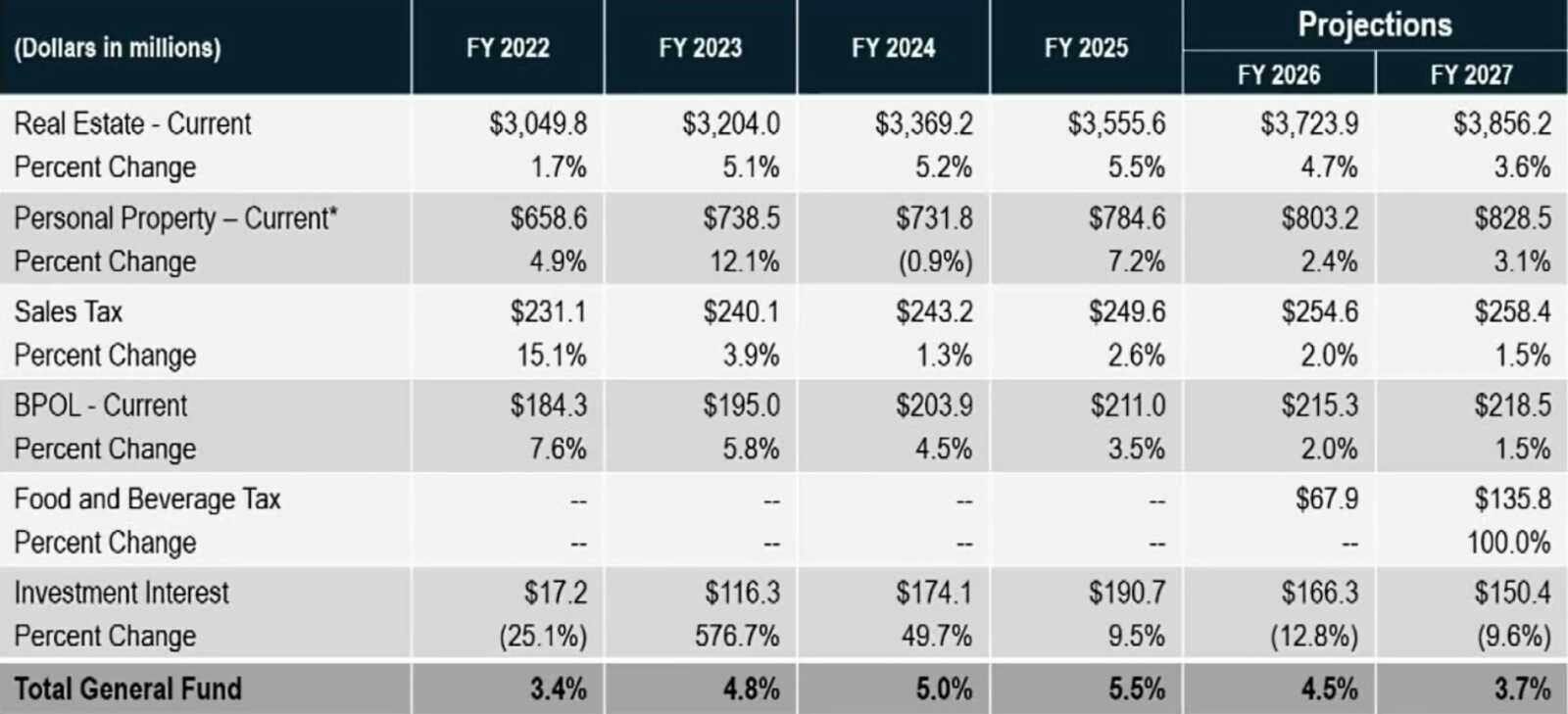
Total anticipated revenue growth of 3.7% for FY 2027 is the lowest since the county saw a 3.5% uptick in fiscal year 2022, but is “still a healthy increase,” Hill said.
The budget package proposes maintaining the existing tax rate of $1.1225 per $100 assessed value. Because assessments are still projected to increase by 3.6% overall, largely from increases in the residential sector, total estimated real estate revenue would grow to $3.856 billion.
Personal property tax revenue would increase 3.1% to $828.5 million.
Hill’s projections anticipate that the county’s new food and beverage tax, which took effect on Jan. 1, will generate $135.8 million in its first full fiscal year. It anticipates 1.5% increases in sales-tax revenue (to $258 million) and business/professional/occupations tax revenue (to $218.5 million).
The budget plan calls for a 2% cost-of-living adjustment for all employees, plus a variety of additional increases based on collective bargaining agreements.
The county government’s living wage for its lowest-paid employees and contractors would rise to $18.50 per hour, on the way to $20 per hour in FY 2029.
The increases will “ensure we remain competitive in a tight labor market,” said Hill, who has been county executive for nine budget seasons.
After projecting a $131.5 million budget gap in December, partly as a result of declining office values, Hill reported that there have now been some positive signs for the non-residential real estate market, which is projected to increase for the first time in three years by 0.92%.
The county’s direct office vacancy rate has also dropped for the first time since 2019, as more older buildings are demolished or repurposed and developers pull back on “speculative” construction.
“More than 900,000 square feet of office space was demolished in 2025, compared to just 320,000 square feet currently under construction and expected to be fully occupied upon completion,” Hill said in a message to the board. “As we continue to right-size our office market inventory, we are hopeful that we have turned a corner and a stronger commercial real estate market is beginning to emerge.”
Though Hill’s revenue projections have become more optimistic since December, his proposed budget has still targeted more than 100 positions and $32.9 million for elimination.
Efforts would be made to move affected employees to other positions, but the spending cuts include some notable programs, including a pilot program to help low and moderate-income residents with home repairs and speech and hearing services for children in the health department.
Spending on debt service would increase nearly $19 million to account for a sale of $400 million in government and school bonds in January.
School funding less than requested
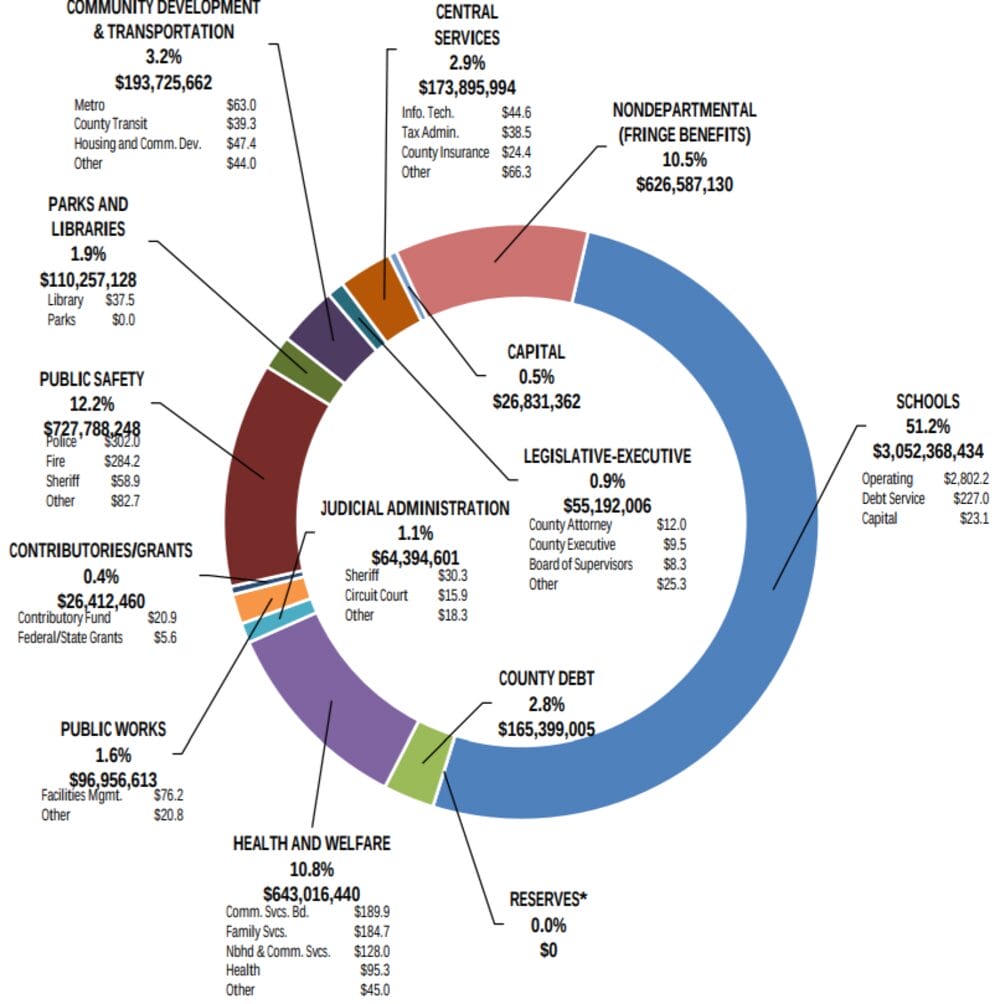
Hill proposes about $94.6 million in additional operating funding for Fairfax County Public Schools, below the $138.4 million sought by Superintendent Michelle Reid.
Reid’s budget proposal, released in January, seeks a total of $2.84 billion in operating support from the county government, representing about 69% of the total FCPS budget. Hill’s proposal would transfer about $2.8 billion in overall operating funds.
Hill said he is hopeful increases in state funding for education will help fill some of that gap. That view was echoed by Mason District Supervisor Andres Jimenez.
“We’re hopeful our partners in Richmond will do the right thing,” Jimenez said.
According to Hill’s message on his proposal, FCPS would receive approximately $106 million under the state budget put forward by former Gov. Glenn Youngkin before he left office in January. That will give the county more flexibility, but the amount allocated for compensation would amount to only a 0.4% pay increase for teachers.
“I remain hopeful that by continuing to work with our state representatives and the new administration, additional state funding can be identified,” Hill wrote.
Hill’s budget proposal allocates an additional $7.5 million for the school system’s construction fund, as well as additional funding for debt service on $230 million in bonds sold in January.
Board of Supervisors Chairman Jeff McKay said that despite lingering questions about the region’s economic future, the budget proposal was “a breath of fresh air” compared to those of the last few years.
McKay said the economic trends provide “some glimmer of hope … despite headwinds.” He said he would see if there were ways to reduce the real estate tax rate to partially offset higher assessments in the residential sector.
Hill included $23.2 million in unallocated funding in his advertised budget that the Board of Supervisors could use to address different priorities, such as tax relief, affordable housing, additional FCPS support or restoring proposed reductions.
Others shared McKay’s caution on getting too far in front of a potential regional recovery.
“Economic trends are in doubt, still,” said Mount Vernon District Supervisor Dan Storck. “Retail in particular has been hurting.”
Springfield District Supervisor Pat Herrity said that while he appreciated trims made to some programs, they didn’t go far enough to offset the impact on homeowners.
“Taxes have still gone up 50% in the last 10 years,” he said. “I don’t want to leave our taxpayers thinking we’ve actually reduced our budgets. We’ve got a lot of work to do.”
Others pushed back on the idea that overall budgets can be reduced year after year.
“Most community members don’t see how much local government does. There’s a cost to that,” Sully District Supervisor Kathy Smith said.
Hill told supervisors economic figures were continuously being reviewed, and staff are “trying to figure out what’s coming down the pike next.”
“As we get more details and more data, we’re going to be able to talk to you more strongly about what’s happening,” he said.
Supervisors will meet with the Fairfax County School Board in coming days to discuss budget issues. On March 17, supervisors will set maximum tax rates for consideration throughout the rest of the budget season.
Supervisors will hold public hearings on the budget and tax rates April 14-16. Plans call for supervisors to mark up (finalize) the budget on April 28, with final adoption on May 5.
The FY 2027 spending plan goes into effect on July 1.
Looking beyond the coming fiscal year, Hill said concerns abound. He pointed to slowing housing-value appreciation, higher employee and retirement costs, higher debt-service costs and more costs related to transportation.
“These pressures are real,” he said.
The next economic update for supervisors from staff will come in April, Hill said.
