

Fairfax leaders will have another funding gap to fill in the coming months, as they solidify fiscal year 2027 budget proposals for both the county government and school system.
How much additional funding the county will need to generate or cut, and where they will find it, remain very much up in the air.
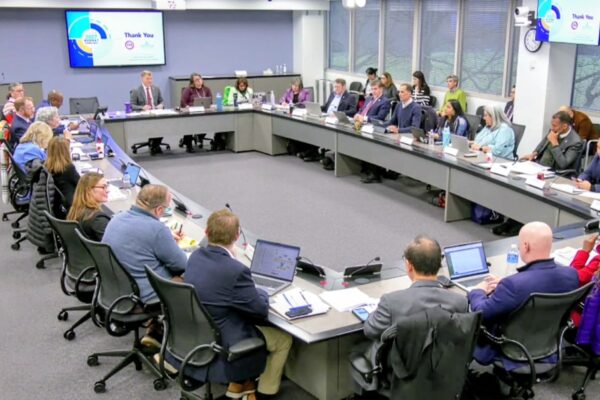
At a joint meeting yesterday (Tuesday) of the Board of Supervisors and School Board, budget staff offered a best-guess estimate that the county could face a gap of $131.5 million, with spending exceeding an anticipated $225.5 million in new revenues by $163.8 million on the county government side and $193.2 million on the school side.
It was merely a starting point for discussion, said Christina Jackson, the county’s chief financial officer.
“None of the revenue estimates we’re talking about … is guaranteed,” she said at the meeting.
Leigh Burden, chief financial officer for Fairfax County Public Schools, said the FCPS budget plan is a work in progress, as well.
“It’s very early for us” she said. “There’s still a lot of uncertainty.”

County and FCPS seek more collaborative process
While staff continued to warn about the unpredictable potential impacts of federal government actions, from the recent shutdown and job cuts to changes to programs like Medicaid and SNAP, the projected shortfall is lower than it was in previous years.
Facing an estimated $292.7 million gap, the Board of Supervisors adopted a fiscal year 2026 budget in May that introduced a meals tax while cutting $51 million. In effect as of July 1, the budget totaled about $5.7 billion, including $2.9 billion for schools.
FCPS received a smaller transfer than what Superintendent Michelle Reid had requested, leading to sniping between county and school leaders. As the FY 2027 budget process rolls forward, Jackson indicated there is more collaboration taking place behind the scenes.
“We are a little more in alignment this year,” Jackson said.
The school system’s budget request coming in early 2026 will represent “the barest essentials of what FCPS is going to need,” said School Board Chair Sandy Anderson.
With early forecasts shared last month suggesting a need for a $180 million increase in funding from the county, Burden said the financial picture being presented by FCPS at the meeting “truly does just represent our bare-bones needs.”
Anderson, who represents Springfield District on the school board, said Democrat Abigail Spanberger’s election as governor and Democrats holding majorities in the General Assembly provide hope that more education funding will be provided by Richmond in the coming year. She urged county supervisors to join with School Board members to press for it.
“We have a window to make meaningful progress — as partners, working together,” Anderson said.

Uncertainties about overall economic conditions and federal government policies remain top of mind for county leaders, but how things will play out throughout the budget process remains guesswork.
“We appreciate having the numbers in front of us,” McKay said. “We hope they go in the direction we want them to go. We have a lot of hard work to do.”
The coming months would be a time “to ask the questions we need to ask” before finalizing the budget, he said.
Residential property values up, office decline continues
County staff expect to see lower growth in the real estate tax base in FY 2027, with commercial values continuing to slip and home sales slowing while prices increase.
The budget forecast anticipates an average home-assessment increase of 3.2% for 2026. With no change in the current tax rate, the assessment bump would add $285 to a typical homeowner’s tax bill next year.
While housing assessments will be up, those of mid-rise and high-rise office buildings are expected to be down a cumulative 5% to 8% when assessments are released early in the new year.
Despite higher assessments for hotels (expected to increase 2% to 4%) and retail space (1% to 3%), the major decline of office property values will drag the overall commercial sector into negative territory for the third year in a row — down a projected 0.6%, according to staff.
As a result, Fairfax will continue a trajectory already seen in neighboring Arlington for years, with the tax burden being shifted more onto households.

To ease that burden, and the political risk that comes with it, the Democratic majority on the Board of Supervisors authorized a tax on prepared food and beverages, to go on top of the existing sales tax. The addition of a new revenue source allowed for a small cut in the real estate tax rate for fiscal year 2026.
That meals tax takes effect Jan. 1. Jackson said budget staff can’t be sure how much it will bring in until a few months’ of data are reported, though the FY 2027 forecast was based on an assumption of flat revenues.
“We want to make sure we’re conservative” in forecasting, she said.
More budget cuts likely on the table
As part of the budget planning process, Hill directed all county government departments to identify potential cuts totaling 5% of their overall budget. In addition, a request for suggestions from staff resulted in 850 budget-cutting recommendations.
“We anticipate including some of these ideas” in the final budget package, Jackson said.
Springfield District Supervisor Pat Herrity said he would have liked to see the school system take similar steps.
“I didn’t see any reductions built into this [FCPS] budget,” he said.
“We’ve not added new initiatives,” countered Braddock District School Board member Rachna Sizemore Heizer, who may no longer be around once this budget season kicks off in earnest.
Sizemore Heizer is the Democratic nominee in the Dec. 9 special election to fill the Braddock District supervisor seat vacated in September by James Walkinshaw. She is competing for the office against Republican Ken Balbuena and independent Carey Chet Campbell.

Both the county government and FCPS will need to budget with an eye toward collective-bargaining agreements either already or soon to be ratified.
Members of the SEIU Local 512 chapter representing general county workers ratified their first contract in October. Scheduled to be presented to the Board of Supervisors for its approval next Tuesday (Dec. 9), the agreement’s proposed pay raises and other provisions would cost $51.6 million, according to the county’s budget staff.
Under state law, if the money is not available, localities are not required to honor union contracts — as FCPS employees learned this year, when their promised pay raises were trimmed to compensate for county supervisors not fully funding Reid’s budget request.
The Board of Supervisors and School Board are slated to next meet on budget issues on Feb. 24. By that point, Reid and Hill will have released their budget proposals on Jan. 22 and Feb. 17, respectively.
Also by that time, the General Assembly will be more than halfway through its 2026 session, and the federal government will have faced down another funding deadline in January by either passing new appropriations bills or allowing another shutdown.
Under state law, localities must adopt balanced budgets. As he did last year, McKay said he wished his colleagues, the media and the public would stop referring to the current budget gap as a deficit.
“There is no deficit,” McKay said. “We are not allowed to have a deficit. So stop saying ‘deficit.'”
