


Local governments like Fairfax County can expect “increased costs, decreased federal support and decreased local autonomy” as the Trump administration works to further implement its agenda in 2026.
That was the analysis of Mark Ritacco, chief government-affairs officer of the National Association of Counties (NACo), who was among those laying out expectations for the coming year to the Fairfax County Board of Supervisors yesterday (Tuesday) morning.
“We are entering a new era — federalism is shifting, federal policy is shifting,” Ritacco said at the Dec. 2 meeting of the supervisors’ legislative committee.
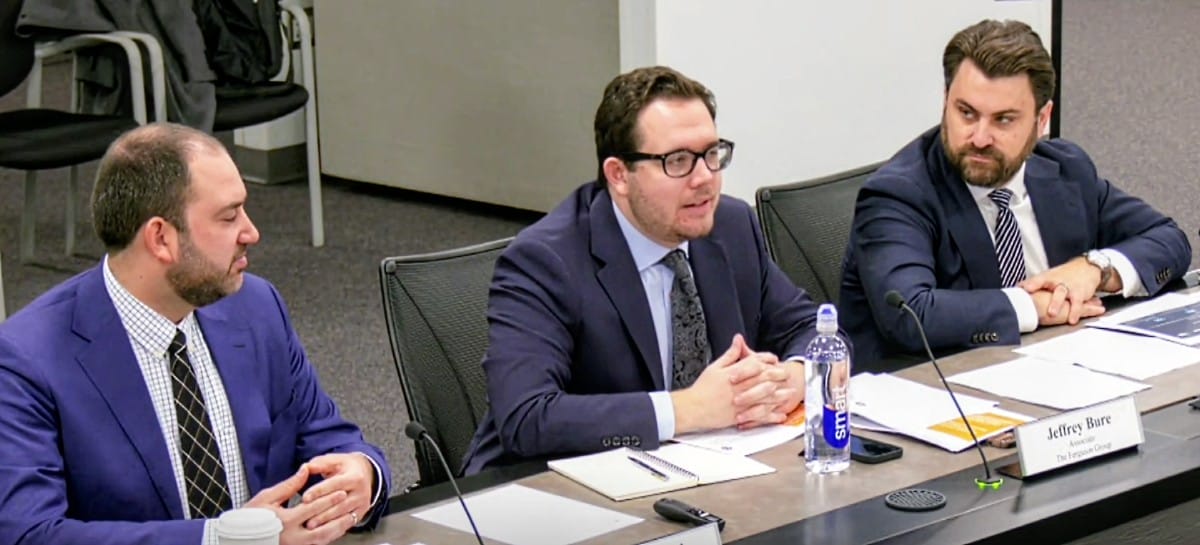
He was on hand with Zach Israel and Jeffrey Burke of the Ferguson Group, a lobbying firm employed by the local government to advocate on federal issues.
Israel and Burke went over a host of areas where the local government is likely to be impacted by changes in federal policy over the coming year, from health care and the environment to transportation funding and data centers.
Also looming is the question of how much personnel the federal government has shed, and how much further downsizing might go. According to the presentation, an estimated 207,000-plus civilian workers have left the federal workforce this year, including 154,000 who accepted the government’s “deferred resignation” offers, as of Nov. 18.
“It’s hard to know what the current status is now,” said Israel, noting up-to-date figures are limited due in part to the seven-week government shutdown.
The NACo and Ferguson Group representatives did present one area of potential good news: Burke said Congress was poised to — potentially — back “a great, broad bill” supporting housing construction.
“This could have a really big impact,” he said of the Road to Housing Act, which passed the U.S. Senate in October.
Burke acknowledged, however, there was “not quite as much support” in the House of Representatives, where the bill has yet to be considered.
Supervisors, who are in the midst of preparing the county’s 2026 federal policy priorities, tried to take it all in.
“This is sobering [although] not unexpected,” Board Chair Jeff McKay said after the presentation.
“You’ve got our attention,” added Hunter Mill District Supervisor Walter Alcorn. “We have real issues that are of big concern.”
Singling out one area of alarm, McKay said Fairfax’s plan for a bus rapid transit system dubbed “The One” along Richmond Highway is dependent on federal transit funding that may or may not materialize.
“The project cannot happen without that money — we cannot construct it,” McKay said of a project that seeks more than $460 million in federal funds, or approximately half its overall costs.
The committee chair, Mason District Supervisor Andres Jimenez, said the ongoing plight of federal workers and contractors needs to be kept in mind as the coming year plays out.
“It’s hard to find a neighbor, a friend or family member who hasn’t been impacted,” he said.
Tasked with trying to keep track of all the issues is Jennifer Van Ee, the county government’s legislative director.
“When the federal government changes, it really does affect us in a very specific way, given our proximity,” Van Ee said at the committee meeting.
Supervisors later this month are expected to adopt both their 2026 legislative priorities for the federal government and the Virginia General Assembly session that begins in January.
