

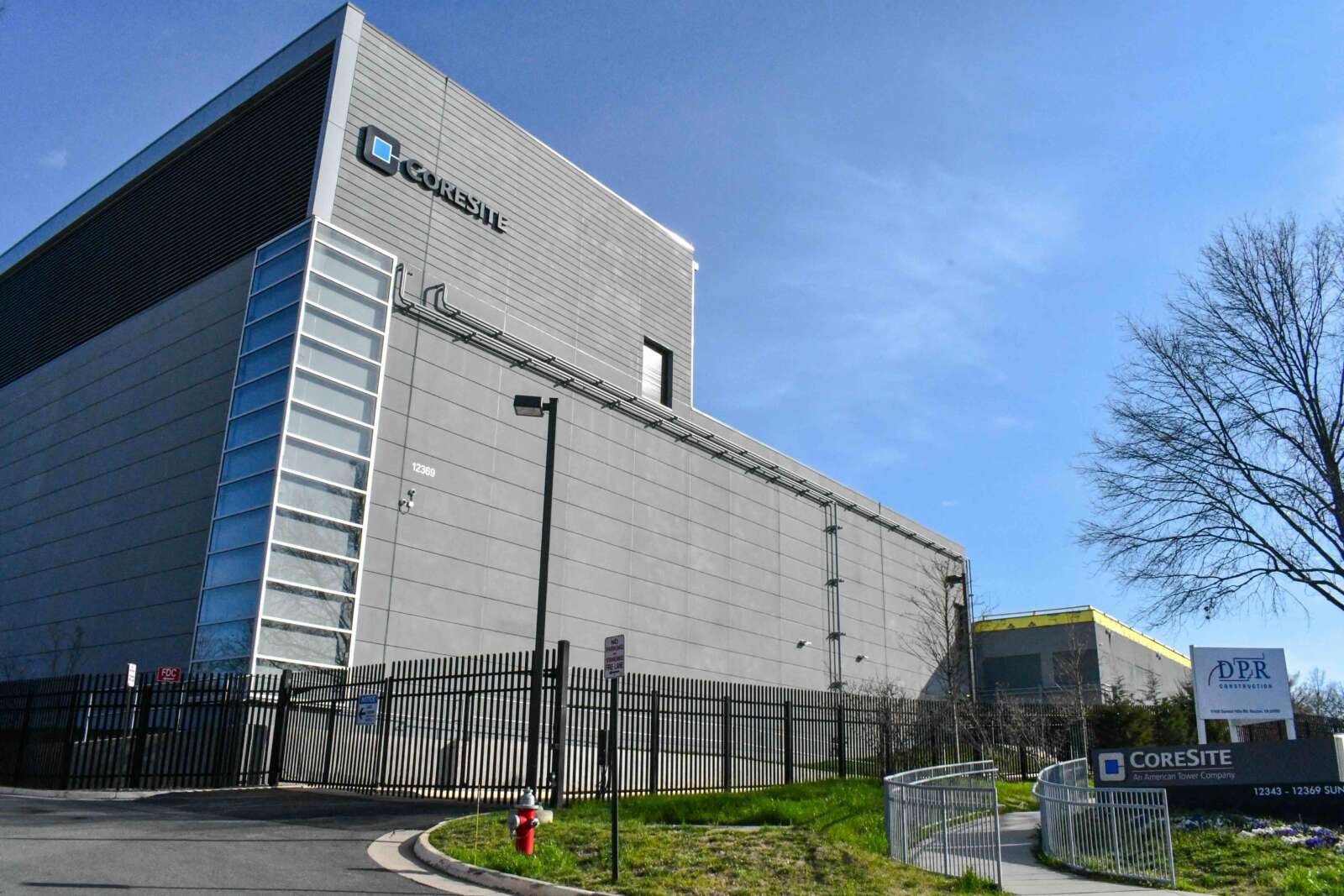
Nearly a third of Virginia’s data centers are located within 200 feet of residential areas, with Fairfax County leading the state, according to a new report released Monday (Dec. 9) by the Virginia Joint Legislative Audit and Review Commission (JLARC).
Assessing the impact of data centers throughout Virginia, the JLARC report found that 55% of Fairfax County’s 20 data centers are within 200 feet of residential zones, and 70% are within 500 feet.
In contrast, Loudoun County, home to 71 data centers, the region’s highest concentration, has only 24% of its facilities within 200 feet of residential neighborhoods and 34% within 500 feet. Prince William County, with 24 data centers, reports just 21% within both 200 and 500 feet.
The report attributes the trend of data centers being built close to homes — including single-family houses, townhouses, and apartment complexes — to the decreasing availability of suitable land for development.

Although Fairfax County has made some changes to its zoning laws to lessen the impact of data center developments on local communities, the report says additional measures are necessary to address challenges, such as infrastructure demands and environmental impacts, and prevent further encroachment of data centers on residential areas.
“Trends in real estate availability and facility design increase the likelihood of future residential impacts,” the report states. “As the industry’s footprint in Northern Virginia grows, the amount of land ideal for data center development is decreasing, and developers are more likely to consider locations closer to residential and other sensitive areas.”
Report says local land use practices are the problem
The report, which was commissioned by JLARC in 2023, points to local land use practices as a significant factor behind the growth of data centers near residential neighborhoods across Northern Virginia, notably in Fairfax and Prince William counties.
Northern Virginian localities, mainly Loudoun, Prince William and Fairfax Counties, have historically placed industrial areas next to residential neighborhoods — a practice that the JLARC report criticizes as contrary to widely accepted land use principles.
Fairfax County approved stricter regulations in September designed to create a more substantial buffer between industrial developments and residential zones.
Still, the JLARC report argues that “zoning ordinances often include requirements intended to mitigate negative impacts from businesses, but these requirements are not always sufficient,” citing the planned Plaza 500 data center near the Bren Mar neighborhood in Springfield as a case study.
Fairfax County is reviewing a site plan for the 461,244-square-foot data center proposed at 6295 Edsall Road by Starwood Capital Group. Residents successfully blocked an earlier plan in 2022 that would’ve rezoned the entire Plaza 500 business park, allowing an even bigger development.
According to the JLARC report, the county’s historical zoning practices have allowed major industrial projects to be built adjacent to residential areas without adequate buffers, potentially affecting residents’ quality of life with noise, pollution and other disruptions.
To support the Plaza 500 project and other data center demands, Dominion Energy has proposed a new, 5-acre substation and 120-foot-tall transmission lines near Edsall Road. The State Corporation Commission, which oversees utility infrastructure and energy projects in Virginia, is currently reviewing Dominion’s application, with a public hearing scheduled for Jan. 21, 2025.
Before the Board of Supervisors revised the county’s zoning rules for data centers in September, residents of Bren Mar and other affected neighborhoods worried the changes were insufficient and called for stricter measures, such as increasing setback distances from homes to between 500 and 1,000 feet and strengthening environmental protections.
The board ultimately approved a setback limit of 200 feet, among other requirements. Franconia District Supervisor Rodney Lusk defended this approach, noting the data center industry’s role in generating tax revenue at a time when the county sees declining revenues from other commercial sectors.
Economic benefits and trade-offs
Data centers are a major economic driver for Virginia, contributing $9.1 billion annually and supporting over 74,000 jobs, according to the report. However, the economic boon comes with challenges, particularly for energy infrastructure.
As of 2024, data centers consumed about 5,050 megawatts of electricity — roughly 20% of the state’s total energy use. Demand is expected to double within the next decade due to the industry’s rapid growth and the rise of energy-intensive technologies like artificial intelligence.
Dominion’s proposed Edsall substation is one example of the infrastructure projects required to support Virginia’s booming data center industry. Statewide, utilities will need to build more transmission lines, substations, and other grid enhancements to keep pace with this growth.
“To meet transmission needs, the state would have to increase interzonal capacity to the Dominion transmission zone by approximately 40 percent and construct additional transmission within the zone,” the report said. “Many of the new transmission lines would need to be built in densely populated regions of the state with limited options for siting new infrastructure.”
Acknowledging the need for continued oversight, Fairfax County supervisors directed county staff to conduct further studies on the environmental and energy impacts of data centers. The board included increased local authority to regulate data centers as one of its priorities for the 2025 General Assembly.
When asked about the JLARC study, a spokesperson for Chairman Jeff McKay said he hadn’t yet reviewed the report but noted ongoing efforts to study the impact of data centers.
“The Board approved a data center Zoning Ordinance amendment that regulates the placement of data centers in Fairfax County,” the spokesperson told FFXnow. “The Board’s decision took a balanced approach, based on public input, that made a significant leap in modernizing our zoning ordinance. The goal since starting that process was to develop best-in-class regulations that address both residential and environmental concerns.”
