


Fairfax County leaders appear to have largely abandoned controversial efforts to impose a future countywide residential trash district.
“We’ve heard pretty loud and pretty clearly that this is not the model,” said Providence District Supervisor Dalia Palchik, who chairs the Board of Supervisors’ Environment Committee and presided over its May 12 meeting.
Supervisors did not take any formal action at the meeting to end consideration of the proposal for a “unified service district” for trash collection, but the general sentiment was clearly against moving forward at this point.
Board Chair Jeff McKay was among those ready to kill off the proposal, despite his belief that it should’ve been considered more extensively.
“It’s a missed opportunity,” McKay said. “I don’t think it got the fair airing with our everyday citizens.”
Currently, about 10% of Fairfax households, most in more established neighborhoods in the eastern portion of the county, get trash service through the county government. The remainder use private haulers.
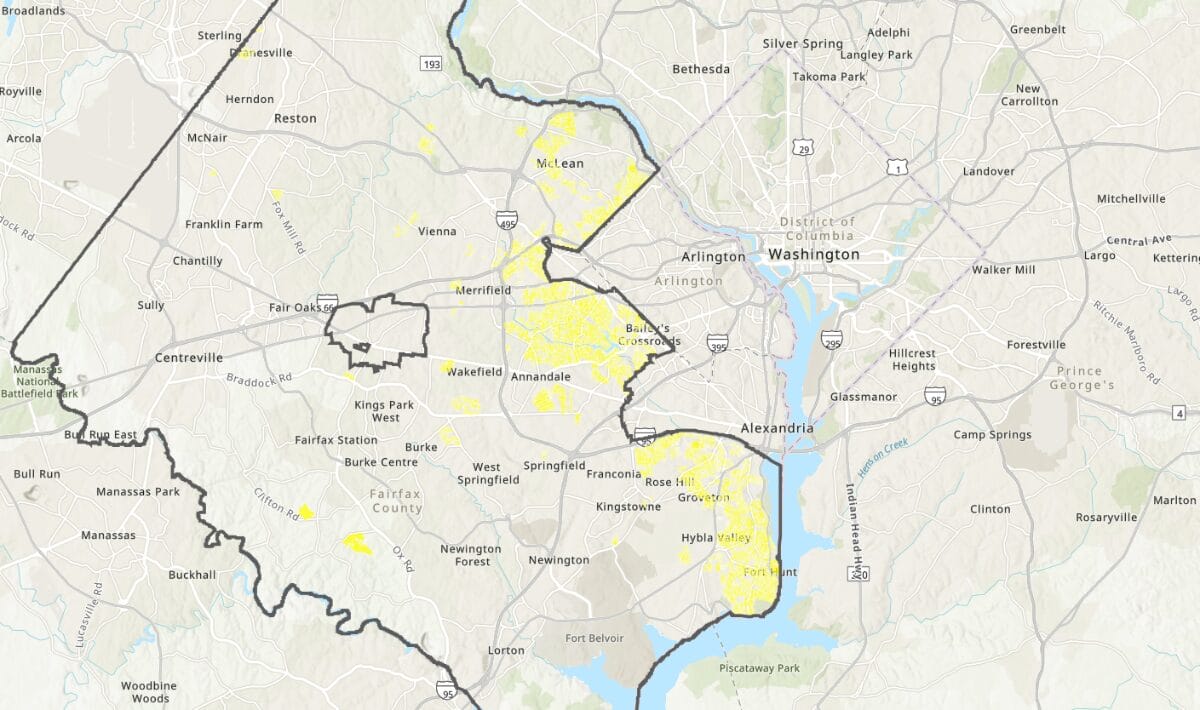
As part of an update to the county’s solid waste management plan, the Department of Public Works and Environmental Services (DPWES) in late 2024 formally proposed potentially expanding that to all households. Under a unified sanitation district, trash and recycling services would be provided by private haulers contracted directly by the county, rather than individual property owners or homeowners’ associations.
State law gives localities the power to do so; neighboring Arlington long has held a monopoly on trash collection in single-family neighborhoods, as has Falls Church.
DPWES, which currently handles collections for county customers, argued that the centralized model would result in more reliable service, reduce greenhouse gas emissions by limiting the number of haulers visiting each neighborhood and allow regulation of collection pricing.
Before moving to a government-run program, Fairfax officials would be required by law to give five years’ notice to private collectors that they will be displaced.
When the proposal began to percolate 18 months ago, trash haulers mobilized in opposition, and criticism of the plan resonated with the public.
“We heard loud and clear” their concerns, McKay said.
The only voice at the May 12 meeting for starting the five-year clock on consideration of the change was Mount Vernon District Supervisor Dan Storck.
He said that taking a procedural step forward would not obligate the county to ultimately move ahead with taking over all trash collection, but it would provide time to further consider the issue.
“I don’t understand why we don’t pull the trigger,” Storck said. “I want to start that five-year clock. Let’s start the clock, let’s start the process.”
On the other end of the issue was Springfield District’s Pat Herrity, who had opposed the concept of a unitary service district from the start. He told his colleagues he was “happy that we listened” to the public and haulers.
Herrity and Hunter Mill District Supervisor Walter Alcorn each floated the idea of expanding the county’s trash-hauling services into more neighborhoods where they might be embraced, or finding other ways to reduce duplication from multiple haulers serving residents in individual communities.
It was Alcorn who asked last summer that the unified sanitation district proposal be put on hold, pending more discussion and community input.
At the time, he said moving to a countywide system was one of several alternatives on the table to address resident concerns about multiple haulers in individual neighborhoods.
“We have kind of a Wild West out there,” Alcorn said in a summer 2025 social media post, outlining existing conditions in trash collection. “We’re looking at all the options.”
No formal or even informal vote tally was taken at the May 12 committee meeting, but DPWES Director Christopher Herrington said staff plan to end further work on the proposal “unless we hear differently.”
