

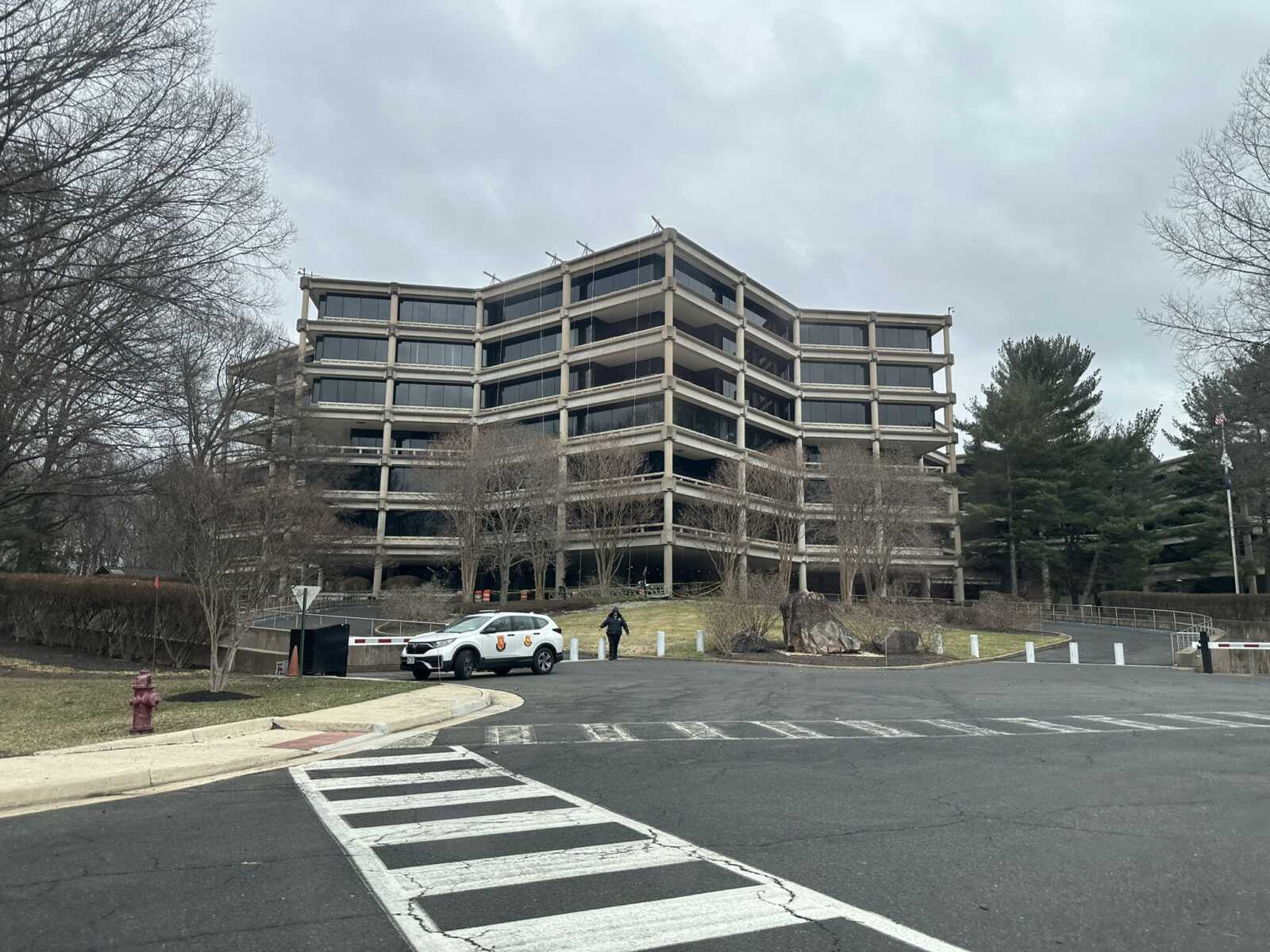
The federal government is considering offloading at least parts of its Franconia warehouse and U.S. Geological Survey campuses in Fairfax County.
Both properties were listed by the General Services Administration (GSA) in spring 2025 as potential sale targets as part of the new Trump administration’s bid to slash federal spending.
While that list of more than 400 federal properties deemed “not core to government operations” was taken down a day after it appeared online, the “B” side of the Parr-Franconia Warehouse complex in Springfield and the John Wesley Powell Federal Building in Reston are now being formally evaluated for possible disposal, the Public Buildings Reform Board (PBRB) confirmed at a public meeting last Thursday (June 25).
Established by Congress in December 2016, the PBRB is an independent advisory board tasked with identifying underutilized federal properties that could be sold to reduce the government’s maintenance and renovation costs.
Paul Walden, the board’s executive director since February 2023, emphasized at the June 25 meeting that the PBRB is separate from the GSA, the agency that manages most of the federal government’s properties and contracting. It’s also not related to the so-called Department of Government Efficiency that the Trump administration created to implement its cost-cutting, anti-regulatory and technology goals.
The board’s review of federal office space in the D.C. region found a nearly 70% decrease in occupancy, according to Walden.
“We’re looking to recommend that the government get rid of places with low occupancy,” he said. “The GSA inventory averages over 50 years in age, and recent utilization data tells us that, [in] most markets, federal employees fill a quarter to a half of those buildings, but those require billions of dollars in Congressional appropriations to renovate, which is probably never going to happen.”
Franconia warehouse seen as redevelopment candidate
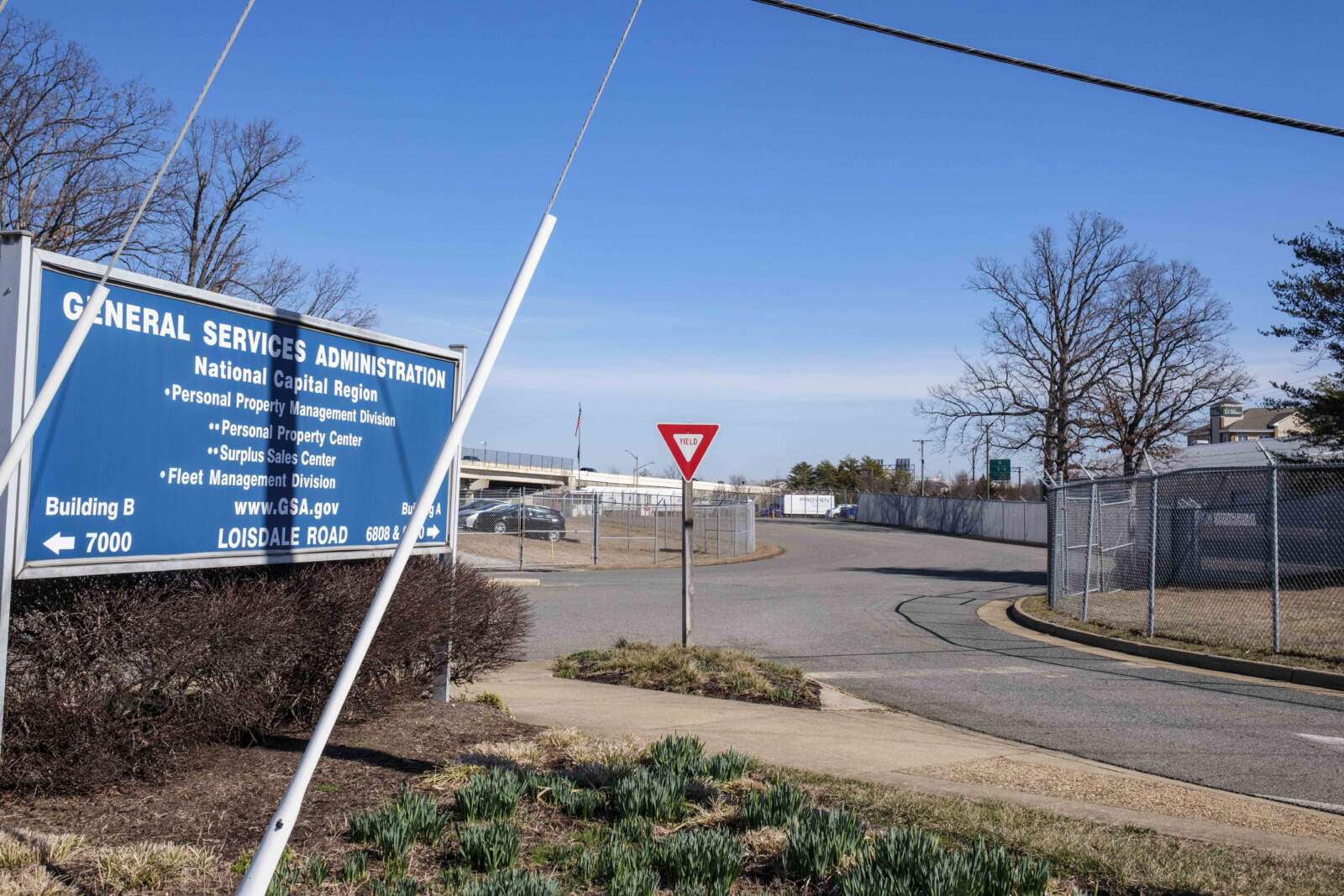
The PBRB has identified the Franconia “B side” warehouse building at 7000 Loisdale Road as a priority for disposal, describing it as a “valuable location with redevelopment potential.”
Encompassing 308,483 square feet of space, the targeted buildings are located on the southwest side of the warehouse complex, which also hosts a 1-million-square-foot Building A and was championed by Fairfax County as a potential site for the FBI’s new headquarters. Other than the GSA, it’s unclear exactly which agencies were utilizing the B buildings, but the CIA reportedly has a facility on the campus.
The GSA didn’t respond to comment requests from FFXnow by press time, but it’s currently “in the process” of vacating the warehouses, which were mostly used for storage, Walden said by email after the PBRB meeting.
“The Franconia [building] presents advantageous industrial rezoning and potential for data center development,” PBRB chair Talmage Hocker said during the meeting. “… If we could do a data center there, that would be amazing.”
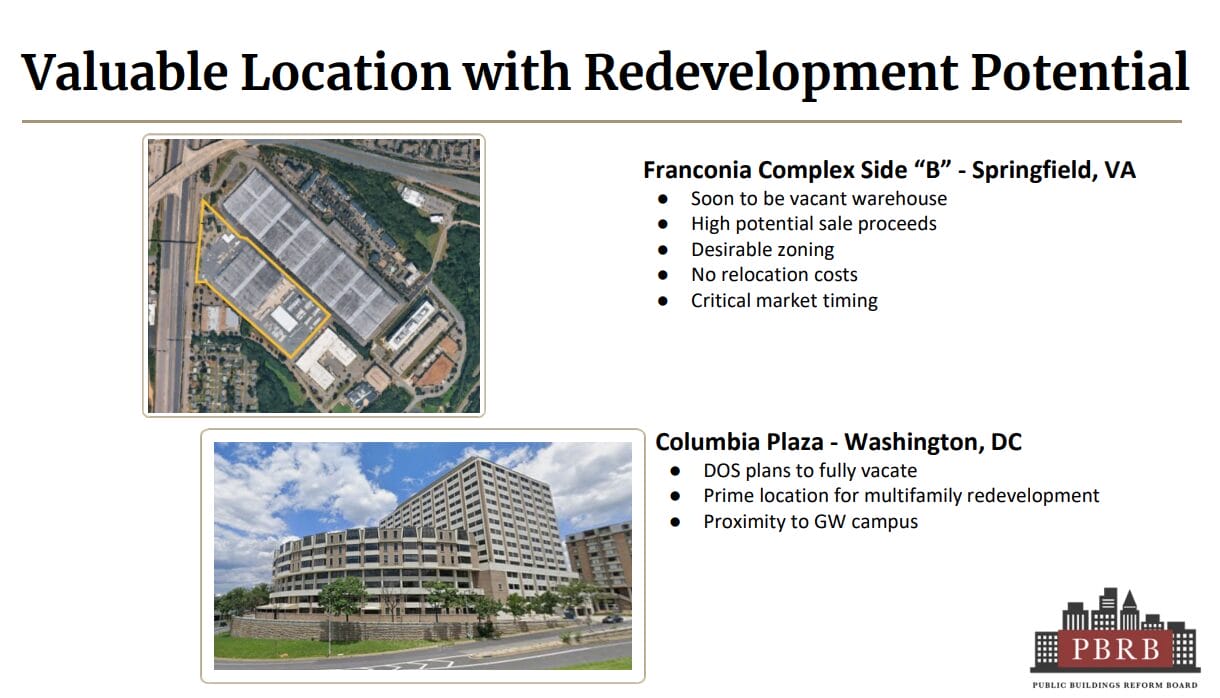
Whether a data center continues to be a development option remains to be seen, and Walden confirmed that the board hasn’t received any letters of interest from potential buyers for the site.
Fairfax County planning staff attended the PBRB meeting as part of their ongoing Franconia-Springfield Study, which will establish new vision for future land use, transportation, parks and more in the area that includes the Franconia warehouse site.
Last fully updated in 2009, the existing comprehensive plan recommends industrial uses for the 70-acre warehouse property with options for redevelopment, including for light industrial/research uses, office with supporting retail, or an entertainment, conference center and hotel complex.
“The county is currently conducting a study that will lead to a future Comprehensive Plan Amendment,” Fairfax County Department of Planning and Development Director Tracy Strunk told FFXnow. “That process includes staff analysis and community engagement before any recommendations are made to the Planning Commission and Board of Supervisors, anticipated in summer 2027.”
Plan for USGS campus under discussion
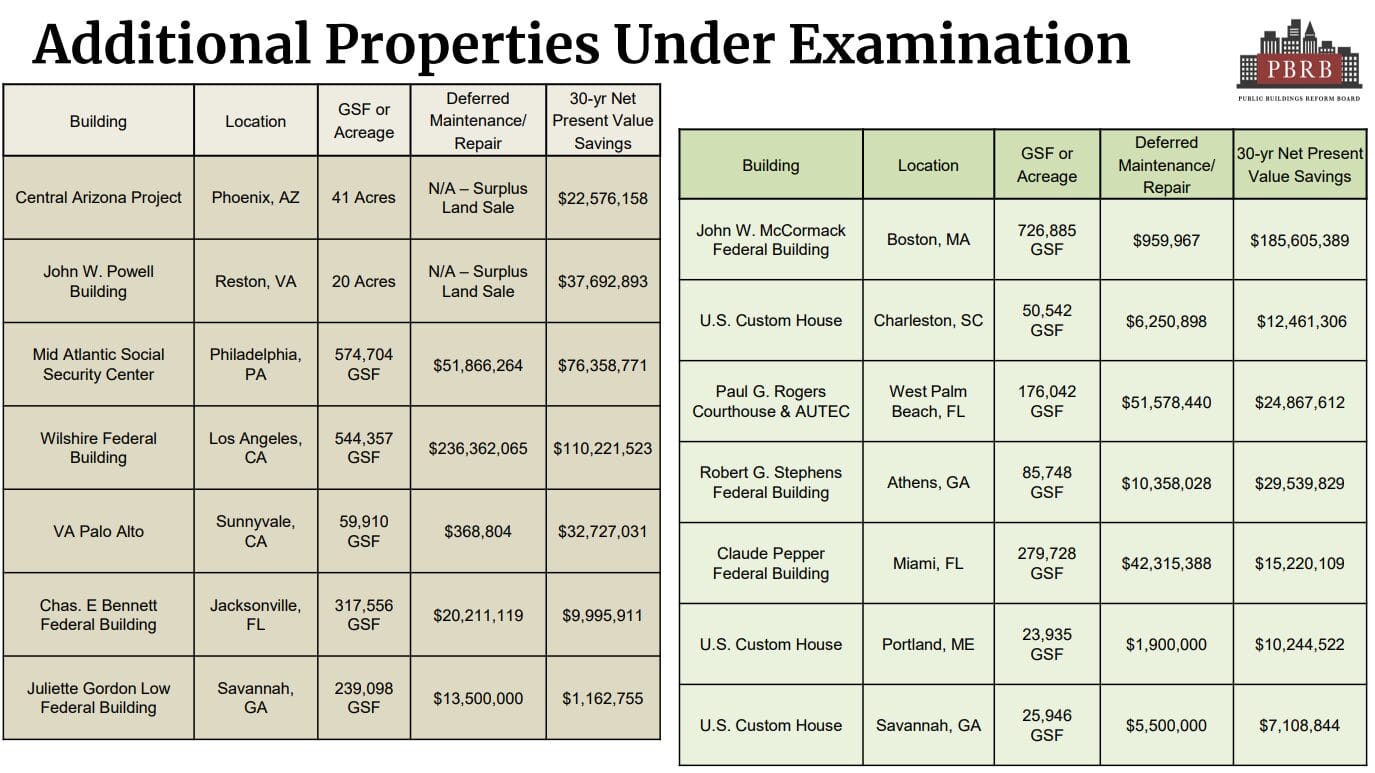
Meanwhile, the PBRB provided few details about the plans for the Powell building in Reston, indicating only that 20 acres of the U.S. Geological Survey’s (USGS) National Center campus could net over $37 million in savings over 30 years with a “surplus land sale.”
Named after the USGS’s second director, the Powell building was constructed in 1973 at 12201 Sunrise Valley Drive as the mapping and earth science agency’s national headquarters.
Hosting over 2,000 employees — at least as of 2011 — and the USGS Library, the 105-acre campus was added to the National Register of Historic Places in 2020 for its unique architecture and landscaping as well as its role in Reston’s emergence as a “new town” with integrated residential, commercial and civic uses.
Despite what was listed in the PBRB presentation, the scope of a potential sale of the USGS National Center campus remains to be determined, Walden told FFXnow by email.
“We’re still in discussion with [the Department of the Interior] regarding how much of that facility, including the vacant land, could be considered for disposal,” Walden wrote. “GSA would be in charge of the disposal process and would have to consider the impact of any historic preservation requirements.”
Growing maintenance backlog a ‘downward spiral’
When screening properties for review, the PBRB considers a range of factors, with the most critical being occupancy and utilization rates and capital costs for deferred maintenance, Walden said at Thursday’s board meeting.
Under the USE IT Act signed by then-President Joe Biden on Jan. 4, 2025, shortly before he left office, federal agencies must regularly report space utilization data with the goal of meeting a threshold of at least 60%. For buildings that don’t meet that minimum after two consecutive years, the GSA is directed to address the gap by either consolidating agencies or selling excess space.
Data released by the GSA for the first time in March found that none of the 9,700 reported buildings met the 60% target, but according to the PBRB, only about 275,000 federal employees were accounted for — a fraction of the approximately 2 million people who work for the federal government, not including contractors.
“The conclusions that can be drawn from the data are not generalizable to the entire portfolio,” the PBRB said in a clarification issued yesterday (Monday). “It’s a mystery as to why the rest of the space was not accounted for in the data set. The veracity of the data is unknown, as well. The website contains no explanation or data verification information.”
Though there are separate columns for total and office space, the data doesn’t appear to distinguish between offices where people actively work and conference rooms, libraries, storage or other facilities that serve a function but aren’t expected to be constantly occupied.
Also unknown is how current utilization rates might’ve compared to rates from before the Trump administration’s mass layoffs of federal workers and completed or ongoing dismantling of USAID, key Education Department offices, the U.S. Forest Service and other agencies.
Per the PBRB’s presentation, the underutilized space is costing the federal government $1.34 billion a year — $660 million for owned properties and $677 million for leased sites. However, the data only calculates the cost to bring utilization up to 60%, so it doesn’t included unallocated or unused space.
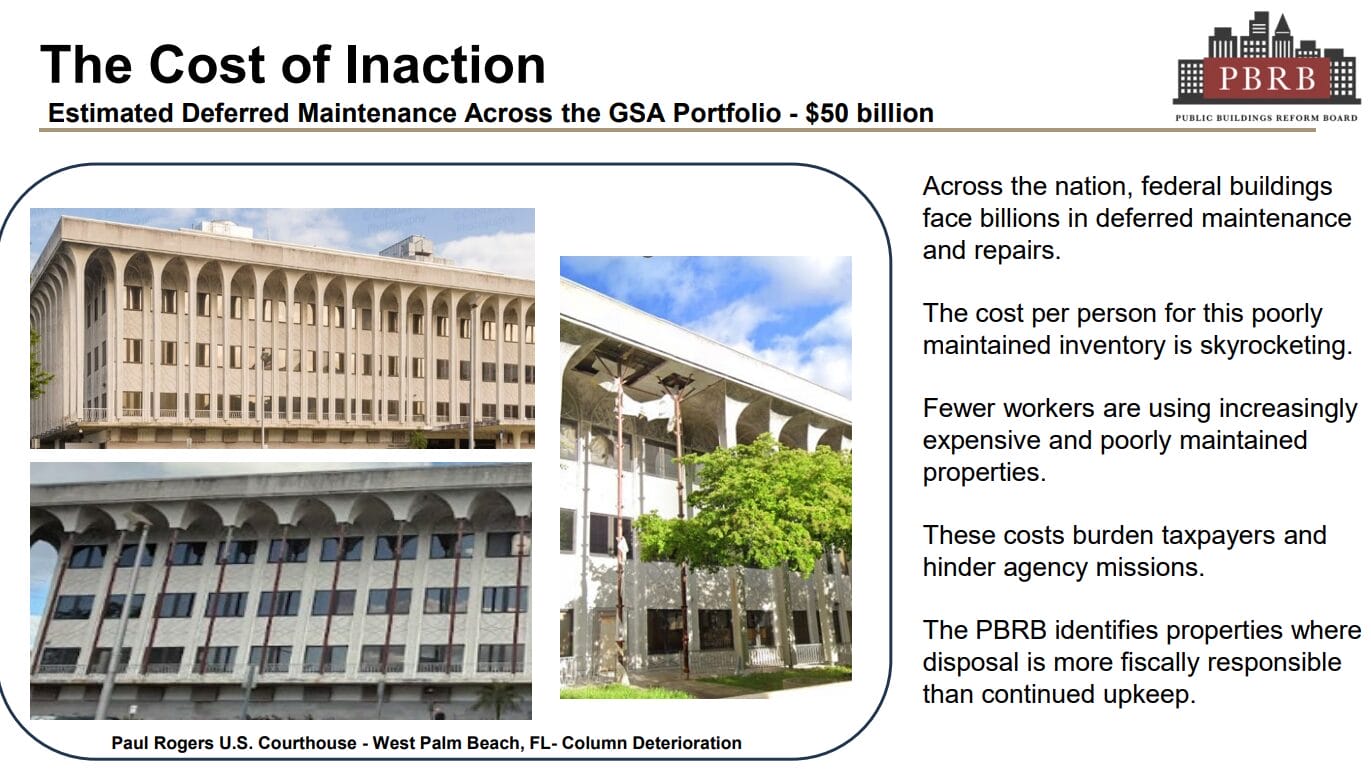
At the same time, the federal government’s backlog of maintenance and repair needs has ballooned to approximately $50 billion, the PBRB reported in March.
“The only way out of this downward spiral of these buildings is through really significant disposals,” board member Dan Mathews said, adding that $50 billion “if anything, is a conservative number.”
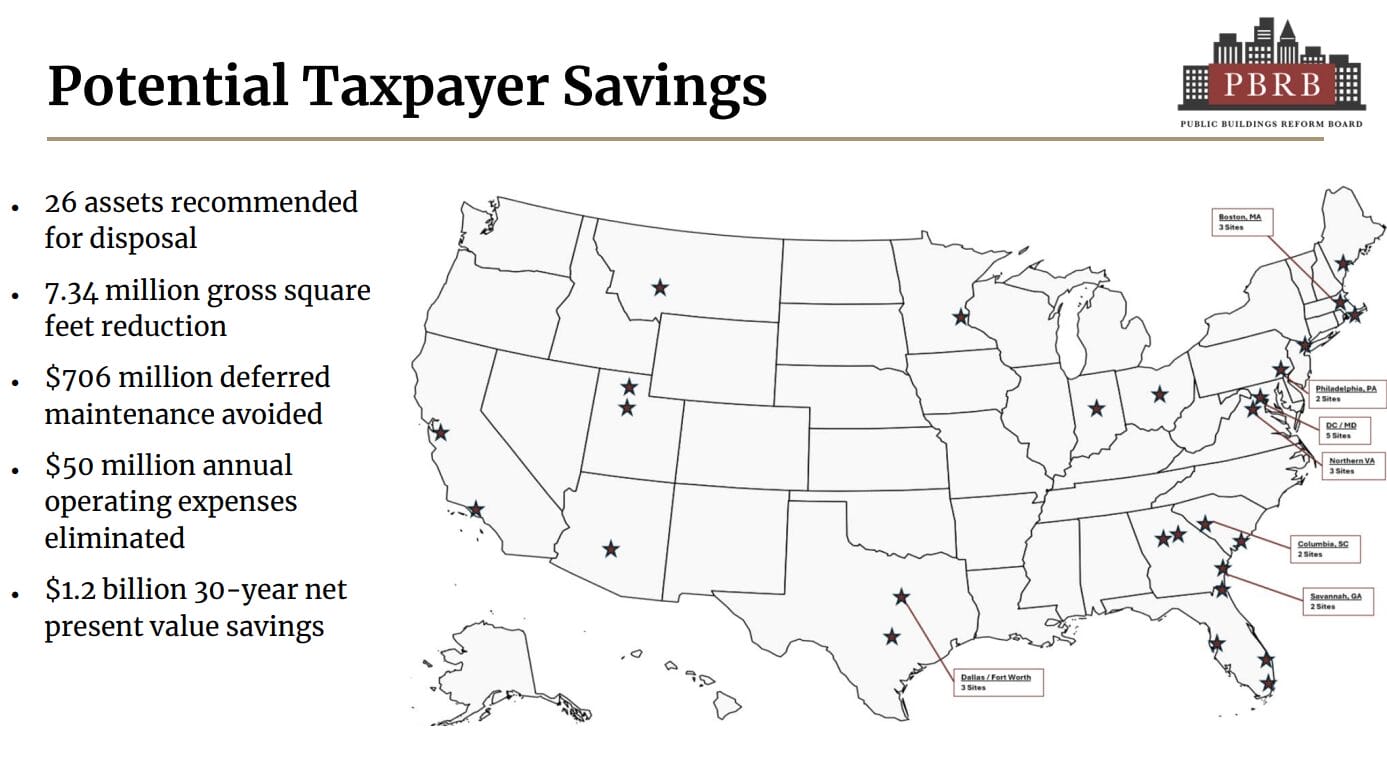
The Franconia warehouse and Powell building are included in the board’s third round of review.
A first round of recommendations submitted back in December 2021 was rejected by the U.S. Office of Management and Budget (OMB), which cited insufficient information on implementation costs and outreach to affected agencies, the public and other stakeholders. The board was unable to provide a follow-up because it didn’t have enough members to meet quorum.
Biden appointed three members — Mathews, Jeffrey Gural and Michael Capuano — during his term as president.
The PBRB recommended 11 properties for consolidation and disposal in May 2025. Two of those have since been sold or transferred, with the Center at Riverside previously occupied by the Animal & Plant Health Inspection Service going to the U.S. Coast Guard in May and the GSA’s own Regional Office Building in D.C. getting bought by a developer in March.
The Chet Holifield Federal Building in California, known for its “ziggurat” design, is slated to be transferred today (June 30), according to the PBRB’s presentation, though the new owner’s identity doesn’t seem to be public yet.
One property recommended in the second round — the Wilbur J. Cohen Federal Building in D.C., which houses the agency that oversees Voice of America — might be taken off the table, because separating its utilities from an adjacent building that’s not being disposed of turned out to be too complicated, GSA Office of Real Property Utilization and Disposal senior analyst Rich Butterworth said.
The PBRB must present its recommendations for the third and final round of property reviews by Dec. 31, after which it’s currently slated to be disbanded. The board could continue if Congress approves an extension.
