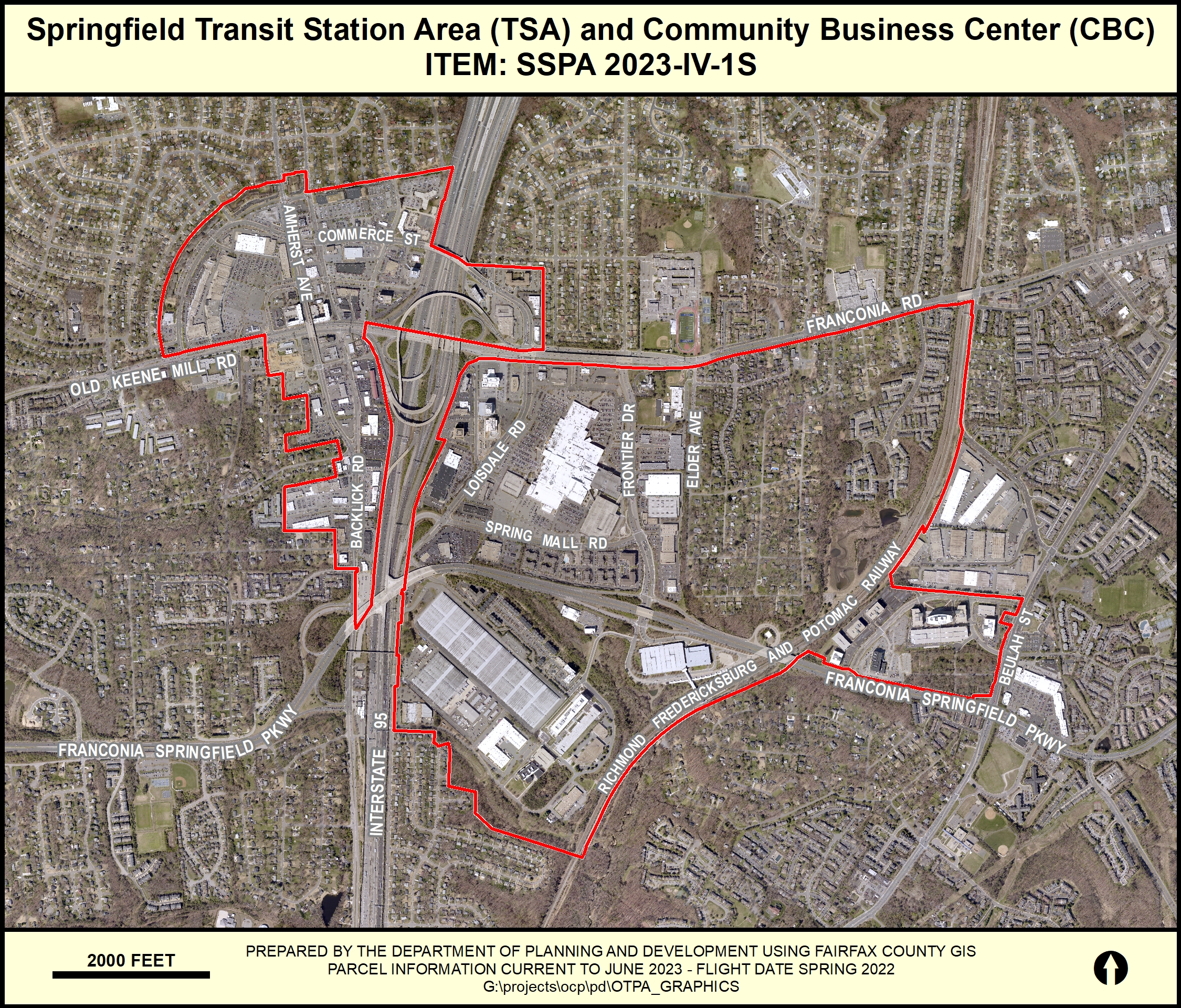
Fairfax County is revisiting its vision for downtown Springfield in the hopes of adapting it to a new era.
The county’s Department of Planning and Development will formally kick off its Franconia-Springfield Planning Study with a virtual community meeting tomorrow (Tuesday) at 7 p.m. Interested members of the public must register to receive a link to the Zoom meeting.
Additional in-person and virtual meetings are planned throughout this fall and the coming spring. Some meetings are aimed at the general public and others targeted toward specific focus groups, such as parents, Spanish speakers or small business owners.
An advisory group made up of representatives from local neighborhoods, Inova, Springfield Town Center, community nonprofits and other stakeholders also convened for the first time last Monday (Sept. 29).
“Robust community engagement will be central throughout the process to ensure the updated [Comprehensive] Plan reflects the community’s aspirations and priorities,” Franconia District Supervisor Rodney Lusk said in a statement to FFXnow.
Authorized by the Fairfax County Board of Supervisors in April 2023, the study aims to update the recommendations for the Franconia-Springfield Transit Station Area (TSA) and Community Business Center (CBC) in the Fairfax County Comprehensive Plan, which is used to guide future land use and development decisions.

The planning effort will build on a market study released in 2022 that found Springfield’s core still has room for growth, particularly for new housing and amenities, even though the mixed-use, accessible “urban village” envisioned by county leaders more than a decade ago has been slow to come to fruition.
In fact, since its comprehensive plan was last fully updated in 2009, downtown Springfield hasn’t added any new multifamily housing, the market study said. A 439-unit apartment building finally began construction on a Springfield Town Center parking lot last year and could finish sometime in 2026.
The lack of housing development appears to have had a measurable impact on Springfield’s population, which dipped by 131 people between 2013 and 2023, even as Fairfax County’s population rose overall by more than 43,000 people, according to an existing conditions report compiled by county staff as part of the comprehensive plan amendment study.
Springfield residents are now older, with people aged 65 to 84 making up the largest cohort in 2023 compared to 25-34 year olds in 2013. Like the county as a whole, Springfield has also seen a shift in the racial diversity of its population, primarily from Asian residents making up a greater share (from 19% in 2013 to 24% in 2023) and the proportion of white residents declining (from 43% to 27%).
Given those and other changes, the planning study is intended to ensure future developments in the area meet the needs of the community as it is now, not as it was over a decade ago.
“Revisiting the Plan now will provide an opportunity to connect with the community and refine a shared vision for the area’s future, one that will guide growth and redevelopment for the next 20 years and beyond,” Lusk said.
Though the community engagement process will officially kick off with tomorrow’s virtual meeting, the public can already submit comments to county staff online.
According to Lusk’s office, the planning study will involve three phases:
- A visioning phase to engage the community and shape a shared vision for the area that will be used to create a preferred Plan scenario to include land use changes, development levels, parks and open space, transportation connectivity, infrastructure, and other key elements;
- An impact analysis phase to evaluate the preferred scenario; and
- A decision-making phase that includes public hearings with the Planning Commission and Board of Supervisors.
In addition to soliciting community input, the county is accepting proposals until Oct. 24 for land use changes that could be considered during the study’s visioning and analysis phases.
Similar to the Site-Specific Plan Amendment process that wrapped up in June, the proposals must come with a statement of justification explaining the potential change and how it “advances” the county’s goals and community interests, along with a concept plan and acknowledgement from the property owner if they’re not the ones filing the submission.
This story initially cited “Storck’s office,” referring to Mount Vernon District Supervisor Dan Storck, when mentioning the three phases of the Franconia-Springfield Study. The attribution has been corrected.