

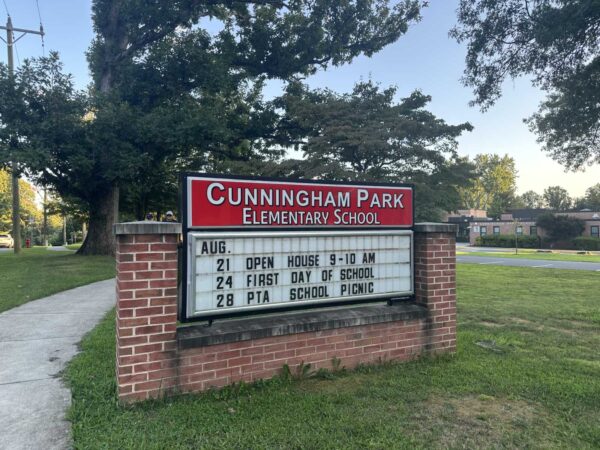
Fairfax County Public Schools students are heading back to the classroom today (Monday), a familiar sight that might inspire nostalgia and stress among even non-parent residents.
However, in recent months, Fairfax County and the school system have adopted a number of changes to policies and services that are taking effect during the new school year, particularly around the use of technology in the classroom.
Tougher digital tech restrictions
All FCPS students are officially prohibited from using a cellphone or other “smart” devices, including smartwatches, smart glasses and wireless earbuds, during the school day. All devices must be turned off and stored “from bell to bell,” the school district says.
During the 2025-2026 school year, FCPS barred the use of cellphones throughout the day for all students — with the exception of high school students during their lunch period. Some students and staff have complained that the evolving policies over the past couple of years have been confusing and inconsistently enforced.
After the General Assembly passed legislation this spring clarifying that all K-12 schools should prohibit student cell phone use from bell to bell, the Fairfax County School Board adopted a blanket ban for all students on May 7 as part of its annual Student Rights and Responsibilities review.
The new policy took effect on July 1. Exceptions are allowed for students with an Individualized Education Plan, a Limited English Proficiency plan and documented health needs.
“Parents/guardians are asked to avoid contacting their student(s) directly on personal devices during the school day,” FCPS says on its cellphone policy page. “For urgent, non-emergency messages, please contact the school’s main office. School staff will ensure that important information is communicated to students in a timely manner.”
Students are also now prohibited from using personal devices, such as laptops or tablets, for school-related activities under a series of educational technology policies adopted by the school board in July. School-issued devices are provided to most students, though parents can opt their children out of being allowed to take their laptop or tablet home.
The school board also voted to bar elementary school students from using generative artificial intelligence technology, and to no longer issue laptops and tablets at the preschool and kindergarten level. FCPS Superintendent Michelle Reid indicated at a work session last week that the latter restriction might create challenges with meeting state requirements for reading support services.
No more high school crossing guards
This year, high school students walking to and from school will no longer have police available to help stop traffic so they can cross often busy streets.
Fairfax County’s fiscal year 2027 budget, adopted on May 5 by the Board of Supervisors, nixed the use of crossing guards at public high schools, eliminating $1.89 million and 13 full-time positions from the Fairfax County Police Department’s budget. The county is also leaning on contractors, instead of uniformed police officers, to fill crossing guard vacancies at elementary and middle schools.
Intended to reduce costs and alleviate FCPD staffing challenges, the changes to the crossing guard program have raised public safety concerns and contributed to tensions between the Board of Supervisors and some school board members. The school board has also objected to a proposal to institute fees for currently free Middle School After School activities.
According to FCPS, the elimination of high school crossing guards specifically affects Annandale, Centreville, Chantilly, Edison, Oakton, South County, South Lakes, West Potomac and West Springfield high schools. McLean High School is also losing its coverage after the police department shifted to using contractors at its crossing last year.
Coverage is still being provided at Hayfield, Lake Braddock and Robinson secondary schools.
“We encourage students, families, and drivers to use extra caution when traveling to and from school, follow all traffic laws, and remain alert to pedestrians and other vehicles,” FCPS said in a newsletter on Friday (Aug. 21). “Because traffic patterns may be different, please allow a few extra minutes when arriving at or departing from school. We appreciate your patience and attention to this matter.”
Speed cameras in school zones will resume operations at 20 locations. After expanding last year, the program isn’t adding any new locations at the start of this school year, but cameras are “in progress” for 10 more schools, according to the county’s website.
A timeline for when cameras will take effect in those new locations hasn’t been announced yet.
Weapons screenings, bag policy at football games
The OpenGate weapons detectors that FCPS deployed at all high and middle schools last year will now be used at varsity football games. The scanners, which are also used to screen visitors at school board meetings, can detect guns, knives, ammunition and other prohibited items.
FCPS is also following the lead of professional sports teams like the Washington Nationals by restricting bags to clear options, small clutches and medical or diaper bags.
More from FCPS on its new standardized bag policy for football games:
Students, family members, and all spectators are reminded that the following items are prohibited:
- Backpacks
- Purse
- Fanny pack
- Tote bags
- Outside food and beverage
- Sporting equipment (balls, bats, sticks, etc.)
- Any item prohibited by FCPS policy, or determined by event staff to present safety concerns
Approved bags are limited to:
- Clear plastic, vinyl, or pvc bags no larger than 12” x 6” x 12”
- Small clutch bag no larger than 4.5” x 6.5”
- Medical and diaper bags permitted but subject to inspection
Expanded mental health program and more
Starting July 1, FCPS expanded its partnership with the virtual mental health therapy provider Hazel Health to include free sessions to middle school students. The teletherapy program was first made available to high school students in 2023.
“Parents are encouraged to contact Hazel Health directly if they are seeking mental health support for their child, have noticed changes in their child’s mood or behavior, or are having difficulty connecting with a therapist in the community,” FCPS said when announcing the expansion, noting that families can also contact their school’s counselor, psychologist or social worker for help.
Other notable changes to expect this school year include:
- New student ID cards, rolled out initially for bus riders
- The introduction of an online platform for viewing school menus and nutrition information
- No day off on Veterans’ Day after the school board approved a new calendar eliminating that as a student holiday. The 2026-2027 calendar also has only four early-release Wednesdays for elementary schools, down from the eight included last year.
- Explicit prohibitions on the creation and distribution of “intimate” images, with potential punishments including a suspension of up to five days. Aimed at combatting both real and fake nude images from being used against students, the policy requires administrators to report violations to the police and the offender’s family.
- Other SR&R updates included clarifications around what constitutes hate speech, the addition of a Universal Grade Matrix to standardize discipline procedures, and revised suspension procedures for students with disabilities.
