

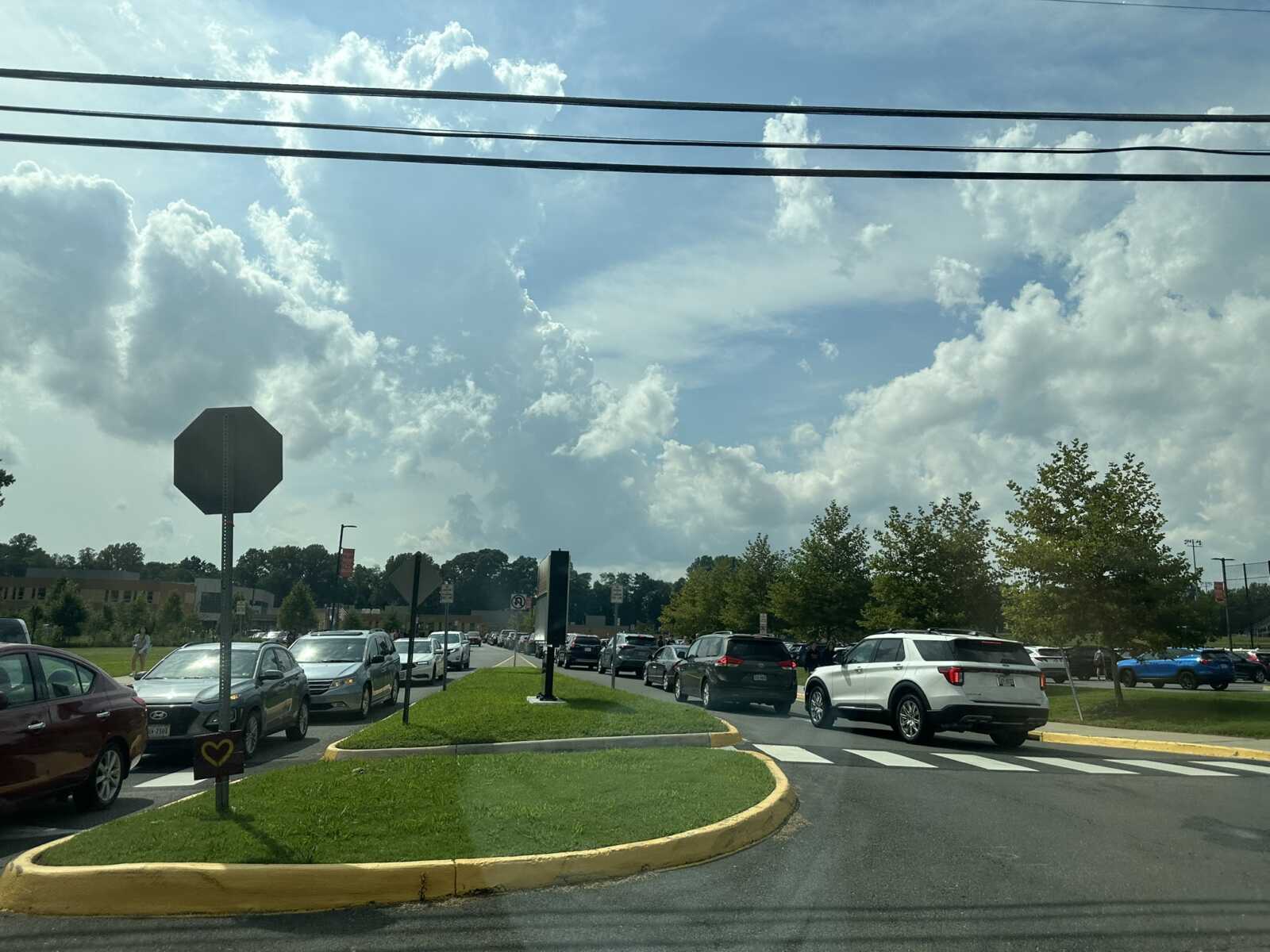
The “kiss and ride” pick-up and drop-off sections at many Fairfax County Public Schools are overextended to the point of becoming the school system’s “most significant operational concern districtwide,” a new staff report found.
The results of a Safe Routes to Schools assessment conducted over the past year and a half were presented to the Fairfax County School Board yesterday (Sept. 8) as part of a discussion of pedestrian and traffic safety around schools, just one week after a student was hit by a car while walking to South Lakes High School in Reston.
During the budget committee work session, FCPS staff and school board members made it clear that many schools were simply never built to handle the large number of drivers now using kiss and rides.
While many schools operate kiss and rides without significant issues, at others, the behavior of some drivers has become a major concern, said Brian Lambert, chief safety and security officer.
“Instead of using the kiss and ride, folks will get close to the school and let their children out,” said Lambert. “In fact … parents themselves have chosen to use the kiss and ride, and then get frustrated with the kiss and ride, and so use an alternative drop-off in a neighborhood, as opposed to waiting for the protocols.”
While the Fairfax County Board of Supervisors will soon decide on the future of funding for crossing guard services at 10 high schools, potentially reversing a budget cut approved in May, FCPS still has work to do on its end to make the areas around some schools safer.
“Regardless of whether there is a crossing guard, we have severe problems with our kiss and rides,” Providence District Representative Karl Frisch said, citing issues with “illegal U-turns” and problematic drop-offs in neighborhoods, unauthorized lots, or even in “the middle of the road.”
“As we deal with the conversation around crossing guards, we must also deal with this fundamental issue and know that these solutions that many of these schools have put in place … require constant vigilance,” he said. “It’s a bit like plants growing between sidewalk cracks. You can get the plant out, but if you wait too long before maintaining it, it will grow back.”
The kiss and rides were built for a different time when most kids rode the bus or walked to school. Manning the kiss and ride was viewed as a courtesy service, one which would be performed by staff on top of their existing duties. But after the pandemic, there was a noticeable uptick in parents driving, leading to longer lines, and more frustration.
Instituting stronger rules isn’t always enough to stop the problem, said Superintendent Michelle Reid.
“One of the things that we hear from principals is, as we tighten up kiss-and-ride guidelines, rules, supervision on site, what we are then seeing is that two blocks away, or down the street, people are dropping children off, sometimes in the middle of the street, the car’s not even fully stopped,” Reid said. “Or we have backups in neighborhoods.”
“The tighter we get, the more, in many cases, the congestion moves a block away, which is still congestion,” she added. “And it’s still dangerous potentially for children who are walkers.”
To alleviate problems going forward, staff recommended expanding active transportation programs, improving traffic circulation patterns, reviewing illegal drop-off and pick-up locations, improving communication with parents, and evaluating infrastructure improvements. Finally, while the overwhelming majority of students do take the bus, FCPS still needs more bus riders and walkers.
According to Mason District Representative Ricardy Anderson, many parents do want their kids to walk to school, but they just feel unsafe allowing them to do so.
“It is hard to be a walking school in so many places because of either crossing a main road — again, without a crossing guard — and/or a lack of sidewalks,” Anderson said. “Because I’ve had parents from Weyanoke Elementary who’d like to walk, but there’s no sidewalks and they’re afraid … Similarly, with Mason Crest Elementary, they can’t get across Gallows [Road].”
A single crossing guard, even paired with large amounts of walkers, can’t address the complexity of traffic flow around some schools, the Safe Routes report found.
At McNair Elementary School in Herndon, for example, many children walk from nearby apartments. Congestion piles up near the shared entrance for the kiss and ride, school buses and walkers. In addition, a “significant” number of students and parents do not use the existing crosswalk, and parents dropping off their kids often perform illegal U-turns.
The report recommends a mix of short and long-term changes to help the school address the issues, including potentially consolidating kiss-and-ride operations in McNair Upper’s parking lot, adding more signs or barriers to separate pedestrian and vehicle traffic, and installing infrastructure to discourage mid-block crossings.
McNair was among nine schools identified by the assessment as priorities for “targeted” support, along with Annandale Terrace, Cardinal Forest, Lemon Road, Mount Eagle, Oakton and Ravensworth elementary schools, Mark Twain Middle School, and Justice High School.
“Obviously, there are some or many undesirable behaviors on the part of … parents or even on the part of students or community members … creating certain risks, and they may be choosing to do that,” said Ilryong Moon, one of the school board’s at-large representatives.
However, he added that it’s up to the school board and FCPS officials to address risky behaviors “with more urgency.”
“Let’s not wait until another person, another student, staff members, another community member gets injured or gets killed for us to do that,” Moon said.
Ultimately, FCPS needs more staffing to “deal with operations and safety,” Hunter Mill District Representative Melanie Meren said, citing the additional issue of teachers having to assist with weapons screenings that are now required at all middle and high schools.
The added responsibility has drawn protests from teachers and their unions, which argue that they’re not qualified or being paid to supplement school security staff.
The kiss and ride is “a big issue here,” she said.
“Look, I still remember standing at the corner of Flint Hill Road, where, when I was there for back-to-school events, me and the two leading advocates who’ve been working on this for seven years, heard tires screeching through that intersection,” Meren recalled. “The principal was standing out there. So, instead of being the instructional leader of that school, that principal is dealing with traffic.”
