


The Washington region will likely fall well short of its goals to reduce greenhouse gas emissions, and the rise of data centers is the prime culprit.
With just four years to go, the region is less than halfway toward meeting agreed-upon emissions reduction targets by 2030, according to new data presented by the Metropolitan Washington Council of Governments (COG) on Wednesday (Sept. 9).
“If we continue on this trajectory and status quo, we’re not going to meet the goals,” Clark Mercer, COG’s executive director, said at the monthly board meeting.
The goal of a 50% reduction from 2005 levels was set in October 2020 after regional efforts managed to cut greenhouse gas emissions by 20% from 2005.
While the region is making progress in many environmental areas, the need for more power supply for commercial properties — data centers and others — means the region is unlikely to reach its goal for 2030, and could imperil reaching a goal of an 80% reduction by 2050.
“It’s sobering to see we’re still fairly far away from reaching where we want to go,” said Charles Allen, a D.C. City Council member and a COG vice chair.
Cindy Dyballa, a Takoma Park City Council member and chair of COG’s Climate, Energy and Environmental Policy Committee, observed that “while local governments have implemented many effective policies, programs and projects to support greenhouse gas reductions … the region is unlikely to meet these goals … without expanded and accelerated climate action.”
Dyballa said falling short of the reduction target doesn’t mean the effort would be a considered a failure. The 50% target “sounds ambitious because it is,” she said.
At the COG meeting, representatives from member jurisdictions adopted a resolution reaffirming the current goals and encouraging localities to do what they can to be more aggressive in environmental efforts.
Beyond data centers and commercial development, concerns were raised about continued residential sprawl and housing construction techniques.
“More people aren’t really the climate problem,” said Alexandria Vice Mayor Sarah Bagley. “It’s how we are building the housing for them, where we are locating it. Are we giving them options to be car-free or car-light?”
There have been some successes within overall regional environmental efforts, said Maia Davis, a COG senior planner who presented data to board members. The region has seen significant growth in solar power and in electric vehicles.
On the down side, after achieving a regional goal of 50% overall tree canopy, that figure appears to be declining again, Davis said.
While data centers have been proliferating in the outer suburbs, particularly Loudoun County, for nearly two decades, their escalating expansion regionally and nationally has impacted local life in many ways, including on the environmental front.
Data centers represented about 11% of the region’s total greenhouse gas emissions in 2023.
“We know there has been tremendous growth in data centers recently, and continued projected growth,” Davis added.
Regional environmental efforts also are being impacted by the Trump administration’s seeming antipathy both to environmental issues and to the D.C. region, several leaders said at the meeting.
Despite falling short in expected progress, the region still has options for making up ground, Davis said.
“We have plans, we have strategies in place,” she said. “Clean power and clean vehicles are the top two ways … followed by cleaner and greener buildings.”
At the meeting, COG board members were presented with locality-specific information on where their jurisdictions are in meeting the goals. That information will be made public shortly, officials said.
A draft inventory shared with the Fairfax County Board of Supervisors in December indicated that the county’s emissions are declining following an uptick in 2023 attributed to increased travel after the pandemic.
According to COG, approximately 90% of the region’s greenhouse gas emissions comes from building energy consumption and transportation. The remainder emanates from waste, land use — agriculture, forests and trees — and fugitive emissions, officials said.
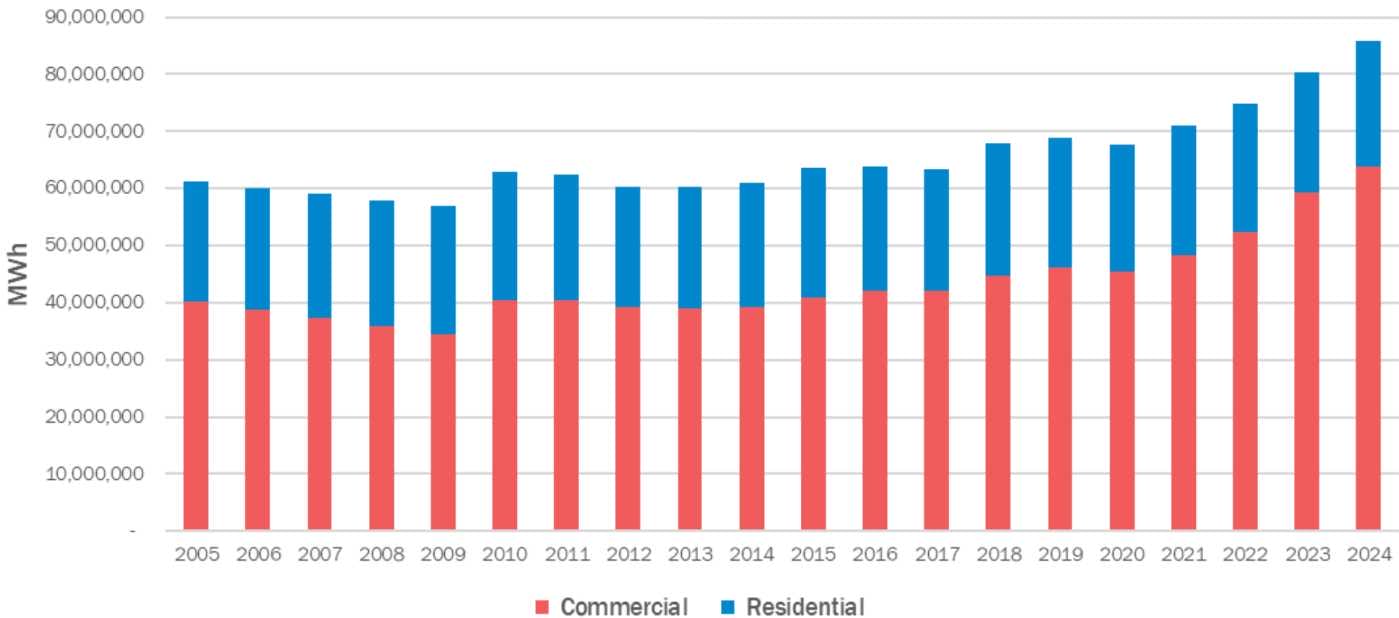
More extreme weather conditions are impacting energy needs across the region, but the commercial sector has seen by far the majority of the growth.
Total electricity consumption has increased from 61.2 million megawatt hours in 2005 to 85.95 million MWh in 2024, up 40%, but residential consumption has grown just 5%, while commercial consumption is up 59%.
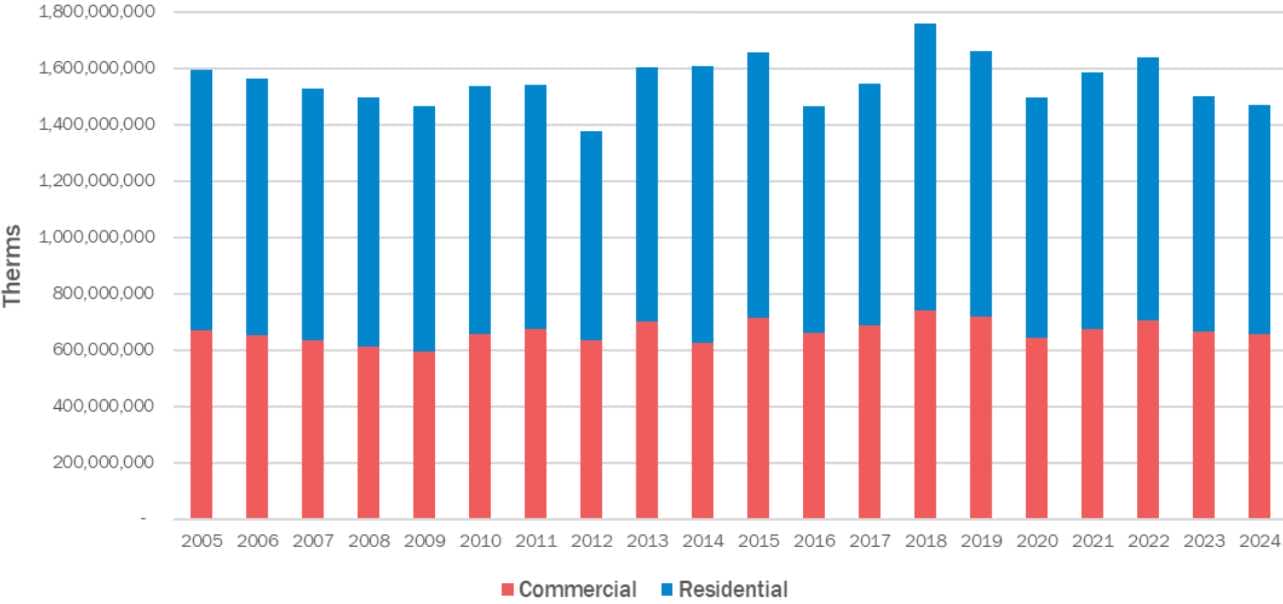
While electric consumption is up, consumption of natural gas declined slightly from 2006 to 2024, with residential consumption down 11% and commercial consumption by 2%.
