


A local youth recently reminded Fairfax County supervisors they still have time to turn their elections next year into ranked-choice voting events.
“It is a very realistic goal,” said John Tashkhanov, speaking at the monthly public comment session at the tail end of the Sept. 29 Board of Supervisors meeting.
Tashkhanov lives in Annandale and is a student at BASIS Independent McLean. He also serves as Virginia policy director for Beyond Partisan, a student-run advocacy group.
Since 2020, localities across Virginia have been delegated powers by the General Assembly to use the ranked-choice method for elections of their governing bodies, including boards of supervisors and city and town councils. To date, only Arlington (general elections and primaries) and Charlottesville (primaries) have taken the plunge.
“Fairfax has an opportunity to act,” Tashkhanov said.

As the name suggests, ranked choice voting allows those casting ballots to rank candidates in order of preference. Under the process approved for Virginia races, if no candidate receives more than 50% of the total vote, the candidate with the lowest vote total is eliminated and their supporters’ votes are redistributed to the candidates they selected as their second choice.
The process continues in rounds until a candidate receives a majority of votes.
A similar, but slightly more complex, process plays out when there are multiple seats decided on a single ballot, but that wouldn’t be the case for the Fairfax County Board of Supervisors.
Supporters like Tashkhanov say ranked choice requires candidates to reach beyond their base and build broad support. It also eliminates the possibility that a candidate in a large field could win with 20% of the vote or even less.
In May, Hunter Mill District Supervisor Walter Alcorn hosted a Reston town hall on the topic that drew mostly supporters of ranked choice. Alcorn at the time said the event was primarily to build awareness, and didn’t suggest he would seek a format change in time for the general election in November 2027 — when all 10 supervisor seats will be on the ballot.
The state law allowing a switch to ranked choice elections left the decision in the hands of each locality’s governing body, and doesn’t require a public referendum to enact the format change.
Tashkhanov came to the Sept. 29 meeting seeking supervisors’ support for having county election officials conduct a public feasibility assessment focused on a switch from the more traditional method, where a candidate with the most votes is elected even if they don’t secure an overall majority.
Even if supervisors were supportive of a switch in conducting elections, and there is no conclusive evidence that they are, timing may work against any effort to make the change for 2027. Primaries will be held in June, with candidates allowed to start circulating petitions to qualify for the ballot in January.
At public comment sessions, supervisors typically don’t respond to speakers. Board Chair Jeff McKay thanked Tashkhanov for coming but otherwise gave no indication that any follow-up might occur.
Of Fairfax’s 10 incumbent supervisors, all are Democrats except Springfield District’s Pat Herrity, a Republican.
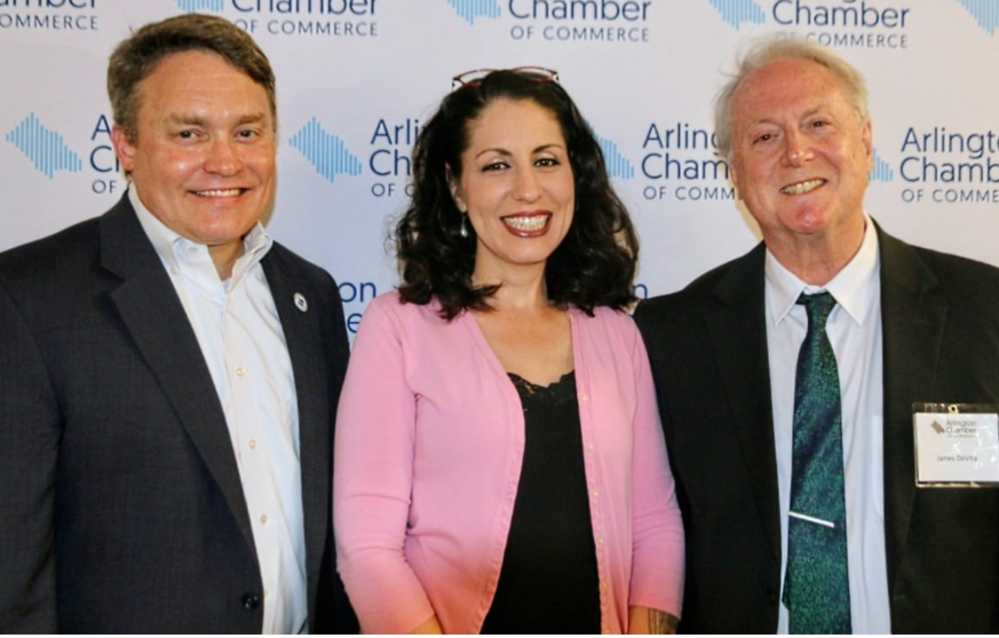
Arlington elects at least one of its five County Board members every November. The county has used a ranked choice system for three years, starting with primaries and, in 2024, expanding to general elections.
The format switch has not impacted general elections, as the Democratic nominees received 58% and 65% of the vote in the 2024 and 2025 races, respectively. But it did play a bigger role in the two-seat 2023 Democratic County Board primary, where one of the candidates leading after the first round was leapfrogged by another contender as others were eliminated.
Public reaction to the format change has been mixed in Arlington, with one survey finding no clear consensus and a second showing a majority in favor of the switch.
Sally Hudson, founder and executive director of the Ranked Choice Virginia advocacy group, told FFXnow there’s still time for Fairfax supervisors to consider a change for 2027.
“Legally, yes,” she said, noting that all state law requires is the enactment of an ordinance at least 90 days prior to an election.
Technologically, the county’s election equipment is able to handle ranked choice voting, said Hudson, whose group has had discussions with individual supervisors on the matter.
“The best sign of collective enthusiasm is when a body invites their local director of elections to present a formal readiness assessment at a public meeting, and Fairfax hasn’t taken that step yet,” Hudson said. “Arlington and Charlottesville both started that way, and Albemarle, Loudoun and the cities of Fairfax and Richmond have done the same.”
Falls Church officials also have considered making a switch to ranked-choice for city council races, which will next be held in November 2027.
Ranked choice advocates plan to be back before the General Assembly over the winter, asking state lawmakers to give municipalities the option of using ranked choice for local races outside their main governing bodies.
