

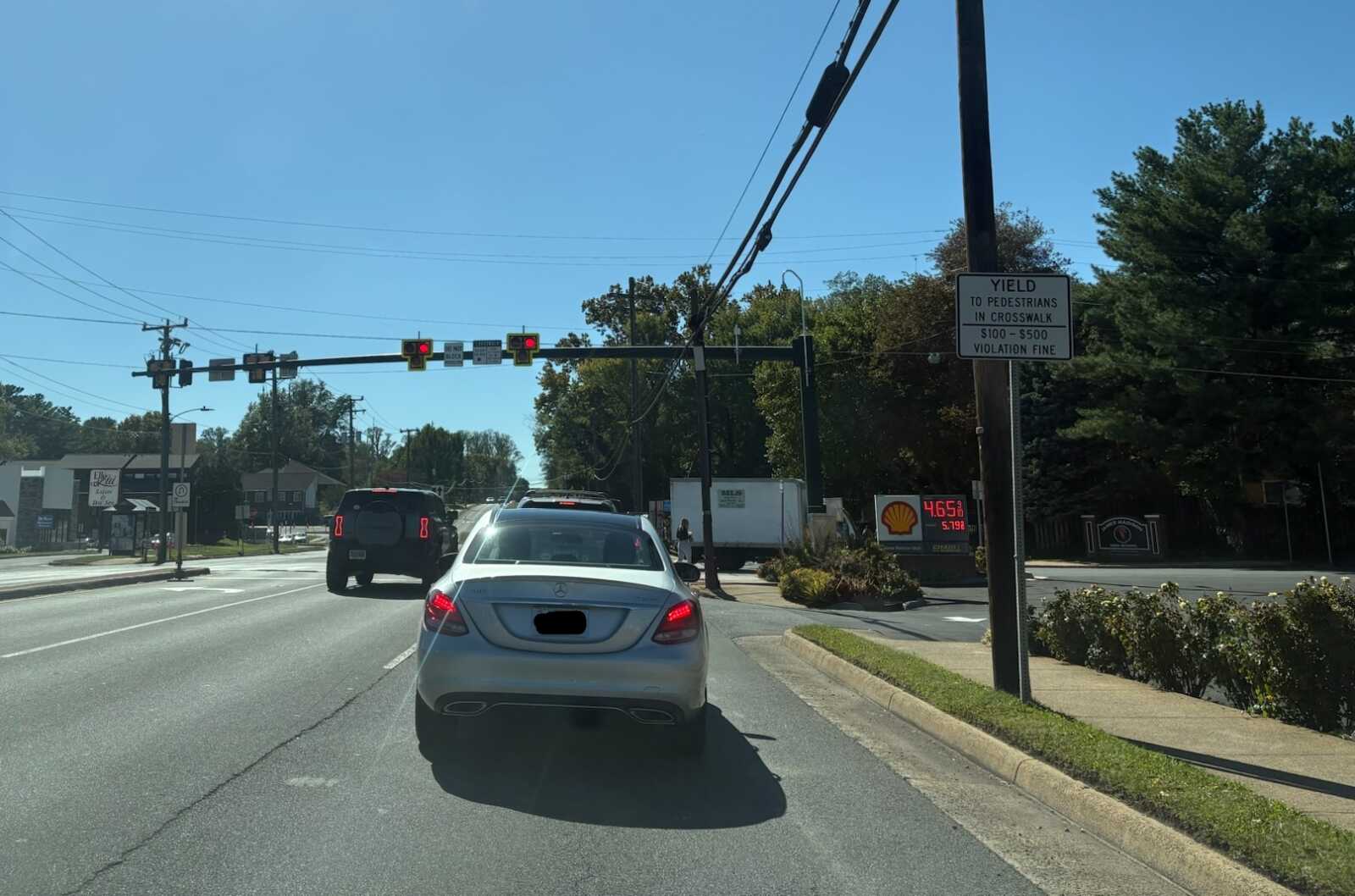
Town of Vienna staff received a green light earlier this month to revisit the possibility of installing a traffic signal on Maple Avenue outside James Madison High School.
The Vienna Town Council voted unanimously at its Oct. 5 meeting to award a purchase order to the consultant Rinker Design Associates for a signal justification report that will determine whether to replace the existing High Intensity Activated Crosswalk or HAWK signal at the James Madison Drive intersection.
The $166,370 that staff were authorized to spend on the contract includes a 25% contingency reserve.
Councilmember Howard Springsteen recalled that, after a previous traffic signal request was denied due to the site’s proximity to the Nutley Street intersection, the town “fought to get the HAWK light there” to “mixed results.” He questioned what has changed in the interim.
“This is great,” he said of the possibility of a traditional signal. “I know we tried years ago and got our hand slapped by VDOT, saying you can’t.”
Vienna transportation engineer Andrew Jinks admitted that he wasn’t aware of the full history of why a HAWK signal was installed, since those discussions occurred before he joined the town. But he confirmed that VDOT was consulted about the proposed study and expressed confidence that there might be a different outcome this time.
“With all respect to VDOT, I think there’s a different way of looking at this, and that’s what we’re going to do,” Jinks said.
The HAWK signal, which flashes red lights telling drivers to stop when activated by a pedestrian, was installed at Maple and James Madison Drive in 2019, according to Vienna’s Department of Public Works.
The signal is intended to give pedestrians — often students, in this case — safer passage across busy Maple Avenue, but town staff say traffic congestion has become an issue at both the James Madison intersection and at neighboring Nutley Street, despite the completion of signal upgrades throughout the corridor last fall.
According to the town’s current Capital Improvement Plan (CIP):
Although it is anticipated to improve when the new traffic signals are completed, the intersection of Maple Ave. and Nutley St. currently backs-up all the way to James Madison Dr. Additionally, James Madison High School and shopping center traffic causes
congestion at this intersection, resulting in substantial cut through traffic in local neighborhoods because buses and cars cannot make protected left turns. Therefore, DPW would like to explore the potential for a traffic signal at this intersection to improve conditions for the high school, shopping centers, and local neighborhoods.
If the study shows that a signal is warranted, construction would cost an estimated $700,000, the CIP says. The project is currently fully funded with money distributed to the town by the Northern Virginia Transportation Authority (NVTA).
Councilmember Chuck Anderson expressed hope that a shift to a traffic signal could improve traffic flow and safety on Maple Avenue, especially if the still-languishing 444 Maple Avenue redevelopment ever gets off the ground.
“As a person who uses a HAWK light across Maple with some frequency to get donuts that I should not be buying, I will tell you that you kind of take your life into your own hands,” Anderson said, referring to a different HAWK light outside the Vienna Plaza shopping center where Dunkin’ Donuts is currently located.
“Given the number of students using that HAWK light, I would far prefer a regular traffic signal at Madison Drive and Maple,” he added.
Councilmember Jessica Ramakis echoed his safety concerns, while Mayor Linda Colbert noted that a traffic signal could allow school buses to turn directly onto Maple Avenue instead of going through the residential neighborhood along Windover Avenue to reach Nutley Street.
According to Jinks, the signal justification study will take about six to eight months to complete. Depending on the results, that could be followed by a relatively quick design process and construction, which he predicts would take about 10 months.
“That sounds like the not-too-distant future,” Ramakis said. “It takes some time to do the study, but … perhaps we could have a different arrangement there that’s safer for the community within two years, it seems like.”
