


Apartment hunters in Fairfax County are getting better deals than they did a year ago, with prices significantly discounted from the market peak last summer.
Median apartment rents in five major Fairfax corridors all showed declines in January compared to a year before, according to figures reported Jan. 28 by Apartment List. But all remained above the median rate for the D.C. metropolitan area of $2,116 for the month, price-wise.
On a year-over-year basis, median rents were down 3.6% in Fair Oaks, 2.8% in Fairfax, 0.5% in Herndon, 1% in Reston and 1.4% in Tysons.
In those corridors, median rents for one-bedroom and two-bedrooms units were $2,112/$2,361 in Fair Oaks; $1,846/$2,113 in Fairfax; $1,759/$2,111 in Herndon; $2,118/$2,443 in Reston; and $2,317/$2,778 in Tysons.
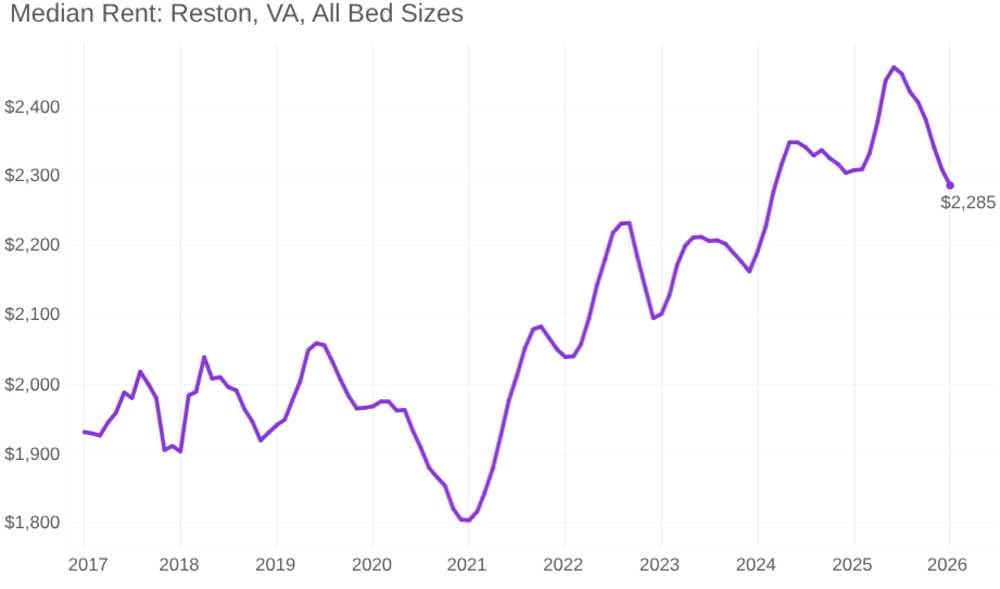
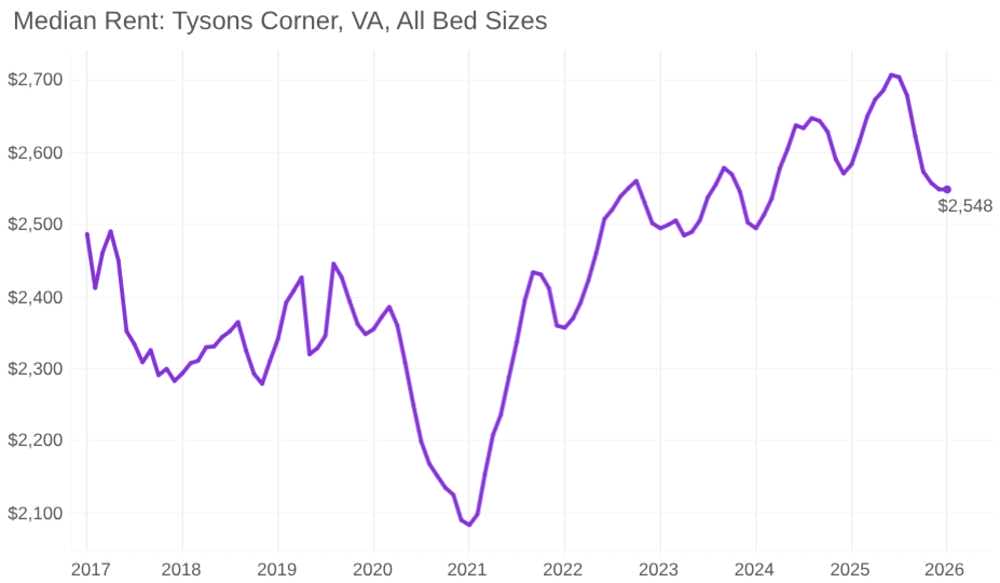
Each of the five corridors hit all-time rental highs in the Apartment List data during the spring and summer of 2025. In most cases, rents in January 2026 ran between $150 and $250 per month lower than at their respective peaks:
- Fair Oaks: The median rental rate of $2,315 in January 2026 for units of all sizes was down from the peak of $2,542 recorded in May 2025
- Fairfax: $2,198, down from $2,364 in May 2025
- Herndon: $2,137 was off from a high of $2,283 in July 2025
- Reston: $2,285 was a decline from $2,455 in June 2025
- Tysons: $2,548, down from a peak of $2,704 in July 2025
In most areas of the county, the rental market bottomed out in late 2020 and early 2021 owing to Covid before beginning a climb back. In Tysons, the nadir was reached in January 2021, when the median rental rate for all apartment sizes dipped to $2,082.
Winter typically is a time for less activity in both the rental and home-sales markets, and pricing often reflects it. But the low prices are not expected to stick around in the rental market.
Nationally, “the market is beginning to creep out of the off-season and will likely return to positive rent growth in the months ahead,” Apartment List analysts said in their January national report.
“This is in line with typical seasonal patterns,” they said.
But those seasonal patterns have shifted slightly since 2022, according to analysts:
“Whereas May used to be the annual peak for rent growth, over the past three years March has been the hottest month, with rent growth slowing down during what were, prior to the pandemic, the months when prices would increase most quickly. The flip to negative rent growth is also coming earlier, with prices beginning to dip in August rather than September.”
Another firm that tracks apartment-rental rates, Zumper, believes a number of factors are giving renters more leverage as 2026 begins.
“The U.S. rental market is largely frozen right now, caught between elevated economic uncertainty and the normal seasonal slowdown we see in the winter months,” said Anthemos Georgiades, Zumper’s CEO.
“While new supply deliveries are set to ease in 2026, any rebound in rents is unlikely to be uniform. Markets that have already worked through excess inventory may see a faster snapback than what national averages suggest,” he added. “The spring leasing season will offer a clearer signal of where the market is headed.”
According to Apartment List, units are taking an average of 41 days to get leased after being listed, four days longer than a year before and the highest figure since records began being kept in 2019.
