


Fairfax County supervisors voiced cautious optimism last Tuesday (Feb. 3) about Metro’s proposed fiscal year 2027 operating and capital budgets.
“A financially stable and reliable transit network is essential to the economic vitality of Fairfax County, Northern Virginia, Maryland, the District of Columbia and the entire metropolitan region,” county leaders said in a letter to Valerie Santos, who chairs the Metro board of directors.
The approved letter praised “targeted improvements” to rail service, “modest but meaningful” upgrades to bus service and continuation of MetroAccess service in Fairfax County.
Leaders of the Washington Metropolitan Area Transit Authority (WMATA) proposed a $4.84 billion spending package on Jan. 15 for the fiscal year starting July 1.
The package includes $2.7 billion for operating expenses — up $116 million from the current budget — and $2.1 billion in capital outlays.
The budget proposal “focuses on service enhancements, rail modernization and no fare increases for customers as we continue to transform America’s Metro system and deliver the service this region deserves,” WMATA general manager Randy Clarke said.
About $3 billion of the combined operating and capital budget would be funded by the Virginia and Maryland state governments, D.C. and localities.
Fairfax County’s share of operating costs and debt service would be about $255 million.
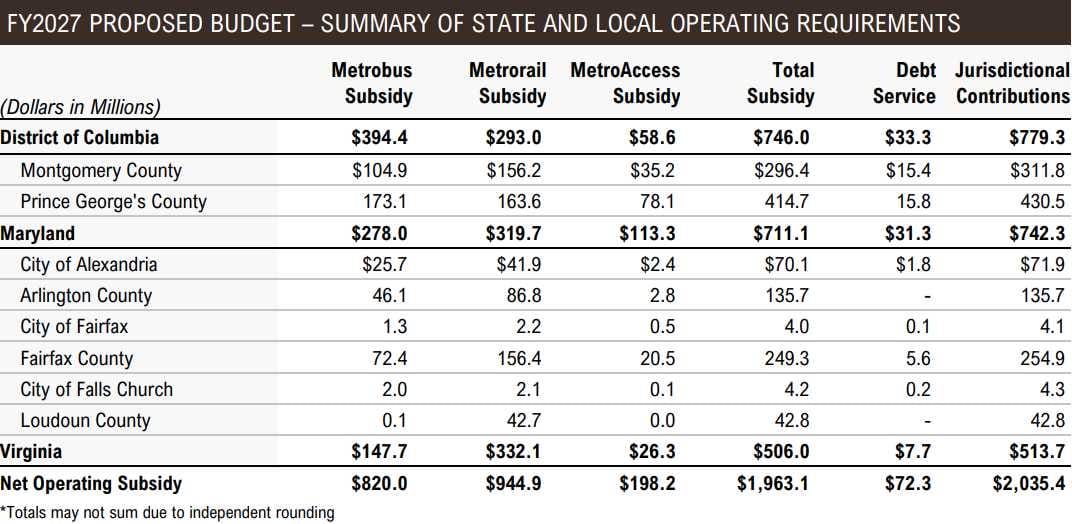
An additional $1.3 billion in revenue would come roughly evenly between federal subsidies and passenger fares.
The budget plan envisions no change to the current fare structure:
- Metrorail base fares will stay at $2.25 to $6.75, based on a trip’s length
- Metrorail late-night and weekend fares will remain the same, ranging from $2.25 to $2.50
- Metrobus local fares will remain $2.25 and the express fare will remain at $4.80
- MetroAccess maximum fares will remain at $4.50
Total ridership for fiscal year 2027 is expected to be 281 million trips, up about 11.4 million (4.2%) from the ridership anticipated by the end of FY 2026 in June. In FY 2025, the last year for which full figures are available, total ridership was just under 264 million trips.
The budget anticipates ridership revenue will total 34.5% of the cost of operating rail service and 9.2% of bus-service costs.
The WMATA budget process will play out in coming months. Still an open question is whether the state governments of Maryland and Virginia and the D.C. City Council will agree to fund improvements envisioned in the DMV Moves plan adopted by regional leaders last November.

The DMV Moves proposal, which also evaluated local bus networks and other transit systems, calls for more than $460 million in new dedicated funding for Metro beginning in mid-2027. The funding would increase 3% annually under the proposal.
In December, county supervisors voted 8-1 to endorse the proposal. The board’s lone Republican, Springfield’s Pat Herrity, voted against it, and the Braddock District seat at the time was vacant.
State legislators propose taxes to fund Metro
In Virginia, the General Assembly is currently considering ways to fund those costs.
Companion bills proposed by Del. Kathy Tran (D-18) in the House of Delegates and Adam Ebbin (D-39) in the state Senate would impose new taxes and fees — including a regional sales and use tax, taxes on rideshare and retail delivery services, a regional commercial parking tax and a statewide highway use fee — to support transit.
The legislation would allocate 49% of revenue in the existing Commonwealth Mass Transit Fund to the Northern Virginia Transportation Commission so it can assist Metro with capital and operating needs. The state could provide another $50 million to match federal funds for WMATA — if D.C. and Maryland pony up at least one-third of the amount.
In addition, the bill establishes a Northern Virginia Transportation District regional fund that would distribute money annually to NVTC and Metro’s capital fund. The Metro funding would start at $136 million in fiscal year 2028 and increase by 3% every year after that.
Combined with an existing commitment of $154.5 million agreed to in 2019, Metro would receive more than $326 million in state and regional funding from Virginia by fiscal year 2032, according to an analysis by the Virginia Department of Budget and Management.
As of press time, the transit funding bills from Tran and Ebbin are both still awaiting consideration by their chambers’ respective appropriations committees.
At the Feb. 3 board meeting, Hunter Mill Supervisor Walter Alcorn said he couldn’t predict how the deliberations in Richmond will pan out.
“We’ll see. I’m moderately hopeful,” said Alcorn, who chairs the county board’s transportation committee and serves on the WMATA board of directors.
WMATA will hold a virtual hearing on its proposed budget at 6 p.m. today (Thursday) and is collecting public comments until 5 p.m. next Tuesday (Feb. 10).
