


Gov. Abigail Spanberger (D) has vetoed collective bargaining legislation from Fairfax County legislators that would have expanded collective bargaining rights in Virginia.
SB 378 and HB 1263 from Senate Majority Leader Scott Surovell (D-34) and Del. Kathy Tran (D-18) would have repealed any bans on collective bargaining, mandating that the state and local governments negotiate labor contracts if public employees form a union.
After Surovell confirmed to FFXnow and other media outlets that Spanberger notified him yesterday (Wednesday) of her plan to veto the bills, the governor made the move official this evening, stating that she supports collective bargaining rights for public employees but believed the legislation on her desk needed revisions.
“While preserving the enrolled bill’s focus on allowing public employees to achieve collective bargaining, my amendments would have also provided additional flexibility for public employers to take into account existing local budget timelines and processes,” Spanberger said in her explanation for her veto.
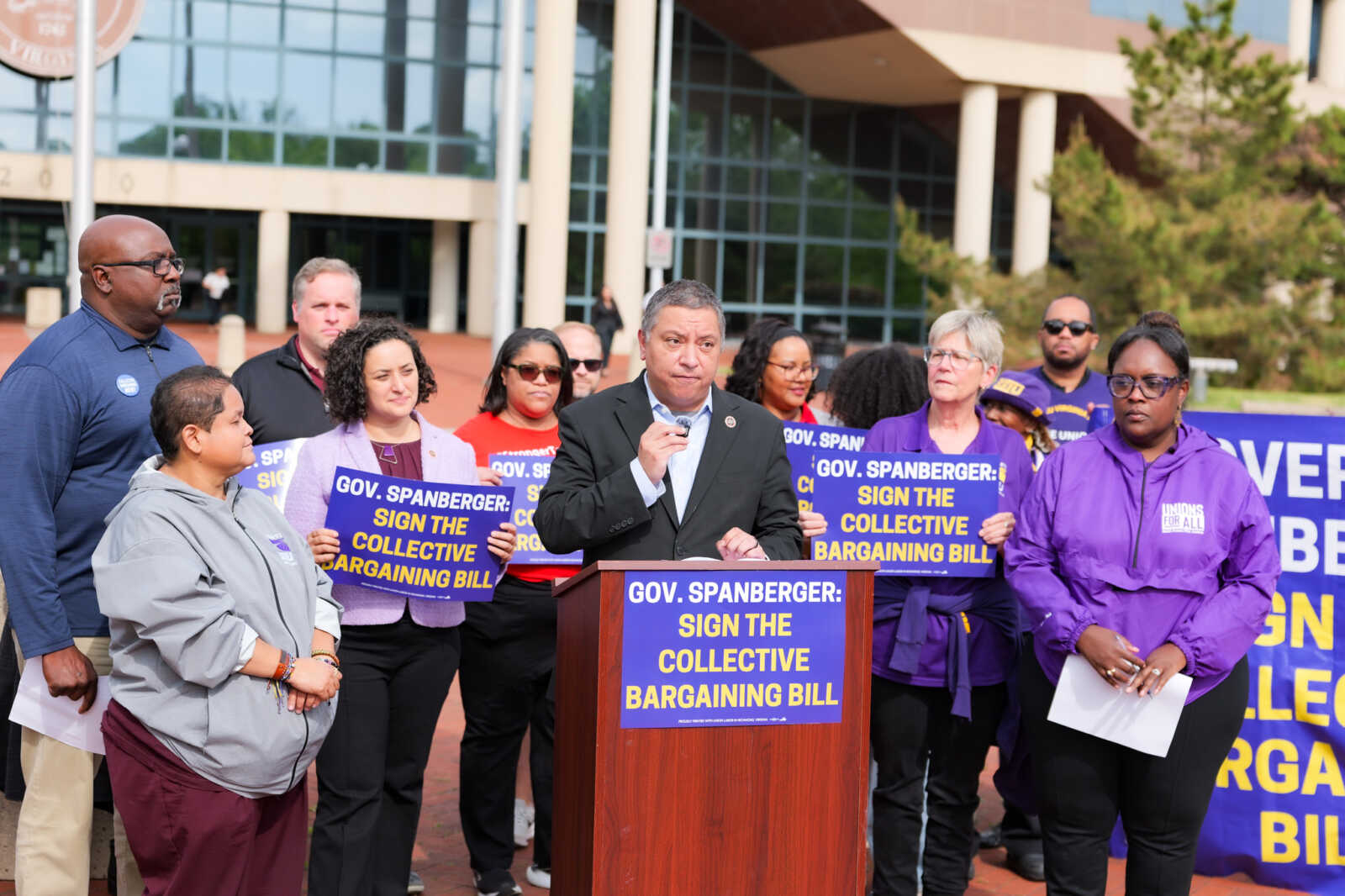
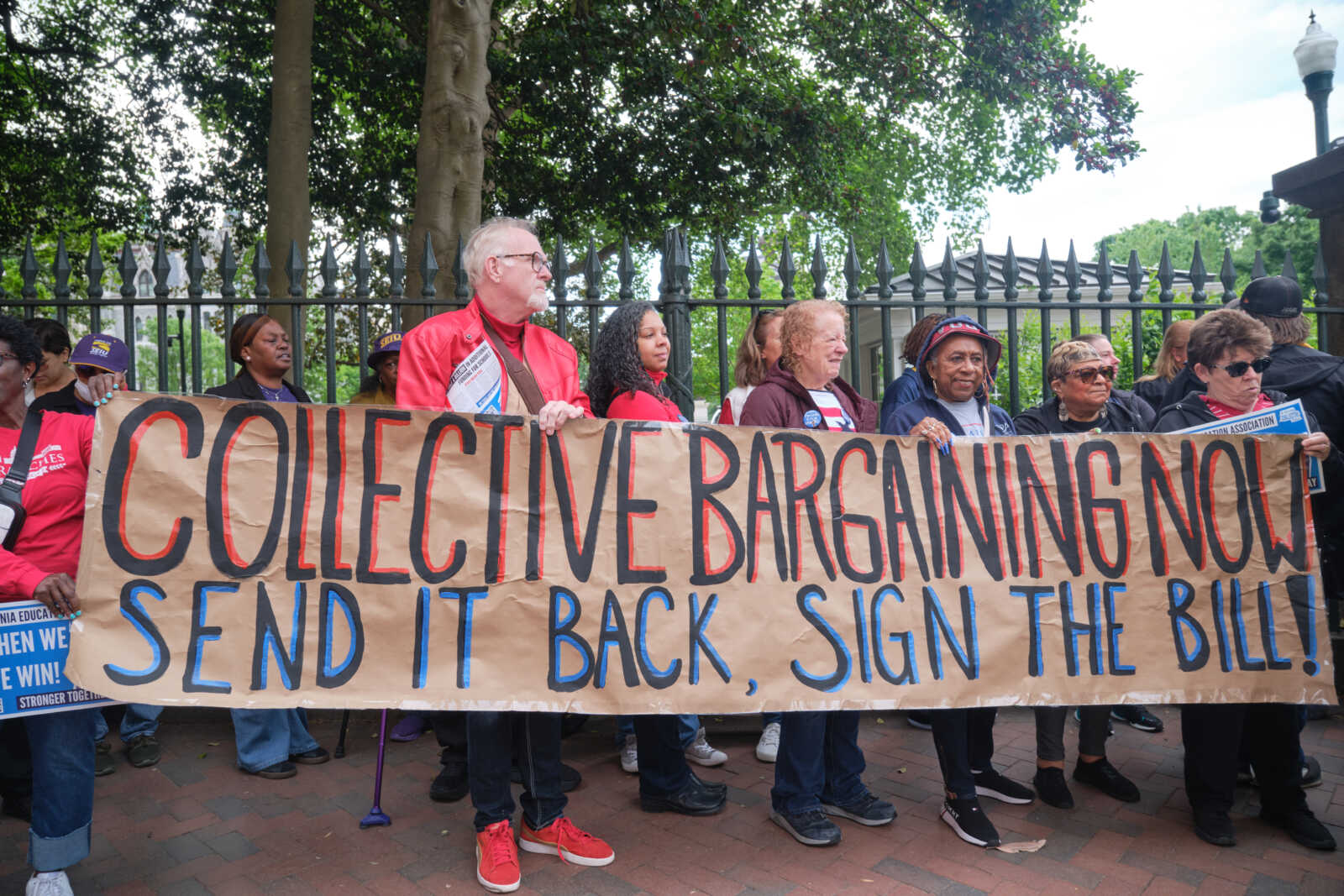
Union members protested the expected veto yesterday outside the Inova Schar Cancer Institute in Merrifield, where Spanberger ceremonially signed several health care-related bills. When asked by a Dogwood reporter about the planned veto, Spanberger reaffirmed her goal to get collective bargaining signed into law but said she wants to “get it right.”
The legislation passed by the General Assembly in March would have expanded upon a 2020 Virginia law that gave localities the choice to adopt ordinances to collectively bargain with public employees for the first time since 1977.
Fairfax County was among the jurisdictions to subsequently authorize collective bargaining, approving contractors for general county government employees as well as police and firefighters. Fairfax County firefighters, teachers and other public sector workers recently rallied outside the county government center to advocate for Spanberger to sign the new state legislation.
Unions shared disappointment that Spanberger rejected the bill, noting that they had supported her gubernatorial campaign in 2025.
“The right to collectively bargain is foundational to all other workers’ rights,” the Virginia Public Sector Labor Coalition said in a statement. “To be clear: in the middle of an affordability crisis, the governor has denied half a million public service workers the freedom to bargain for a living wage, affordable health care, and safe workplaces.”
The Virginia Professional Fire Fighters held a news conference in Richmond today (Thursday) to criticize the veto.
“The General Assembly, through hard work, negotiation and compromise, placed a good bill on her desk, a bill that would have made an enormous difference in the lives of over 500,000 blue-color workers,” Robert Bragg III, president of the Virginia Professional Fire Fighters, said in a statement.
Bragg added, “Virginians trust their firefighters will show up when they are needed most. Unfortunately, now firefighters know they cannot trust their Governor to show up for them.”
The Virginia AFL-CIO said in a statement that the legislation “was not radical” and would have only allowed public employees who formed a union to negotiate their pay, benefits and working conditions.
“This veto is a devastating betrayal to the hundreds of thousands of public employees who have spent years, and in many cases decades, fighting for a seat at the table,” the union said. “Teachers. Firefighters. Home care workers. State employees. Public servants who are the pillars of our communities and who keep Virginia running through crisis after crisis, only to be told yet again that their voices do not matter.”
Signs that Spanberger had qualms about the proposed expansion of collective bargaining emerged in April, when she sent an amended version of the legislation back to the General Assembly, which ultimately rejected the changes at a reconvened session.
The measure had drawn opposition from some local governments, represented by the Virginia Association of Counties and Virginia Municipal League, which took issue with the bill infringing on “local decision-making.”
Spanberger’s substitute called for localities to have flexibility to work with the Public Employee Relations Board on bargaining and clarified that agreements are subject to approval by local governments with budgeting authority. Another major change would have delayed collective bargaining for local employees without a current agreement until 2030.
Unions also took issue with the legislation moving worker protections to the Public Employee Relations Board’s purview. Because the governor can appoint who is on that board, an anti-collective bargaining governor could have an impact on the process.
Once the General Assembly rejected the amendments, the governor’s only options were to sign the originally passed legislation, veto it, or let it become law without her signature.
Spanberger faces a May 23 deadline to take final action on all passed bills from the 2026 session.
