

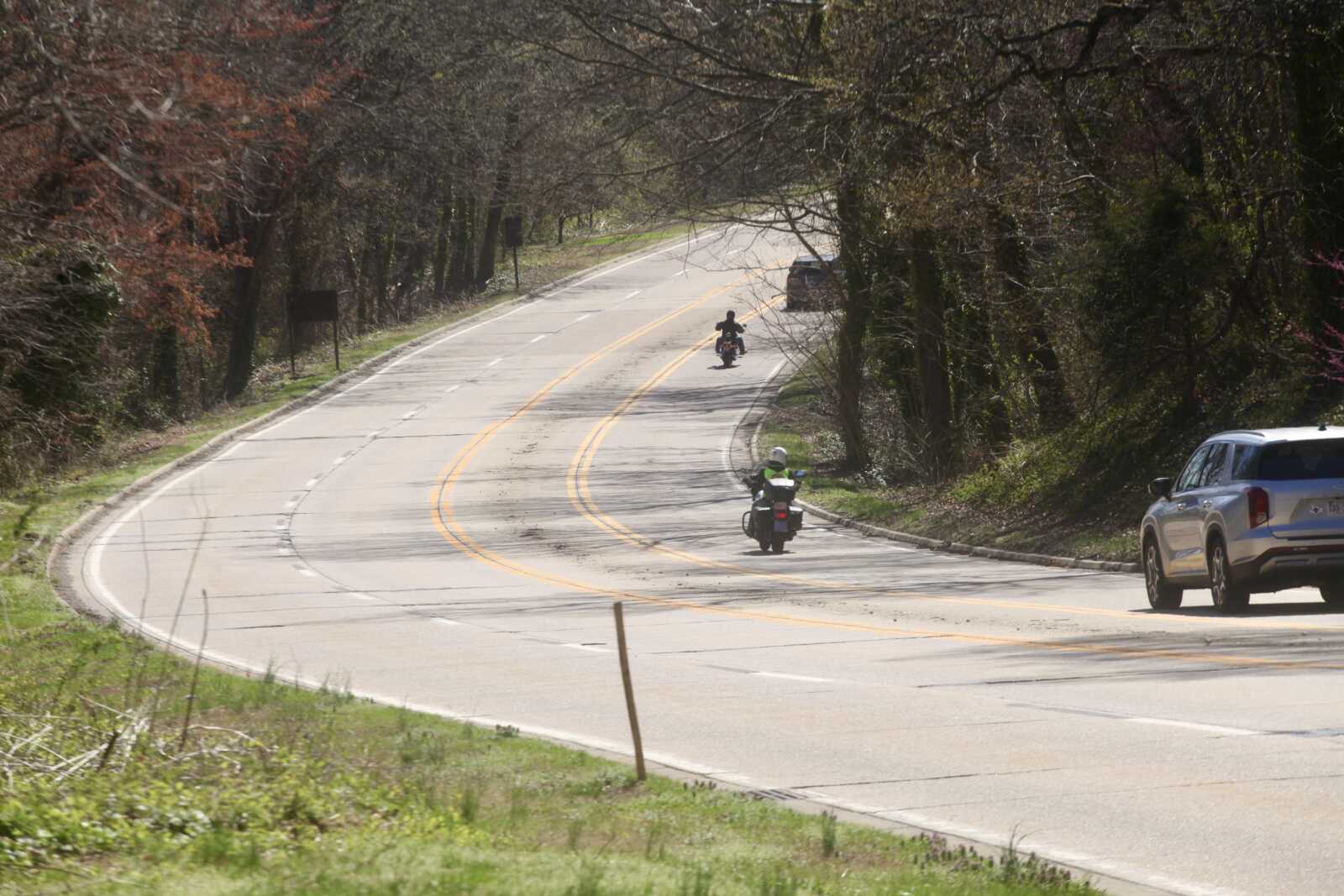
Local and state police will soon be allowed to enforce speed limits and other traffic laws on the George Washington Memorial Parkway, though drivers might not see an immediate increase in officers and troopers.
Virginia Gov. Abigail Spanberger signed Senate Bill 81 in April authorizing state and local law enforcement officers to cite drivers for traffic infractions on federal highways in Northern Virginia, starting on July 1. Local agencies can also seek the federal government’s permission to install automated speed monitoring cameras.
The bill was introduced for a second consecutive legislative session by Senate Majority Leader Scott Surovell (D-34) in response to concerns about speeding on the GW Parkway, particularly on the section south of Alexandria in Surovell’s district.
“[Local and state police] already had authority to conduct law enforcement for felonies, but their traffic enforcement authority was ambiguous. This clarifies it,” Surovell told FFXnow. “They can go out and they can start writing tickets for speeding or [driving while intoxicated], things like that.”
Running alongside the Potomac River for more than 25 miles, from Turkey Run Park in McLean down to Mount Vernon, the GW Parkway is owned and managed by the National Park Service, with the U.S. Park Police serving as the main law enforcement agency.
However, Surovell has argued that the agency’s enforcement of traffic laws has been insufficient on the southern section, where a study completed in 2021 found that most drivers exceed the posted speed limits of 35 to 45 mph and that speed is likely a primary cause in many of the 389 crashes recorded between 2005 and 2018.
The state senator traces the traffic and safety issues on the GW Parkway back to a Pentagon decision in 2005 to double the size of Fort Belvoir, resulting in an increase in commuters in the I-95 corridor and on the parkway.
“The road is just handling traffic volumes it was never designed to handle,” Surovell said. “We have to have law enforcement out there making sure people are driving safely, or else more people can get injured and killed.”
While the NPS has implemented some design changes, including a revised traffic pattern at the Belle Haven Road and Belle View Blvd intersections, Surovell, Del. Paul Krizek (D-16) and Rep. Don Beyer — who represent southeastern Fairfax County in the House of Delegates and Congress, respectively — have been advocating for more robust enforcement measures.
After faltering in the House Transportation Committee last year, Surovell’s bill to allow local and state police enforcement of traffic laws on the GW Parkway initially passed the General Assembly this spring without the option for localities to seek authorization for speed cameras. That provision was dropped by the House, a change that the state Senate initially rejected before agreeing to after a conference committee.
When SB 81 first reached her desk, however, Spanberger sent it back to the legislature with a substitute that restored the speed camera provision. The state Senate accepted the substitute on a 24-15 vote, and the House followed suit with a 66-31 vote on April 22.
Mount Vernon District Supervisor Dan Storck, whose district includes the southern GW Parkway area, said he was “pleased” to see SB 81 pass the General Assembly and secure Spanberger’s signature.
“I appreciate this action in providing clear authority to support these important public safety efforts if the Park Police are willing,” Storck said in a statement to FFXnow.
National Park Service authorization still needed for speed cameras
Exactly how the Park Police will coordinate with state and local police, including the Fairfax County, Alexandria and Arlington departments, remains to be seen.
The Fairfax County Police Department, which has had “discussions” in the past with the Park Police about a possible agreement around traffic enforcement, says it’s now evaluating possible internal policy changes needed before the new law takes effect in July, though the U.S. Park Police will still be “the primary law enforcement agency responsible” for the road.
“FCPD officers will be able to enforce applicable state laws and local ordinances within Fairfax County’s jurisdiction along the Parkway,” the FCPD said. “As we prepare for implementation, the department is working through necessary policy updates, training, operational guidance, and internal approvals to ensure a coordinated transition.”
In a statement, the Virginia State Police indicated that it has no immediate plans to step up patrols on the GW Parkway, unless the National Park Service requests assistance:
Virginia State Police is committed to operating efficiently and responsibly. As part of that commitment, we regularly review our operations to ensure we are delivering the greatest impact.
VSP is committed to traffic enforcement statewide, with priority on the interstate system and other limited‑access highways, where traffic volumes and serious‑injury or fatal crashes are highest. Our staffing and deployment model is built around these high‑risk corridors.
VSP remains in communication with our local law‑enforcement partners, and when staffing and operational priorities are aligned to do so, we will direct patrols to the GWP. At this time, the National Park Service has not requested VSP assistance on the GW Parkway, and we are not actively patrolling it.
A VSP spokesperson noted that the agency’s speed camera program is currently limited to work zones.
Virginia law currently allows localities to place speed cameras in school and work zones. Legislation championed by Fairfax Del. Holly Seibold (D-12) and signed by Spanberger on April 13 will add designated roads with significant pedestrian safety issues to the list of places where Northern Virginia agencies can install cameras, among other changes.
It’s unclear whether the U.S. Park Police would be open to letting local or state police install speed cameras on the GW Parkway. The National Park Service declined to comment on SB 81, stating that it doesn’t comment on state legislative actions.
“Any proposal involving the installation of infrastructure on National Park Service-managed lands would be evaluated through the appropriate federal processes and requirements,” the NPS said. “We do not have any announcements regarding speed cameras on the George Washington Memorial Parkway at this time.”
Calling safety “a top priority” on the GW Parkway, the federal agency said it “supports tools and technologies that help improve public safety and encourage responsible driving behavior,” and will keep working with “law enforcement and transportation partners to reduce crashes and improve visitor safety.”
“The U.S. Park Police will continue to enforce applicable laws and support efforts to promote the safe use of the parkway for commuters, visitors, cyclists, and pedestrians,” the NPS said.
At a ribbon-cutting event last week to celebrate a rehabilitation of the GW Parkway’s northern section in McLean and Arlington, Beyer confirmed that he still believes speed cameras should be added on the highway.
Last year, the congressman introduced a Parkway Safety and Reinvestment Act that would require any revenue generated by speed cameras on NPS-managed highways to be used to install and repair the cameras, or on construction and maintenance projects for the road where the citation was issued.
“There’s lots of maintenance needs, and this would be a brand-new, wonderful source of revenue from people who could choose not to pay it by driving the speed limit,” Beyer told FFXnow after the ribbon-cutting ceremony.
According to his office, Beyer advocated for the bill at a House Natural Resources Committee hearing in March, but a vote on it hasn’t been scheduled yet.
“The levels of speeding on the Parkway are dangerous,” Beyer’s office said in a statement. “By enabling Park Services to retain funding generated by speeding fines on the Parkway — this legislation can help decrease speeds on the Parkway and improve safety. He hopes to see this bill receive a committee markup and come to the floor soon.”
