

The Fairfax County Board of Supervisors on July 14 adopted a roadmap to guide future development of Lorton’s core area over the next 20 to 50 years.
Adoption of the Lorton Core Study represented nearly a decade of work. The adopted plan seeks a mix of uses with a focus on walkability and parks.
“For the first time in years, Lorton has a clear vision,” said Nick Firth, who co-chaired the Lorton Visioning 2040 Task Force.
It is “a vision built around creating a center, a vision built around connection rather than fragmentation, a vision built around becoming a destination rather than a pass-through,” Firth told supervisors in advance of their vote to adopt the updated comprehensive plan.
Task force members unanimously supported the proposal that evolved out of years of deliberations. So, too, did the South County Federation.
“It is not perfect, [but] it is what Lorton could be, and what we will work for in the future, building on what we have and hopefully not taking away any of the great things that make Lorton great,” said Keith Shovlin, who heads the federation.
It has been decades since there was a comprehensive planning effort for the area. The new plan “gives Lorton a clear roadmap for thoughtful growth, a strong community identity and a more connected future,” said Wendy Henley, a task force member and former president of the South County Federation.
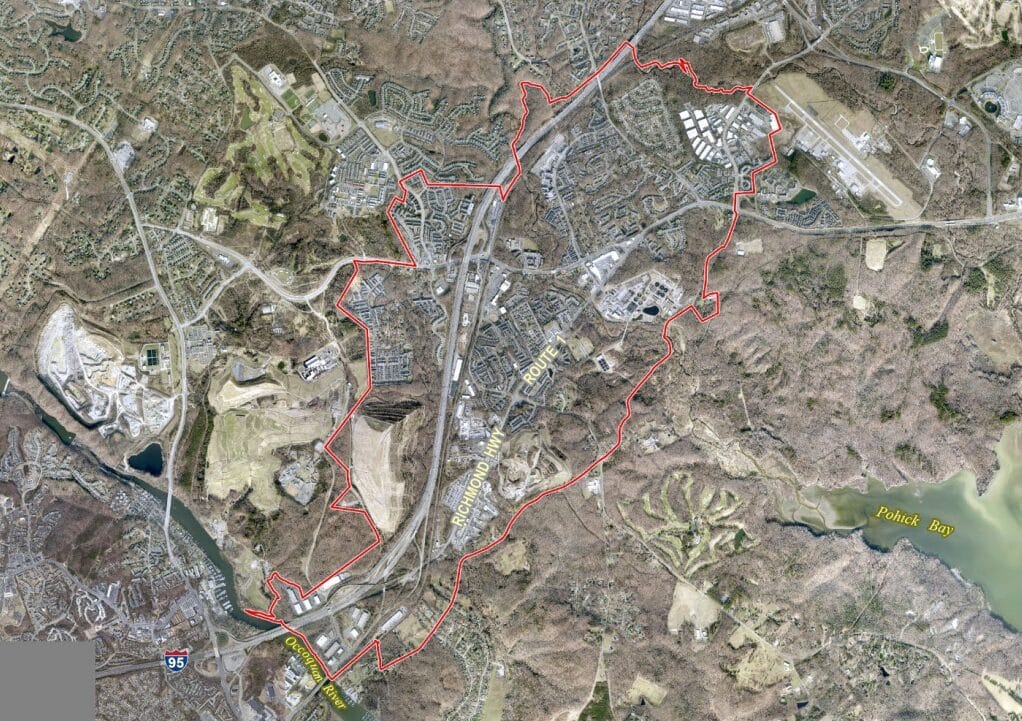
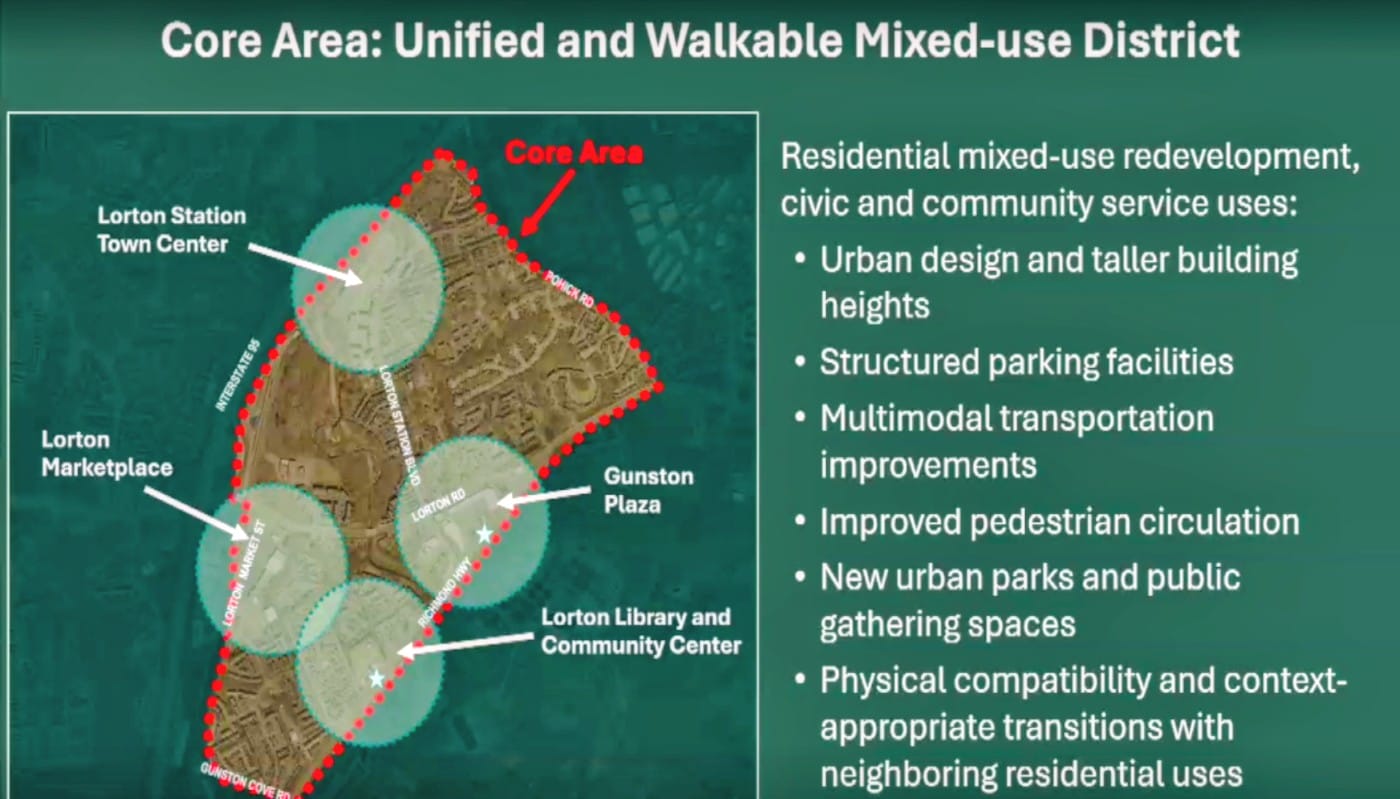
As the name implies, the core area is the most concentrated part of the 3,200-acre Lorton-South Route 1 Community Planning Sector. The core area is roughly bounded by Pohick Road to the north, Richmond Highway to the east and I-95 to the west.
Mount Vernon District Supervisor Dan Storck, who represents the Lorton area, said the new planning document should be looked at as another step in a process that will continue for decades.
“This isn’t a revolutionary change,” he said. “I view this as more incremental changes … to further move us along.”
Board Chair Jeff McKay said the new plan would help to unlock “the untapped potential that exists in this part of the county.”
“If you don’t have a plan, you don’t know where you’re going,” he said.
Like Storck, McKay acknowledged the length of time it took to get the plan ready for final consideration.
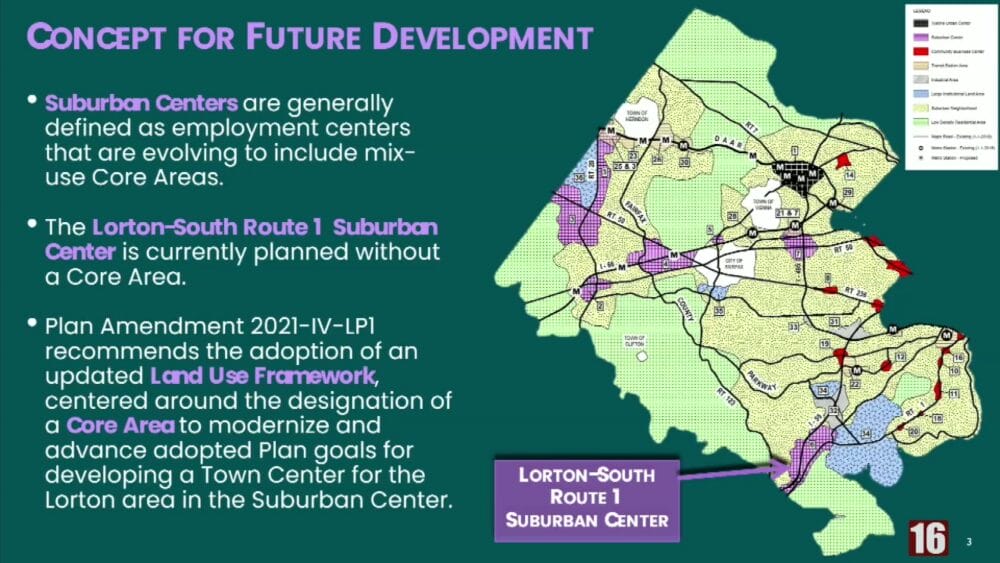
According to the county, a study of the Lorton core was initiated back in 2019, though the Board of Supervisors didn’t officially authorize staff to draw up a plan amendment until January 2021. Before then, the county’s areawide plan for Lorton had been last updated in 1992.
“This has been a long, long process. I think all of us would confess too long,” the board chair said. “This is tough work. It isn’t easy.”
Not everyone came out of the process enthusiastic about all the details.
Kenneth Russell, a lifelong Lorton resident, voiced concerns of residents in the Wildwood subdivision, which in the future could be bisected by a connector road.
“Every Fairfax homeowner needs to know this could happen to their community, as well,” he said during the July 14 public hearing.
Russell had raised similar qualms at a Fairfax County Planning Commission public hearing where the plan was considered in June. There, he also voiced concern about the increased density the plan likely would bring.
Task force co-chair Firth said the aim of the plan was to balance competing concerns and offer a framework to move forward:
“Lorton has faced tremendous change. We’ve had the prison closure, the landfill closure, new neighborhoods popping up. We had a lot of industrial uses coming to the area. But no true vision of our own. There was no true center — we live there but we leave for dining, entertainment, recreation.”
He said the plan will help community members to “stop thinking of Lorton as separate destinations, but one core, unified district.”
Other areas of the region could benefit from the experiences of the planning, Shovlin of the South County Federation said.
“Lorton will help lead the way for the rest of Fairfax County, and maybe beyond,” he said.
According to county officials, the framework adopted on July 14 also includes:
- Six distinct activity modes: “Focuses future growth, community activity, urban design and placemaking within four primary nodes of the core area, including Gunston Plaza, Lorton Marketplace, Lorton Station Town Center and the Lorton Library and Community Center. Two additional nodes are recommended for increased employment activity, south of the core.”
- Enhanced multi-modal mobility: “Revises the planned local street network and incorporates significant transit upgrades, including the extension of the Richmond Highway Bus Rapid Transit (BRT) system — The One — from Fort Belvoir to the Occoquan River, along with dedicated new BRT stations.”
- A reimagined Lorton Road: “Accommodates a task-force-recommended focus on Lorton Road as the ‘Main Street’ of Lorton, optimizing the corridor for wide, lighted landscape buffers, pedestrian and bicycle facilities, and a tree-lined median.”
The overall proposal had the support of the planning commission, which recommended further consideration of ways to reduce Lorton Road’s footprint through the community.
