


Metropolitan Washington Airports Authority (MWAA) board members agreed yesterday (Wednesday) to add $15.5 billion to the authority’s capital spending budget for planned improvements to Dulles International Airport.
MWAA officials also sketched out the anticipated timing and cost of individual components of the improvement plan, which had been pushed as a priority by President Donald Trump.
Without dissent and with little comment before taking action, MWAA board members voted unanimously to support a plan calling for multiple renovation and construction projects that could span two decades and more than quadruple the existing cost for airlines using Dulles.
The improvements will turn Dulles into “a world-class airport,” predicted Mark Uncapher, a Maryland appointee who chairs the MWAA board of directors.
Uncapher said the additional cost, on top of $4.4 billion already budgeted for Dulles improvements, would not put the authority in a financial bind.
“The demographics of our area is very strong, the economy is very strong,” he said at the special meeting on Aug. 19.
Last month, airports serving Dulles agreed to the redevelopment plan, which was proposed by MWAA and dominant carrier United Airlines in response to federal pressure.
At the Aug. 19 meeting, MWAA staff members filled in some of the blanks left when the plan was officially unveiled on July 29 at the White House.
They said the additional funding would come from three main sources:
- $14.2 billion in future MWAA bond sales
- $1.23 billion in future facilities charges assessed on travelers
- $150 million in grant funding, most likely from the federal government
Andrew Rountree, MWAA’s chief financial officer, said the $150 million figure is largely a placeholder, and efforts will be made to focus on securing more grant funding to reduce costs elsewhere.
“There may be some grant opportunities. We will pursue them along the way,” he said.
As part of yesterday’s vote, the MWAA board authorized staff to spend up to $48 million through the end of the year to begin planning efforts and take other necessary steps advancing the project.
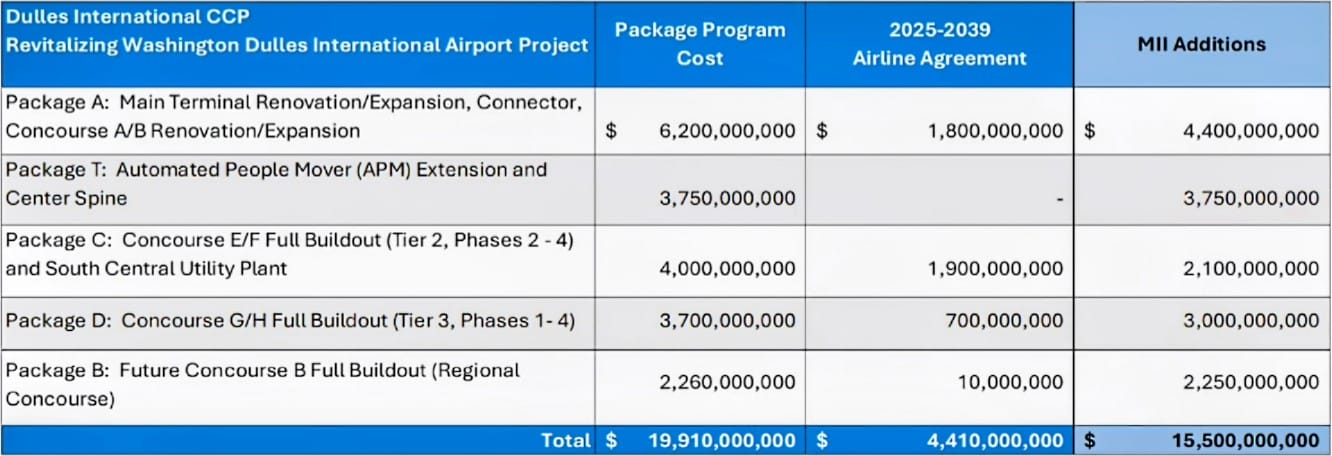
Here is what MWAA officials believe the $19.9 billion — $4.4 billion in existing capital funding augmented by the new $15.5 billion — will support:
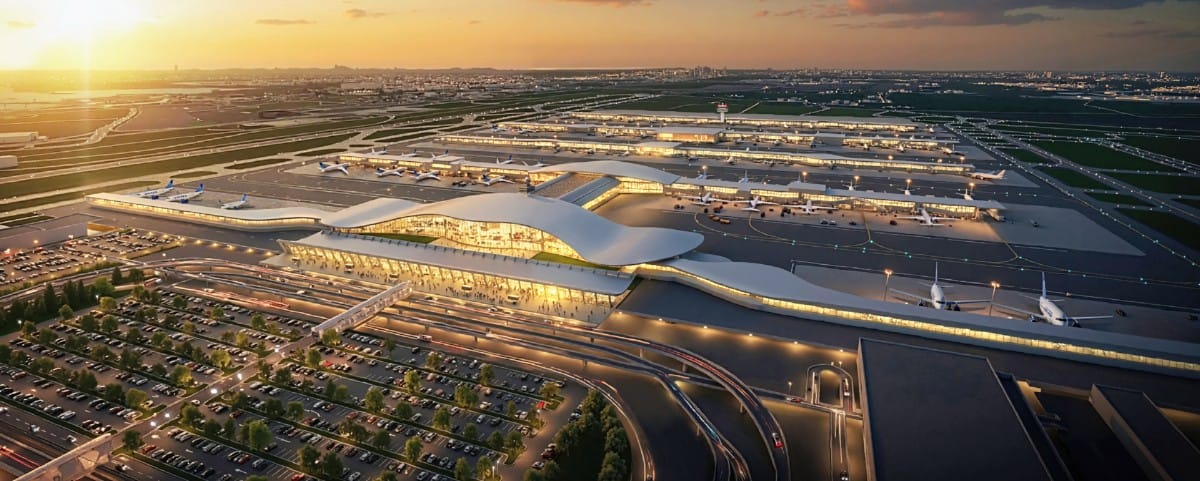
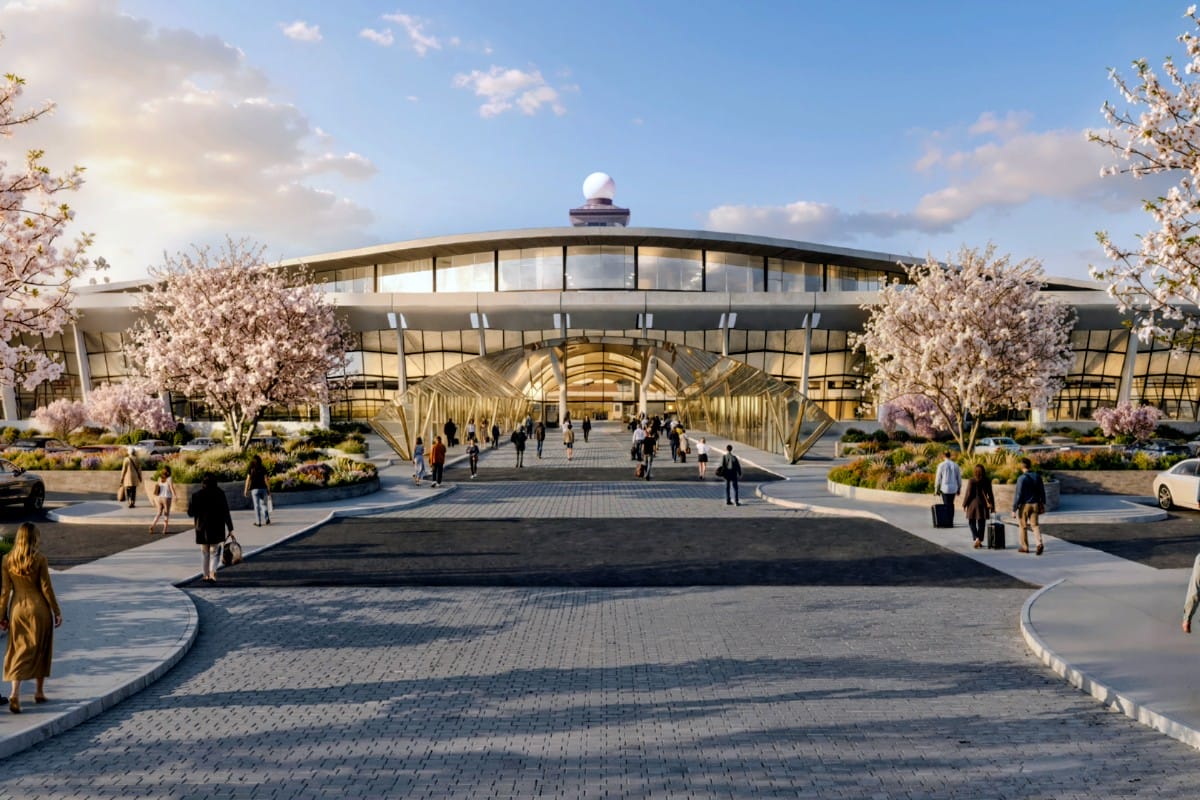
- A $6.2 billion first phase (“Package A”) will include expansion and renovation of the main terminal and renovations to Concourse A/B, with construction expected to start in late 2027 and be completed by the mid-2030s
- A $3.75 billion “Package T” to support expansion of the AeroTrain network, plus creation of an underground access “spine” running between terminals, set to start in 2029
- A $2.3 billion “Package B” that would include demolition of the existing Concourse C/D and, by the late 2030s, creation of a new regional-aircraft gate
- A $4 billion “Package C” that would fully build out Concourse E/F and provide utilities for that concourse and the future Concourse G/H
- A $3.7 billion “Package D” to built a new Concourse G/H, with timing dependent on passenger demand
All that additional debt will come at a cost, most of it passed onto airlines in the form of higher fees associated with airport operations.
This year, the cost-per-enplanement at Dulles is estimated to be $12.77. At yesterday’s meeting, Potter said the costs of the project would push that figure up to $60 to $65 per enplanement by 2040.
“We believe that’s going to be a very, very competitive rate,” he said.
Uncapher echoed the sentiment.
“We remain a very competitive airport. We would remain very competitive among our peers,” he said.
No major airport operator across the nation has projected its costs out as far as the 2038-42 time frame that Potter described. An analysis of publicly available data by DWU Consulting gives projections from airport agencies on anticipated per-enplanement costs:
- Los Angeles International Airport: $66.72 in 2034
- San Francisco International Airport: $47.82 in 2032
- Chicago-O’Hare International Airport: $46.82 in 2034
- George Bush Intercontinental Airport, Houston: $13.21 in 2032
- Hartsfield-Jackson International Airport, Atlanta: $12.33 in 2032
According to Potter, the approximately 50 airlines that serve Dulles are ready to move forward. The airlines “had a lot of impact” on the final plan, he said.
Judith Batty, an MWAA board member representing D.C., said higher costs to airlines would not necessarily trickle down to passengers.
“It’s not added to the price of a ticket,” she said.
But higher costs could put Dulles at a disadvantage in recruiting and retaining carriers, particularly those not in strategic alliances with United.
While MWAA and United are on record saying the proposed redevelopment plan is financially viable, some who watch the industry closely are not so sure.
Gary Leff, an aviation analyst, suggested that passenger growth at Dulles is unlikely to be significant enough to merit the type of redevelopment being proposed.
“Dulles needs work, but it’s surreal to move to borrowing $20 billion for this,” he wrote earlier this week in View from the Wing, an aviation news site. “The project may create more gates for [United’s] competitors, but it makes that space too expensive for them to use and pushes them out to BWI.”
Potter, who has been president and CEO of MWAA since 2011, suggested the additional investments would spur additional air service, not suppress it.
“We look forward to continued growth. We think we have a bright future,” he said.
