

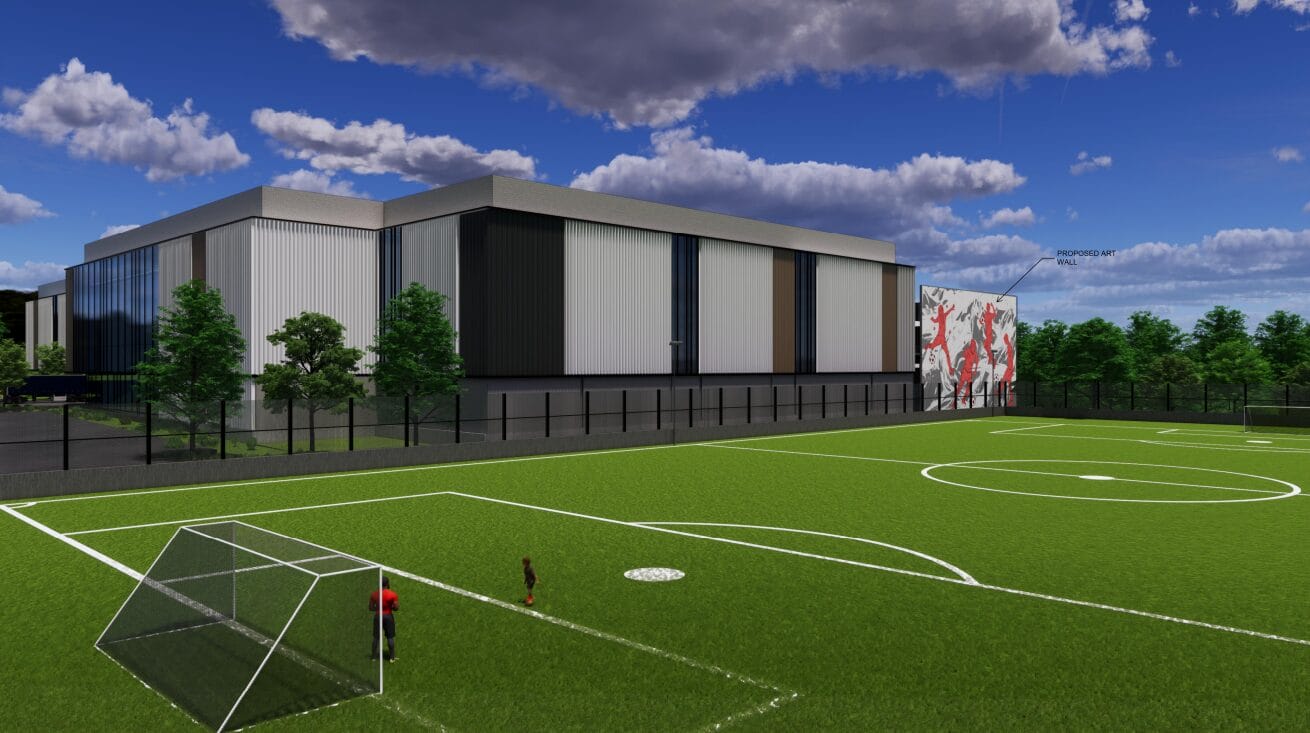
A proposal to replace office buildings in Tysons with an expanded data center has powered down for now.
The California-based operator Serverfarm recently requested that its special exception application to allow a “Vienna Cloud” data center complex on a 14.4-acre site at 7980 and 7990 Quantum Drive be deferred indefinitely, Providence District Supervisor Dalia Palchik shared in a newsletter last Thursday (Oct. 1).
According to Palchik, the deferral came after she raised concerns, spurred by community input, about the project’s potential environmental impacts and proximity to residential neighborhoods.
“In response, the applicant has requested that its public hearings before the Planning Commission and Board of Supervisors be indefinitely deferred,” Palchik said. “The application could be reactivated in the future, but at this time, no public hearings are scheduled.”
Serverfarm and a land use attorney representing it in the zoning case didn’t immediately respond to a request for comment.
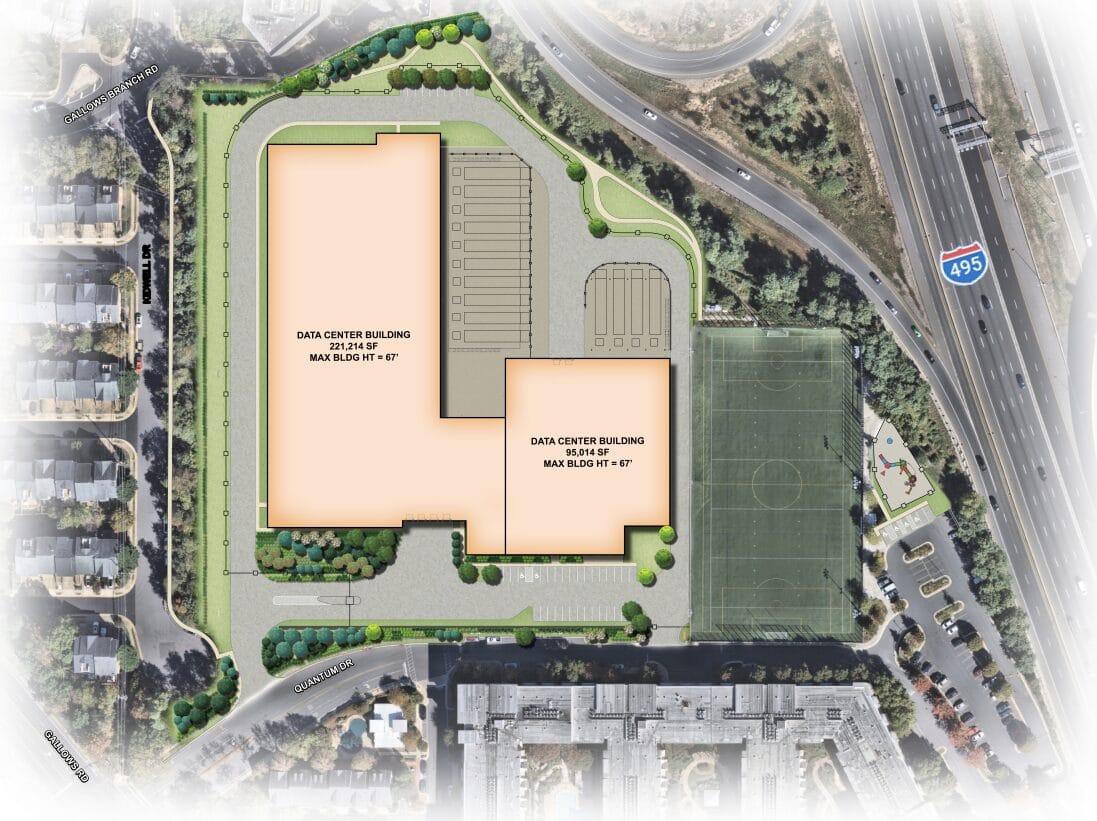
The company submitted an application in March proposing to replace the 1970s-era office buildings on Quantum Drive with two new, 67-foot-tall buildings to house data centers. The buildings already host data centers, but under the redesign, they would become exclusively devoted to the digital storage and processing facilities.
Totaling approximately 316,228 square feet, Vienna Cloud would easily exceed the 80,000-square-foot size limit allowed by the county’s zoning ordinance, which was updated by the Fairfax County Board of Supervisors with new regulations for data centers in 2024.
The site also falls short of the county’s requirement that data centers be placed at least 200 feet away from any residential neighborhood, with setbacks of 107 feet from the Reserve at Tysons Corner apartments to the south and 131 feet from the Heritage Point Townhouses to the west.
In its application, Serverfarm stressed that it will maintain the same setbacks as the existing offices and noted that the part of the building closest to the Reserve apartments would house office and administrative space, rather than the actual data center equipment.
“While the Applicant is also proposing to implement a robust landscaping and screening concept all along the Property’s frontage, it will of course work with Staff, the Planning Commission and the Board to develop further mitigation conditions, as and if deemed necessary,” the application said.
However, Palchik said in her newsletter that she believes the expanded data centers would still be located too close to homes.
“I have made clear to the applicant that I will not support a waiver of the Zoning Ordinance’s 200-foot residential setback requirement,” she wrote.
Palchik, who represents most of Tysons, said she also harbors “concerns surrounding the environmental impacts” that the data centers might have on the local community.
In a statement to FFXnow, Palchik said issues raised by constituents in emails, letters and at public meetings included the requested waiver of the residential setback limit, the location of power generators for the facility, and “general concerns related to the environmental impact” of the proposed expansion.
“I’m grateful to everyone who has taken the time to reach out and made their voice heard throughout this process,” she added.
The data center industry has seen enormous growth in recent years — alongside mounting opposition on both sides of the U.S. political spectrum.
Small, under-the-radar data centers have been around for decades. But the explosion of artificial intelligence chatbots has resulted in data centers that are bigger than anything just about any town has ever seen. Some of them dwarf football stadiums and factories and consume more energy than small cities.
By 2030, data centers will account for nearly 3% of the world’s projected electricity use, with 935 trillion watt-hours, according to a United Nations University report released in June on these buildings’ environmental footprint.
Because of the massive amounts of energy needed to power them, the expansion of data centers in the D.C. region, including the industry’s longtime hub of Loudoun County, is hampering efforts to reduce greenhouse gas emissions, officials with the Metropolitan Washington Council of Governments (COG) reported last month.
Virginia Gov. Abigail Spanberger issued an executive order on Sept. 18 directing state agencies to develop a regulatory framework for data centers focused on increasing transparency and holding the industry accountable for its energy and environmental impacts.
Among other steps, Spanberger dictated that the framework would ban developers from requiring state agencies and employees to sign nondisclosure agreements, eliminate “by-right” approvals in favor of requiring public hearings for projects that need over 25 megawatts of power, and require operators to contribute a “more equitable share” of electricity costs.
In response to the backlash against the industry, Amazon announced on Friday (Oct. 2) that it will invest over $1 billion in the next five years in communities where it builds data centers, including for education, job training, water and energy preservation projects, and other local priorities.
According to Matt Garman, the CEO of Amazon’s cloud computing arm, the technology giant has already spent more than $1 billion in communities with a large data center presence over the past three years.
Garman also said that Amazon is no longer using nondisclosure agreements with government agencies it works with on its projects and hosts open houses in communities where it operates to share information about what it’s doing.

