

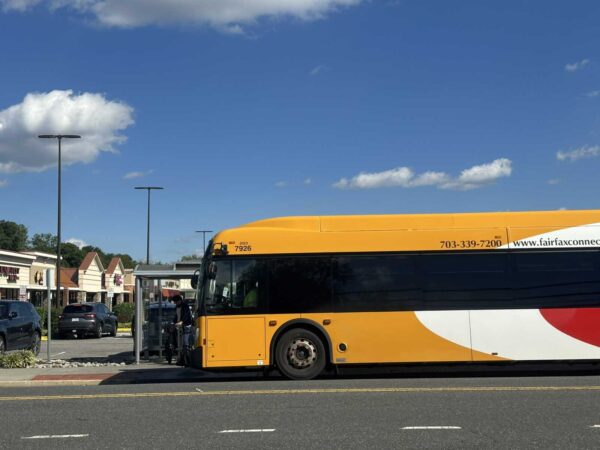
Regional leaders agree more collaboration could be beneficial, but see little reason to pursue a consolidation of four Northern Virginia bus systems into one.
“I did come here … with an open mind, open to any compelling reason [to support consolidation],” Hunter Mill District Supervisor Walter Alcorn said at an Oct. 21 roundtable convened by the Virginia Department of Rail and Public Transportation (DRPT). “I’m still looking for it — I don’t see it.”
Under the two-year state budget adopted at the end of June, the DRPT has been tasked with considering the impacts of a potential Northern Virginia bus system consolidation and reporting back to the General Assembly in December.
Four bus networks are being studied for a potential merger: Fairfax Connector, Arlington Transit, Fairfax City’s CUE and Alexandria’s DASH. The regional Metrobus service operated by the Washington Metropolitan Area Transit Authority is not included in the study.
The study will not recommend for or against consolidating but simply present facts and analysis, DRPT director Maria Zimmerman said at the forum, held in Arlington.
“There are some pros and cons,” Zimmerman said, suggesting final decisions would have to be “guided by the political will here in Northern Virginia.”
Elected and staff leaders from all four jurisdictions used the meeting to say they supported more collaboration among local bus systems, but failed to see a compelling reason for consolidating them.
“We want our systems to work better. We want all of Northern Virginia to be better coordinated and for every rider to have better opportunities,” Alexandria Mayor Alyia Gaskins said. “For us, though, we truly believe ‘better together’ doesn’t mean merged.”
Localized bus service means “being able to be responsive to our residents’ needs,” Arlington County Board member Maureen Coffey said.
Trying to force a merger of four distinct systems “doesn’t seem like the best use of anyone’s time,” Coffey said.
Those who came into the process wary of consolidation seem to have had their concerns validated by a study conducted for DRPT by the consulting firm Kimley-Horn.
Its analysis suggests a merger would take four to six years to implement and might lead to a consolidated system that is more expensive to run than four separate ones.
Further, “the potential efficiencies from a service perspective are relatively minimal,” said Lucas Muller of Kimley-Horn, who delivered preliminary findings at the Oct. 21 meeting.
Muller said one of the major challenges would be finding common ground in four systems that have evolved differently over the decades:
- ART, CUE and Fairfax Connector are owned by localities, while DASH is independent of the Alexandria government
- ART and Fairfax Connector use a contractor to provide service and employ workers, while CUE and DASH employ their workforces directly
- DASH and CUE currently do not charge fares, while ART and Fairfax Connector require riders to pay
- Fairfax Connector, DASH and ART have unionized workforces, while CUE does not
Martha Coello, deputy director of the Fairfax County Department of Transportation, said local governments and the transit agencies are already working to implement strategies that were part of the regional DMV Moves study that recommended funding to support the future of local public transit.
“Getting through that is really key,” she said.
Coello said all Northern Virginia jurisdictions are facing budget challenges, and the prospect of a consolidated system actually costing more, rather than less compared to separate networks, was unpalatable.
“Right now, it would be challenging to move forward,” she said.
Like Coffey, Coello pointed to the ability of local governments to respond best to individual needs of transit users.
“We are dealing with very localized concerns,” she said. “It would be very challenging to meet all of those types of needs in a regional setting.”
Alcorn agreed, saying a consolidated bus service would require trade-offs local officials may not be willing to make.
“Even just the size of Fairfax County can create challenges in terms of getting responsiveness,” he said.
Fairfax City’s CUE is the oldest of the four systems — founded in 1980 — and also the smallest. At the Oct. 21 event, Mayor Catherine Read said she could support more cross-jurisdictional collaboration on issues like procurement.
“Greater cooperation and collaboration could really help,” she said.
Wendy Sanford, the city’s transportation director, agreed.
“We would have much more negotiating power and leverage if we could do this together,” she said.
But Sanford voiced concern about the loss of local identity if the bus systems were forced to merge by the General Assembly or state transportation leaders.
“We have a very unique and special brand,” she said. “People who ride CUE love CUE.”
Feedback obtained from local leaders will be incorporated into the final report delivered in December to the legislature, said Sarah Husain, DRPT’s Northern Virginia transit programs manager.
Combined, the four local systems transport more than 19 million riders a year — about 20% more than Metrobus in Northern Virginia — over 112 fixed routes. Fairfax Connector has by far the largest network of the four.
