

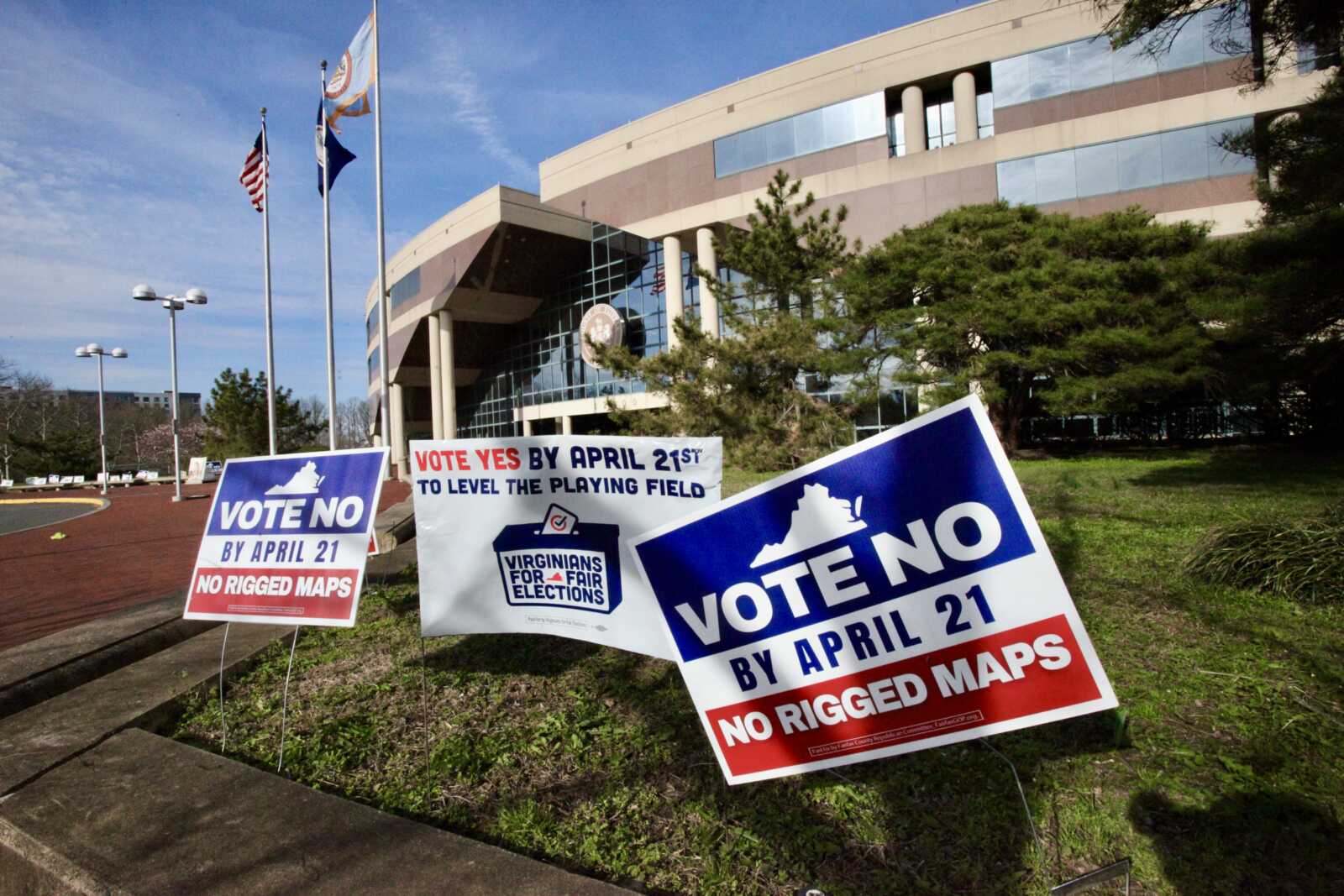
The Virginia Supreme Court’s nullification on Friday (May 8) of the redistricting referendum narrowly approved by voters last month left local and state-level Democrats reeling.
The Fairfax County Democratic Committee blasted the ruling as “a stunning betrayal” of the majority of Virginia voters — including nearly 70% of Fairfax County voters — who backed the proposed constitutional amendment, which would’ve let the General Assembly implement new Congressional districts drawn to favor Democrats in 10 out of 11 seats.
“Fairfax voters showed up, and voters across the Commonwealth did the same,” the FCDC said in a statement. “Their voices were heard, and then silenced by this ruling.”
The Fairfax County Republican Committee praised the ruling, while noting that the state allocated $5 million to administer the now-moot special election.
“The Fairfax Republican Committee is grateful to the Virginia Supreme Court for upholding the rule of law and acknowledging the multiple ways in which the referendum violated the Virginia Constitution,” Fairfax GOP Chair Katie Gorka said. “It’s a shame that $5 million in taxpayer funds had to be wasted in this fruitless exercise.”
Midterm elections move forward as scheduled
In light of the court’s ruling, the Virginia Department of Elections announced that this year’s primary and general elections will continue as scheduled based on the state’s existing Congressional districts.
The primary election will be held on Aug. 4 after it was postponed from its typical June time frame due to the redistricting referendum. All U.S. House of Representatives candidates seeking a political party nomination face a filing deadline of May 26, while independent candidates have until Aug. 4.
Because the candidate filing deadline hasn’t passed yet, the court ruling isn’t expected to have a significant impact on the Fairfax County Office of Elections’ preparations for the Aug. 4 primary, according to Eric Spicer, the county’s general registrar and director of elections.
“We are in the very early stages of planning for the August 4 Primary Election so this ruling should not impact our schedule for August 4,” Spicer told FFXnow. “Ballots have not been printed. We do not prepare ballots until after the candidate filing deadline which has not yet occurred. We will make any necessary adjustments based on guidance that we receive from the State Department of Elections.”
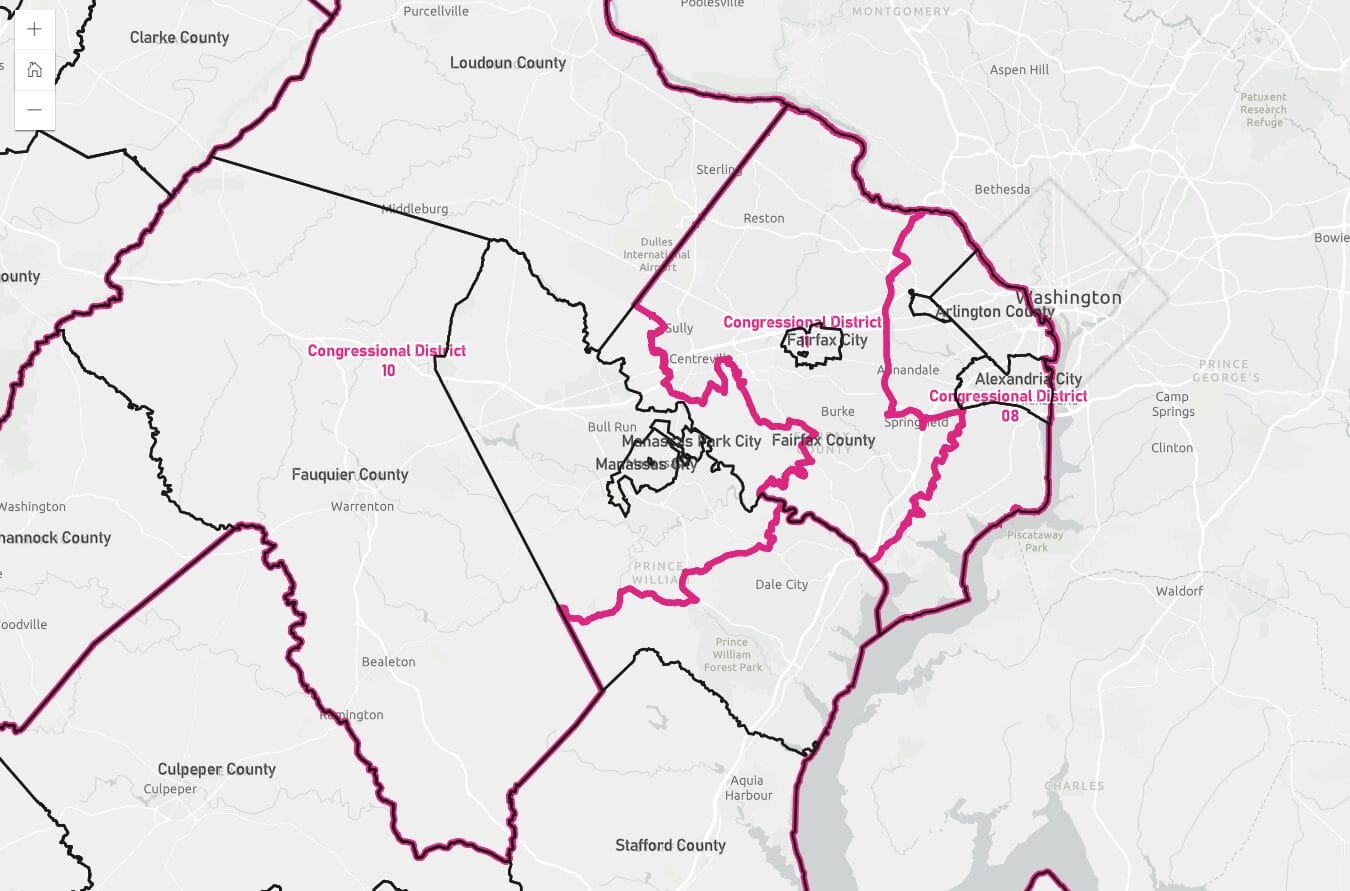
The incumbents representing portions of Fairfax County — Reps. Don Beyer in the 8th District, Suhas Subramanyam in the 10th and James Walkinshaw in the 11th — have all announced reelection bids, but it remains to be seen what kind of primary field they will face.
Former Space Force colonel Bree Fram launched a campaign in January for the current 11th District, challenging Walkinshaw, while Beyer picked up several challengers for 8th District under the proposed new map. Four people are currently vying for the Republican nomination in the 10th District, which includes only a sliver of Fairfax County in Clifton, but no new Democrats have stepped forward so far.
Sen. Mark Warner’s seat will also be on the ballot for the upcoming midterm elections. First elected to Congress in 2008, the senator has never faced a primary, and that won’t change this year after three contenders all withdrew their candidacy. Three people qualified for the Republican primary, and the race also includes independent Mark Moran.
With control of Congress at stake, Gorka said the Fairfax GOP “is already back at work helping to get Republicans elected,” while the FCDC expressed confidence that Democrats will have a strong showing this fall, despite the Supreme Court’s ruling on the redistricting referendum.
“In Fairfax and across the Commonwealth, we will respond. This ruling makes turnout in November even more critical,” the local Democratic committee said. “Fairfax County showed up in April, and we will show up again this Fall. We will register, mobilize, organize, and vote in even greater numbers as we fight for the soul of our democracy.”
Virginia Democrats criticize ruling
Drawing more than 3 million voters, the April 21 special election was ordered after the General Assembly twice passed and current Virginia Gov. Abigail Spanberger signed legislation proposing a one-time, mid-decade redistricting process intended to counter similar efforts undertaken by Republican-led states at President Donald Trump’s suggestion.
The referendum passed with just under 51.7% of the vote statewide, a slim majority, according to results from the Virginia Department of Elections that will now remain unofficial after the state Supreme Court blocked their certification.
However, the decision to void the referendum was also issued by a slim majority, with three of seven justices, including Chief Justice Cleo Powell, dissenting.
Though it had previously allowed the referendum to move forward, the Supreme Court ruled that the General Assembly had violated a requirement in Virginia’s Constitution that legislation proposing an amendment pass twice with a general election for the House of Delegates in between.
“The Commonwealth submitted a proposed constitutional amendment to Virginia voters in an unprecedented manner that violated the intervening-election requirement,” the majority opinion by Justice D. Arthur Kelsey said. “… This violation irreparably undermines the integrity of the resulting referendum vote and renders it null and void.”
State lawmakers first passed a bill asking voters to allow redistricting on a party-line vote on Oct. 31, 2025, when early voting was underway for the Nov. 4 general election that saw Democrats flip Virginia’s statewide offices and expand their majority in the General Assembly. The measure was approved again this past spring, and Democratic leaders unveiled a Congressional map that would’ve dispersed the influence of blue Northern Virginia by carving it into five districts.
Virginia Senate Minority Leader Ryan McDougle (R-26) and other Republicans who filed the lawsuit challenging the redistricting bid argued — and the Supreme Court agreed — that an “election” refers the entire period when voters can cast ballots, so the Oct. 31 passage came too late.
Meanwhile, Virginia Democrats contended that an “election” refers to Election Day. Powell noted in her dissent that the Virginia Code requires absentee in-person voting to “be available on the forty-fifth day prior to any election and shall continue until 5:00 p.m. on the Saturday immediately preceding the election.”
Senate Majority Leader Scott Surovell (D-34), who represents southeastern Fairfax County, maintained in a lengthy statement that Democrats in Virginia’s House and Senate had properly followed Virginia’s established process for amending the Constitution, calling the Supreme Court’s ruling “wrong on the law and unprecedented in its consequences.”
“Over three million Virginians participated in this referendum,” Surovell wrote. “Their votes have been set aside not because of fraud, not because of intimidation, not because of any defect in the casting or counting of ballots, but because four Justices have adopted a definition of ‘election’ that conflicts with state statute, federal precedent, and the considered legal advice of the nonpartisan staff who guided the General Assembly through this process.”
My statement on the Supreme Court of Virginia's decision today pic.twitter.com/dedWJv1KNe
— Senator Scott Surovell – ssurovell.bsky.social (@ssurovell) May 8, 2026
Virginia Democrats, led by House Speaker Don Scott (D-88) and Attorney General Jay Jones, intend to appeal the ruling to the U.S. Supreme Court, though support from a bench stacked with Republican appointees is unlikely.
Many Democrats, including the FCDC and Democratic Party of Virginia Chair Sen. Lamont Bagby (D-14), noted that the referendum’s invalidation came just a week after the U.S. Supreme Court gutted a key provision of the Voting Rights Act that was intended to prohibit discrimination based on race, specifically against Black voters.
“Across the South and throughout the nation, Republicans are redrawing districts, targeting seats held by Black and Brown representatives, and turning back the clock through backroom political maneuvering,” the FCDC said. “With Donald Trump facing record levels of public disapproval, they are increasingly turning to procedural tactics and political manipulation rather than trusting voters to decide.”
Since that April 29 ruling, which concerned a majority-Black Congressional district in Louisiana, Republican legislators in Florida and Tennessee have adopted new maps eliminating districts with significant Black populations, and Republicans in Alabama approved a plan on Friday for new primaries that would take place if courts allow a map removing one of the state’s two Black-majority districts.
While Virginia Democrats put their proposed map on the ballot, the Republican-led redistricting efforts have been undertaken by legislators without direct voter input, noted Virginia Sen. Tim Kaine, whose seat isn’t up for election this year.
“The timing of [the Virginia Supreme Court] ruling speaks volumes,” Kaine said in a statement. “The U.S. Supreme Court eviscerates the Voting Rights Act in a lawsuit brought by a January 6 extremist and Southern states race to craft backroom deals disenfranchising minority voters and candidates. Meanwhile Virginia voters choose to stand up against national disenfranchisement only to see their votes cast into the trash by a 4-3 ruling. A sad day indeed but I’m proud of Virginians’ willingness to stay true to our state’s motto after 250 years. That spirit is needed now more than ever.”
