

Fairfax County supervisors have reacted tepidly to a staff proposal for imposing what might be termed a “trash tax” on Fairfax’s property owners to support solid waste disposal.
“I don’t think we’re ready. It’s kind of a hard sell,” Board of Supervisors Chairman Jeff McKay said in response to the proposal, floated at the May 12 meeting of the board’s Environment Committee.
As proposed by staff, a typical Fairfax homeowner would pay approximately $60 starting in fiscal year 2028, which will begin on July 1, 2027. The cost, which would be based on the value of a property, would rise to an average of about $90 annually by 2032 under the projections delivered to supervisors.
The revenue, estimated at nearly $25 million in the first year, would be used to offset costs of the county’s solid waste disposal operations and reduce “tipping” fees charged haulers who deposit trash for disposal.
At the May 12 meeting, staff described the proposed new tax as a “sustainability fee.”
Elected officials may instead view it as political dynamite, coming on the heels of the county staff’s now largely abandoned attempts to bring all single-family homeowners into a single trash collection district.
That proposal drew negative public reaction, and a trash tax “will get just as much pushback from the community,” McKay predicted.
“Now is not the right time,” he said.
That view was echoed by Braddock District Supervisor Rachna Sizemore Heizer.
“I’m worried it’s going to go down the same path” as the sanitary district proposal, she said.
The county’s Department of Public Works and Environmental Services (DPWES) has over the past decade been using $50 million it received a decade ago to subsidize tipping fees. The funding came after the county government relinquished its partial ownership of the I-95 waste-to-energy plant in Lorton previously owned by Covanta.
That funding will run out next year, and “we have to make a decision” on what to do, said Eric Forbes, DPWES’ deputy director for solid waste management.
The department laid out options to cut costs, but even if they are implemented, staff predicted the county would need to start subsidizing operations by more than $6 million per year — likely through the county’s general fund.
Supervisors directed staff to come back to the environmental committee’s July meeting with more information.
“This is a pretty big decision. Let’s take a little bit of a step back,” said Providence District Supervisor Dalia Palchik, who chairs the committee.
The July meeting likely will include discussion of how the cost of county waste disposal fees compares to other jurisdictions.
“We’re going to actually have to take a look at how we do this. I’m not sure we can continue to afford the cost structure,” Hunter Mill District Supervisor Walter Alcorn said.
Trash haulers in Fairfax County in theory are required to use county facilities for disposal. But some apparently skirt the law, finding other options cheaper. Increasing the county’s tipping fee to cover future costs is likely to increase that trend, said DPWES Director Christopher Herrington.
“We are already more expensive” than surrounding jurisdictions, he said, adding that forcing haulers to use county facilities while simultaneously jacking up tipping fees could lead to court challenges.
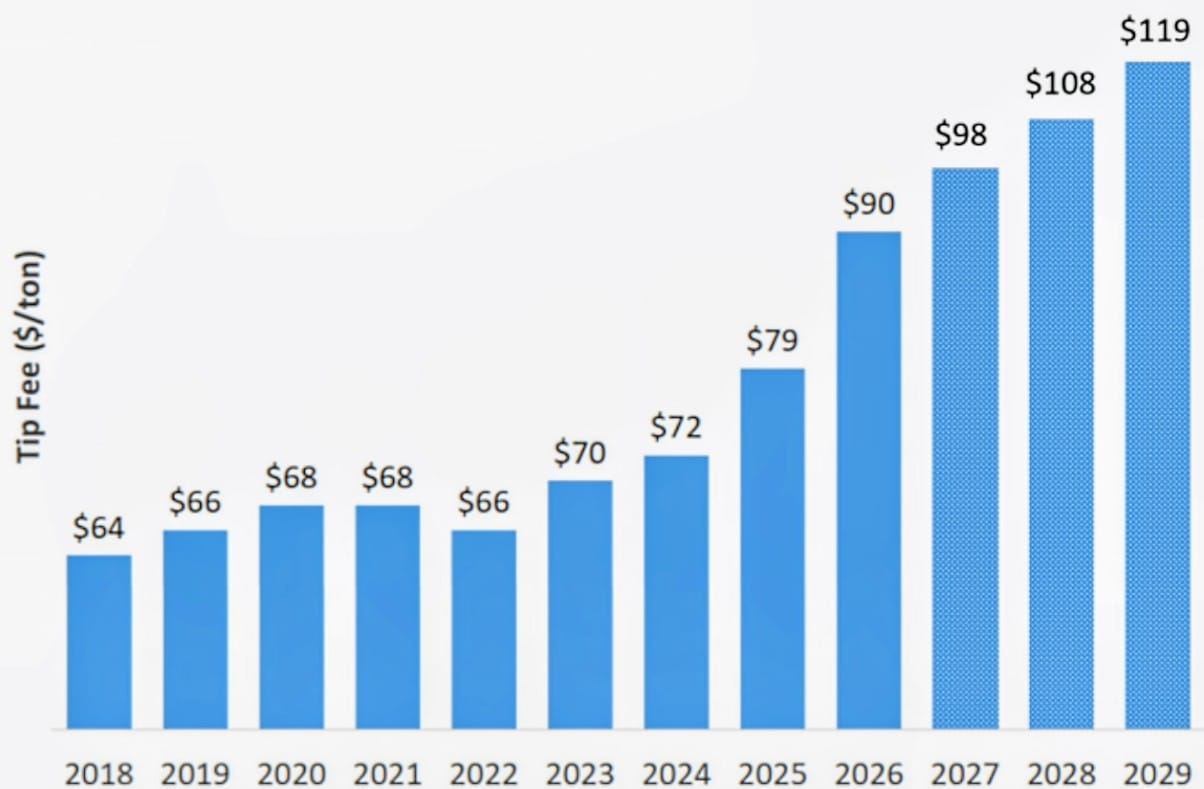
Currently, commercial trash haulers pay about $90 per ton for disposal of materials in Fairfax, a rate expected to rise to $98 next year, about $120 in 2029 and $150 by 2032 if no changes are made.
County staff say the rate could be cut to $80 per ton by 2032 if the sustainability tax is implemented.
In theory, a lower tipping rate would allow trash collection companies to pass savings on to their residential customers. But several supervisors were not sure savings to haulers would trickle down to consumers.
Perhaps reading chagrin on the faces of Herrington and his staff, McKay promised a solution would be forthcoming.
“We understand your problem,” he said, but maintained more discussion is needed.
“I have a lot more questions than I have answers to,” McKay said.
More than 650,000 tons of solid waste passes through the county government’s hands annually on its way to the I-95 Energy/Resource Recovery Facility, now owned by Reworld. The thermomechanical treatment plant burns the waste, creating about 93 million megawatts of energy annually in the process.
