


More than 20,000 Fairfax County residents were counted as jobless for the 10th consecutive month in new employment data.
With 612,551 Fairfax residents employed in the civilian workforce and 20,272 looking for jobs, April’s unemployment rate of 3.2% was up from 2.8% year-over-year, according to data reported June 3 by the Virginia Department of Workforce Development and Advancement.
The last time fewer than 20,000 Fairfax residents were reported as unemployed was in May 2025, when 19,741 people were without jobs as the impacts of the Trump administration’s downsizing of the federal workforce began to take effect.
Before that, the most recent previous time unemployment was above 20,000 countywide was in August 2021, when COVID-19 vaccinations were still rolling out.
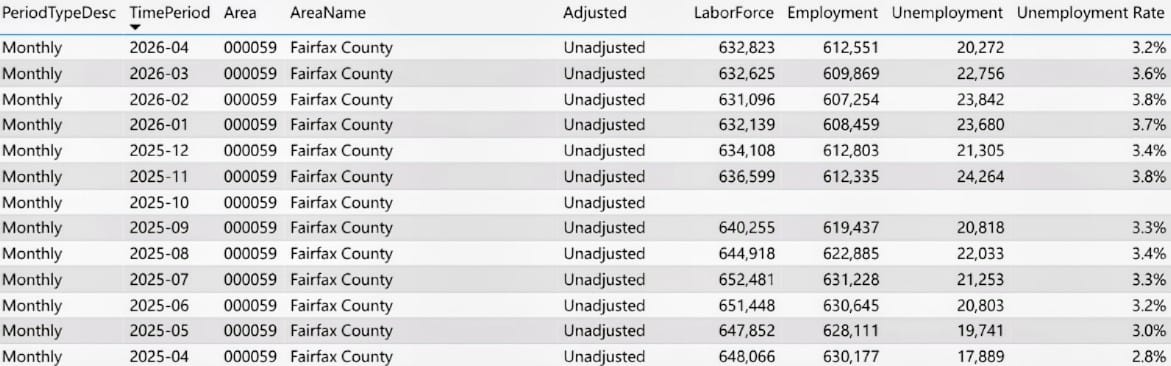
The number of county residents counted as holding jobs was down 3% in April year-over-year, part of a longer-term, regional departure of talent from Northern Virginia.
“We’re down about 108,000 jobs year over year — that’s a challenge,” said Terry Clower, director of the Center for Regional Analysis at George Mason University’s Schar School of Policy & Government.
The decline extends beyond Trump-era federal cutbacks, dating back even before the pandemic but exacerbated by Covid, Clower said.
“Folks left” the region and didn’t return, Clower said at a June 3 forum on regional economic trends sponsored by Mason.
The out-migration trend in Northern Virginia has been attributed in part to fewer residents being able to afford homes in the region.
“Our #1 challenge? Very simply, we need more housing supply,” Ryan McLaughlin, CEO of the Northern Virginia Association of Realtors, said at the June 3 forum.
Local leaders need to step up and address the issue, he said.
“We’re going to need to be shifting our mindset: take what we learned … what we’ve done over the past 30 years,” McLaughlin said. “Not just talking about it, but actual solutions.”
Fairfax County officials have been weighing options for increasing the availability of housing, but reaching the Board of Supervisors’ goal of 10,000 new affordable units by 2034 remains a challenge.
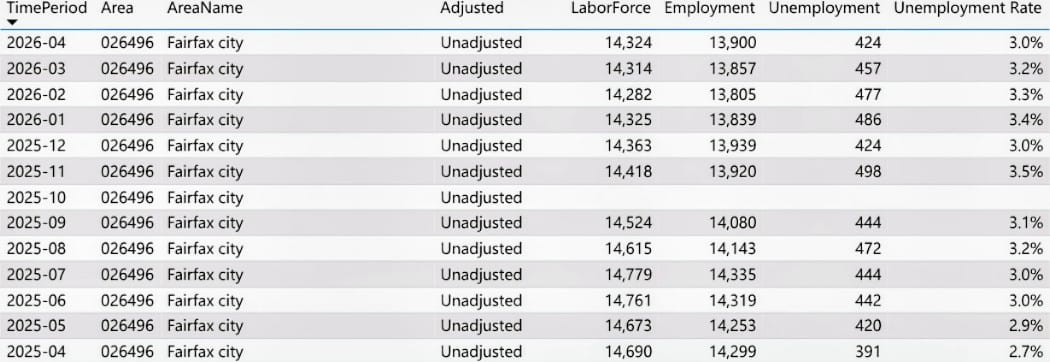
In the City of Fairfax, April’s jobless rate of 3% was up from 2.7% a year before. A total of 13,900 city residents were counted as employed, with 424 unemployed.
April marked the sixth straight month that fewer than 14,000 city residents were counted as working in the civilian workforce and the 11th consecutive month that unemployment stood above 400.
Across Northern Virginia, the jobless rate in April was 3.8%, representing 1.67 million in the civilian workforce and about 54,700 seeking jobs.
A year ago, the Northern Virginia unemployment rate had been 2.7%.
Across Virginia, April’s jobless rate of 3.4% was up from 3% a year before, according to state figures.
Nationally, the Bureau of Labor Statistics delivered a mixed April jobs report.
Unemployment rates were higher in April than a year earlier in 200 of the nation’s 387 metropolitan areas, lower in 152 and unchanged in 35.
The national, non-seasonally-adjusted unemployment rate in April was 4%, effectively unchanged from a year before.
The lowest jobless rates of 1.7% each were found in two South Dakota metro areas: Rapid City and Sioux Falls. The highest rate, 16.5%, was found in El Centro, California.
Among the 56 metro areas with populations of more than a million, the lowest rates were in Birmingham and Honolulu at 2.4% each. The highest rate was found in Fresno, California, at 8.1%.
In April, nonfarm payroll employment increased over the year in four metropolitan areas, decreased in four others and was essentially unchanged in the remaining 379.
Las Vegas saw the largest increase in total year-over-year employment with a growth of 23,600. The D.C. metro region had the biggest decline at 97,100, off 2.9%, according to the federal data.
Figures represent non-seasonally-adjusted data. All April 2026 figures are preliminary and subject to revision.
