

State transportation leaders are back with a new plan for extending the I-495 Express Lanes on the highway’s south side that they hope will win buy-in from leaders on both sides of the Potomac River.
Virginia Department of Transportation (VDOT) officials briefed the Fairfax County Board of Supervisors’ Transportation Committee on Tuesday (Sept. 22) on a revamped design that would allow both for Express Lanes and future Metrorail service on the Woodrow Wilson Bridge.
The inability to guarantee room for later rail service across the bridge was one of the reasons the I-495 Southside project was scuttled — at least temporarily — last year by the region’s Transportation Planning Board.
After the vote, “we went back to the drawing board,” VDOT Mega Projects Director Krishna Potturi said at the committee meeting.
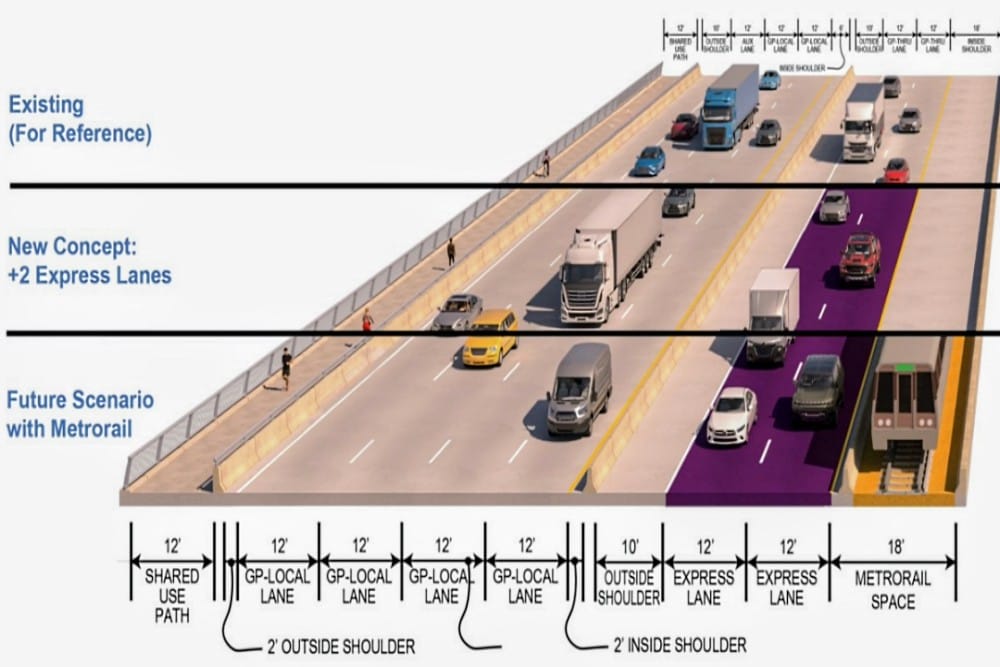
Under the new concept, VDOT proposes significantly reducing shoulder space in both travel directions to accommodate four non-toll lanes and two Express Lanes in each direction, along with an 18-foot-wide right-of-way down the middle for future Metro service.

Beyond losing shoulder space, the plan also eliminates two through lanes in each direction that currently aren’t tolled. VDOT officials contend that adding Express Lanes in their place will result in little negative impact on travelers using the four remaining general-purpose lanes in each direction.
To compensate for the lack of usable shoulder space, the proposal calls for stationing tow trucks near the bridge on a permanent basis to deal with breakdowns or accidents, Potturi said.
The Woodrow Wilson Bridge in Alexandria represents just a small portion of the proposed 11-mile I-495 Southside project running from just east of the Springfield Interchange in Fairfax County to just east of Maryland Route 210. But previous VDOT proposals for reconfiguring the bridge to accommodate toll lanes drew flak from Maryland and D.C. leaders.
Potturi said Maryland officials have been presented with VDOT’s new plan, and discussions between the two states would follow.
Maryland and, to a lesser degree, D.C. hold what is effectively veto power on the proposal, since it must be ratified by regional transportation planning bodies.
“We need them on board,” Hunter Mill District Supervisor Walter Alcorn said.
While some Fairfax leaders have had reservations about past incarnations of the I-495 Southside project, supervisors did endorse the earlier proposal. At the Sept. 22 meeting, Board Chair Jeff McKay called the proposed bridge revisions an “outstanding” response to the concerns raised in Fairfax and elsewhere.
“This is better than a lot of us thought,” he said. “I’m a strong supporter.”
But McKay and other supervisors pushed VDOT officials to find a way for the 18-foot Metrorail right-of-way to temporarily accommodate an additional travel lane before transit service materializes.
Mount Vernon District Supervisor Dan Storck said he was “a thousand percent against” not finding an interim use for the additional space in the center of the bridge.
Drivers stuck in gridlock on the bridge will not respond well to seeing what appears to be empty space that could be available for another lane, Storck said.
“I know I’m going to get verbally abused, and who knows where it goes from there,” he said of the likely public reaction.
VDOT officials say there are some logistical and engineering challenges with using the center of the bridge for another lane on an interim basis, but promised to further study the issue.
There currently is neither a plan nor funding for additional rail service on the bridge, but regional transportation planners see it as a potential long-term expansion opportunity for the Metro system.
Alcorn said he hopes Maryland officials view VDOT’s latest design incarnation the way Fairfax officials seemed to — a positive step toward meeting past concerns.
“This is a great movement in that direction,” Alcorn said, predicting the new version “is going to be received more favorably” than past proposals.
