


Virginia’s top transportation official hopes to get regional buy-in on the controversial I-495 Southside proposal early next year.
“This is a really, really important project,” Virginia Secretary of Transportation Nick Donohue said at a meeting on Wednesday (Oct. 21) of the region’s Transportation Planning Board (TPB).
That body last year declined to include the I-495 Southside proposal on its “Visualize 2050” long-range transportation plan, at least temporarily scuttling the project to add toll lanes on 11 miles of the highway from just east of the Springfield Interchange in Fairfax County to just east of Maryland Route 210.
Maryland, D.C. and some Virginia officials opposed the plan as put forward by then-governor Glenn Youngkin’s administration, saying it did not adequately address concerns about traffic spilling over into local neighborhoods and whether it could accommodate transit across the Woodrow Wilson Bridge.
Donohue came to the Oct. 21 meeting saying Virginia Gov. Abigail Spanberger’s administration, which has been in office since January, wants to make amends, listen to concerns and try to craft a proposal that will win support regionally.
“You’re seeing me here today to make it very clear to everyone in this room that at the highest levels of the state government in Virginia, we understand that we had work to do,” he said. “This is a collaborative process.”
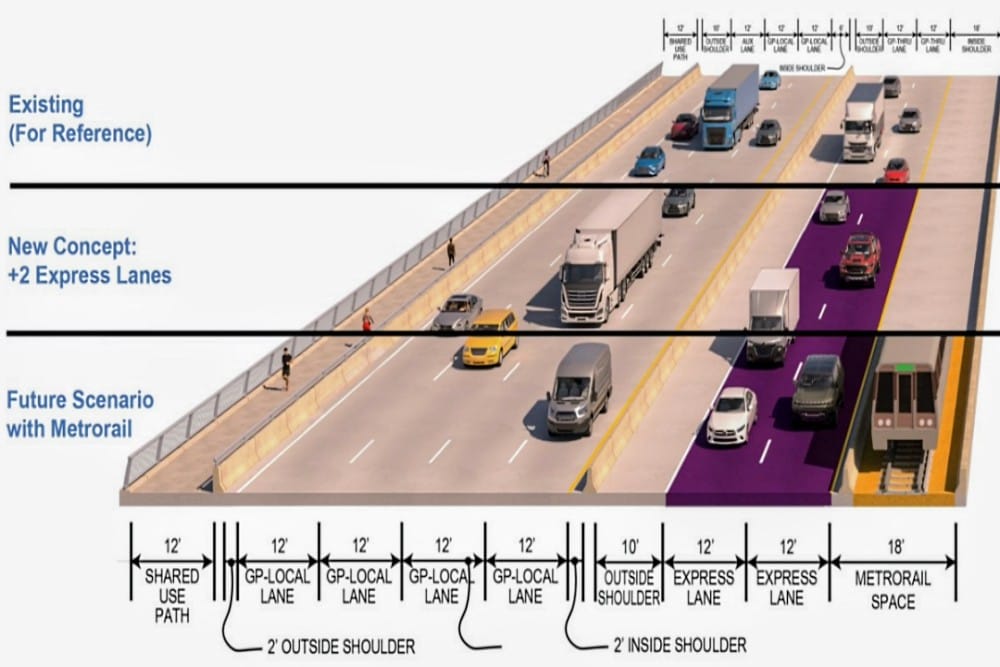
Last month, Virginia Department of Transportation officials unveiled a new incarnation of the plan before the Fairfax County Board of Supervisors that would reserve space in the center of the bridge for future transit use.
Though there is no funding available right now for running rail lines between Maryland and Virginia over the Wilson Bridge, the new design would prepare the span for that eventuality, Donohue said.

“Virginia supports the region’s plan to add Metrorail across this bridge,” Donohue told the TPB panel. “You have a ready, willing and able partner.”
The latest proposal calls for four general-purpose lanes and two Express Lanes in each direction on the bridge. To accommodate future rail service, the design narrows breakdown lanes to just a few feet in width, rendering them unusable for vehicles in trouble.
To address that issue, the new VDOT plan calls for tow trucks to be stationed on both sides of the bridge continuously, so they can remove vehicles involved in crashes or facing mechanical difficulties.
At the Oct. 21 meeting, Kanti Srikanth, deputy director of the Metropolitan Washington Council of Governments and TPB’s staff director, laid out what would need to happen for the proposal to get to the TPB next March.
First, the board would need to authorize an air-quality analysis looking at the new plan. Srikanth said he believed that could be completed in just a few months.
“There’s a lot of work that’s already been done,” he said.
If completed by early February, that report would be sent out for a mandatory 30-day public-review period, allowing a final TPB vote on the project to take place in March.
Maryland officials at the Oct. 21 meeting were cautious but said they were willing to listen.
Joe McAndrew, Maryland’s assistant secretary of transportation for project development and delivery, thanked Donohue for the “thoughtful engagement.”
“We appreciate the Spanberger Administration’s revised approach,” McAndrew said.
But he appeared to still harbor some skepticism of the changes as detailed by VDOT.
“More progress will need to be made,” McAndrew said. “There’s much more work that needs to be done.”
Eric Olson, a member of the Prince George’s County Council, was of the same mind.
“Public engagement is going to be essential and needed, front and center, with our communities in Prince George’s,” he said.
Any plan needs to fully address impacts of potential spillover on local roads, Olson said. It is a concern that also has been raised by officials in Alexandria and Fairfax County.
State Sen. Jennifer Boysko (D-38), who helped scuttle the last incarnation of the proposal, was more upbeat now. The revision “gives me some hope,” she said.
Alexandria City Council member Canek Aguirre said he was similarly not yet sold on the proposal, but more willing than before to consider it.
“The direction and vision has really changed,” Aguirre said. “That relationship needs to continue to build.”
Virginia transportation officials said there will be a number of upcoming public information meetings on both sides of the Potomac before the end of the year, but did not yet have set dates. No decision has been made on whether the Express Lanes would be funded publicly or as part of a public-private partnership.
While Donohue came armed largely with carrots for regional leaders, he also pulled out a stick in pushing them to act quickly.
Gov. Abigail Spanberger’s term only runs through January 2030, he told regional leaders, meaning a plan needs to be approved and ready to go, or a potential successor could reverse course.
“I want to make sure I’m delivering on these commitments,” Donohue said.
