

Fairfax County Public Schools is facing a potential $200 million fiscal year 2028 budget gap that needs to be filled through additional revenue or cost reductions, based on newly released projections.
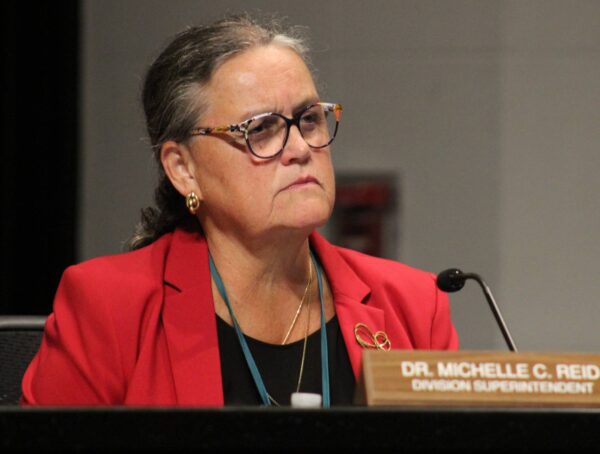
While the cuts currently under consideration would not directly impact classrooms, they would ripple through the 172,000-student district, Superintendent Michelle Reid said.
It is “not sustainable” to do the work necessary to run a school division “with fewer and fewer resources,” Reid said at a School Board budget work session on Tuesday (Nov. 10).
At the meeting, staff sketched out what they described as a very preliminary fiscal forecast that would leave a $197.8 million gap between revenues and expenditures in the budget that would run from July 2027 through June 2028.
That would represent less than half of 1% of the current fiscal year 2027 school budget of $4.2 billion, but as previously warned, addressing the deficit will require a mix of new revenue and cuts, FCPS Chief Financial Officer Leigh Burden told the school board.
Burden said the school system would do “everything possible” while constructing a new budget to ensure “students and school-based staff are not harmed by reductions.” But she acknowledged there were no guarantees.
“This may not be possible,” Burden said.
As has been typical in the past, FCPS’s preliminary financial forecast anticipates no increase in year-over-year school funding from the Fairfax County Board of Supervisors, which is the primary funder of school operations.
Supervisors almost assuredly will increase their annual contribution, but any additional funding likely won’t be enough to cover a $200 million shortfall.
The county board allocated over $3 billion to FCPS for FY 2027 — about half of the county government’s overall budget adopted in May and a $94.6 million increase from the previous year. However, the transfer amount still fell about $43 million short of what Reid had said FCPS needed, and the county controversially eliminated its funding for some school-related services, including high school crossing guards and Middle School After School programs.
Crossing guard funding was ultimately restored in September after reported crashes and public criticism, while the county is still expecting FCPS to implement fees to help recover the costs of the traditionally free middle school extracurricular programs.
How Reid and School Board members tackle the FY 2028 budget will once again largely depend on how much funding the county is willing to provide.
“It’s going to depend on what the county revenue is estimated to be, and we don’t know that yet,” Burden said.
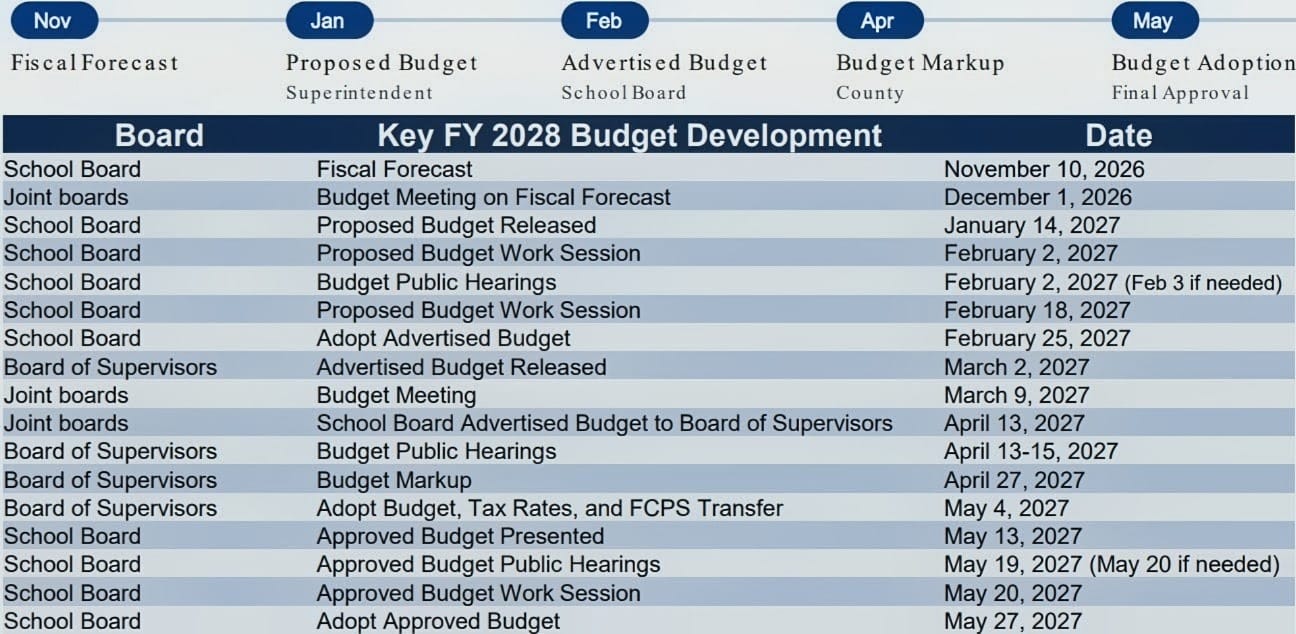
School board members will sit down with the Board of Supervisors in early December to discuss budget issues, but it won’t be until early March that County Executive Bryan Hill releases his advertised budget with a proposed dollar amount for the transfer to schools.
Lower enrollment to impact budget discussions
The projected budget gap comes as county classrooms have seen fewer students than projected.
About 172,000 students were reported attending FCPS at the start of the year, down about 4,000 students from a year before and also from what had been projected. Just two years ago, the school system’s enrollment had topped 180,000.
FCPS leaders already appear to be gearing up for potentially aggressive questioning from supervisors on the need for more funds in an era of declining enrollment.
“Questions will come up. I want to be prepared,” said at-large School Board member Ilryong Moon.
Right now, however, school leaders are working with limited enrollment information. Burden’s fiscal forecast incorporates a cost savings of $45.8 million owing to further anticipated enrollment declines, but she acknowledged it was just a guesstimate.
“That number will change, 100%,” she said.
While FCPS has been able to reduce classroom staffing due to the lower enrollment, those savings are being offset by inflationary pressures, including the cost of fuel.
School vehicles travel a cumulative 93,000 miles per day, and $4 million in contingency funds added to the FY 2027 budget to cover the impact of higher fuel costs will not be enough, Reid said.
“The increases on the fuel costs have really had an impact,” she said. “We’re going to be blowing through the fuel contingency.”
Moving more in the direction of electric buses is a goal, but not a short-term strategy, Reid told School Board members.
“If we move toward EV buses, the buses themselves are significantly more expensive … [and] the infrastructure to support those is an ongoing challenge,” the superintendent said.
Union contracts, energy costs adding up
Fiscal year 2028 will mark the third year since the start of FCPS’ collective bargaining agreements with employees.
The agreement that the school system negotiated in 2024 with the Fairfax Education Unions calls for a 3% cost-of-living increase (COLA), plus an additional longevity or “step” increase for covered workers.
Under budget projections, the COLA would cost $95 million and the step increase $82.7 million more in FY 2028. Higher costs for benefits like retirement and health care not passed on to employees would add another $42.8 million.
The labor contracts are contingent on FCPS having the funds to fulfill them. Without the money, the raises could be scaled back or other revisions made, as was the case for the FY 2025 budget, leaving the education unions with little recourse since state law prohibits them from striking.
Reid told the school board that they have her “commitment to successfully make good” on the agreements if at all possible.
“I know this board is committed to collective bargaining,” she said. “That’s a first priority.”
Another budget pressure looming on the horizon is energy costs, with Dominion Energy having told FCPS to expect a nearly 25% increase in electricity costs for the coming year. In dollar terms, the increase would be just over $12 million.
“This is a huge number — staggering,” Mason District Representative Ricardy Anderson said.
To reduce the funding gap, central office department heads have been instructed to each propose savings totaling 5% of their budget. The lists have been submitted but not yet reviewed.
Providence District School Board member Karl Frisch said Reid and her staff should take care in evaluating the potential cuts.
“A 5% cut or a 10% cut will have a different impact depending on the program,” he said.
Burden said department heads were told they “should not offer up items to be reduced that are either school-based, staff or materials.”
“That’s something we’re going to scrutinize,” she added. “… If it is an item that is going to heavily impact the schools, that is something we likely would deny and ask them to go back to the starting point and try again.”
At the Nov. 10 work session, School Board Chair Robyn Lady, who represents the Dranesville District, echoed Reid’s comments that budget cuts will have an impact even if they are focused primarily on non-classroom positions.
“When we cut personnel, we hurt the product,” she said. “The public and our funders need to understand.”
