

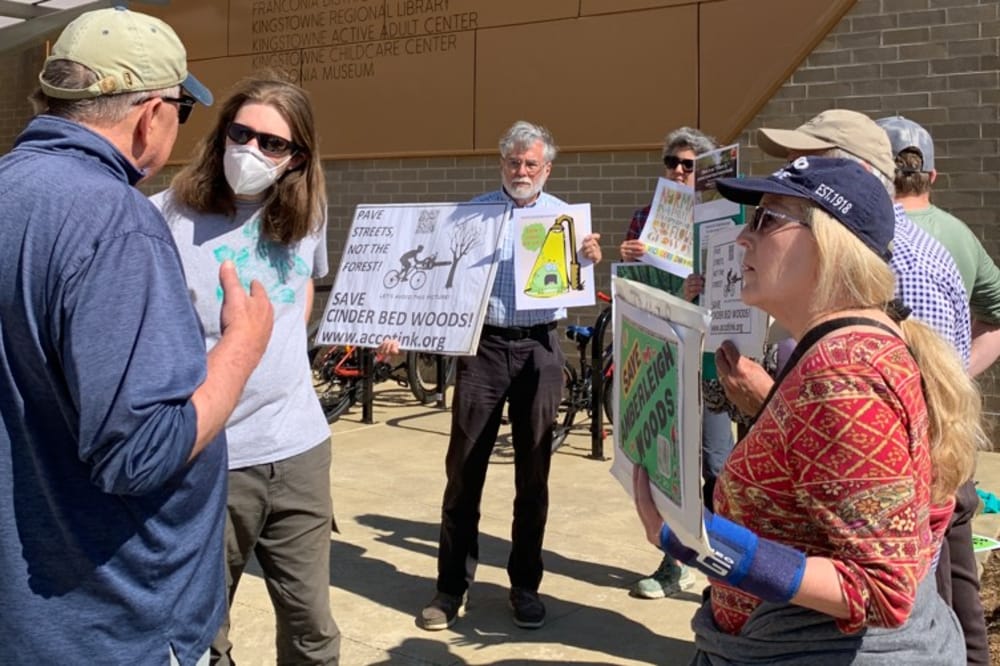
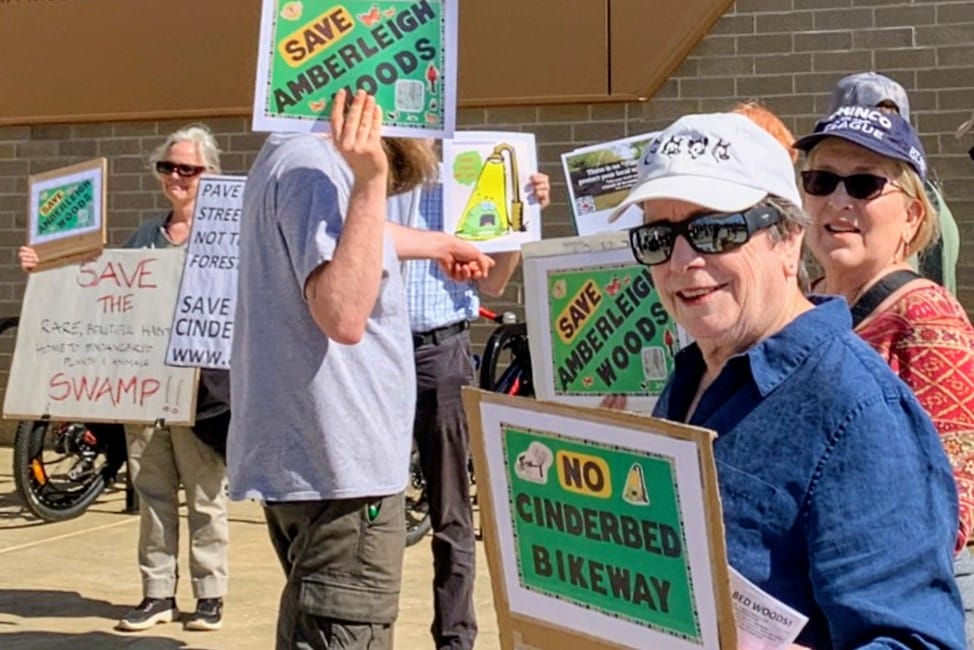
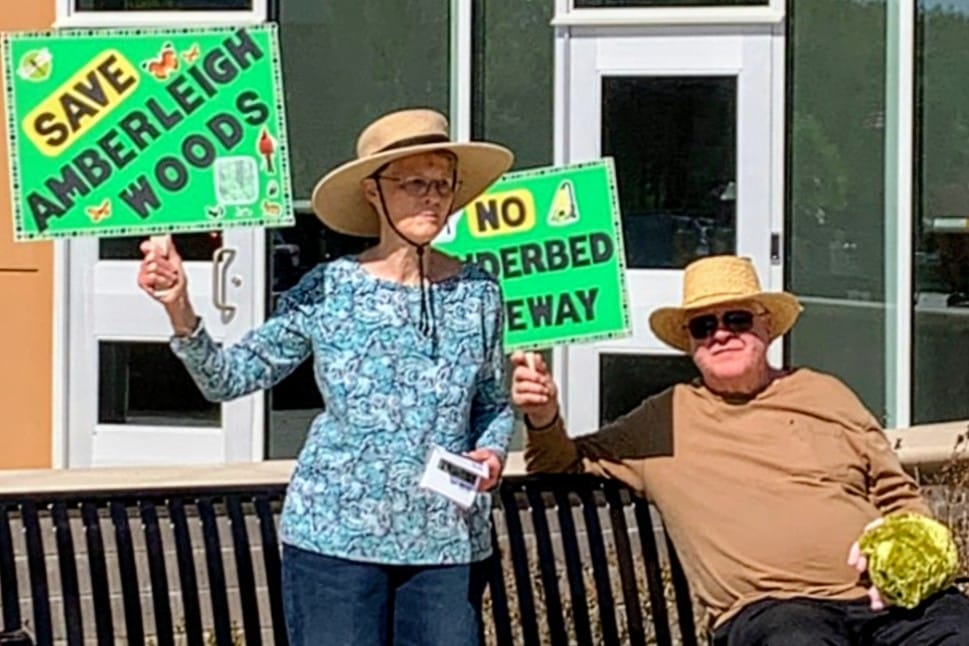
Opponents of the proposed Cinder Bed Road Bikeway found a captive audience at the April 11 dedication of the Franconia Governmental Center.
“The lines of citizens waiting outside to get in gave us protesters the opportunity to open discussions about the Bikeway,” said Philip Latasa, who helped organize the public information rally at the new government facility at 7130 Silver Lake Blvd.
Latasa was a founder of and remains active with Friends of Accotink Creek, one of the organizations opposing the county government’s $18 million plan for the 2-mile-long shared-use path connecting Newington Road and the Franconia-Springfield Metro Station.
Opponents cite environmental concerns and the availability of alternatives for pedestrians and bicyclists in the vicinity.
Dedication ceremonies for the new Franconia Governmental Center drew hundreds of community members on April 11, providing bikeway critics an opportunity to engage with the public.
“The ‘Determined Dozen’ protesters raised our signs and passed out flyers to the hundreds of Franconia District constituents entering the Governmental Center for the ribbon-cutting,” Latasa told FFXnow.
“Most constituents are still unaware that Fairfax County plans to use their tax dollars to build the Bikeway in their names,” he said.

Groups that have joined Friends of Accotink Creek in raising red flags about the proposal’s environmental impacts include Nature Forward, the Northern Virginia Bird Alliance, Sierra Club Great Falls Group, Virginia Native Plant Society and Friends of Little Hunting Creek.
But other advocacy groups support the plan, including those representing local bicyclists.
Last year, the Washington Area Bicyclist Association told FFXnow the Cinder Bed Road Bikeway would be a marked improvement over current conditions:
“The existing bike infrastructure in the area is suboptimal at best. The bike lanes on Beulah and Telegraph are narrow and unprotected, placing riders very close to six lanes of fast-moving car traffic. Low-stress (and less hilly) trail access to the Franconia-Springfield Metro opens up last-mile connections for people in the area who aren’t comfortable riding on high-volume, high-speed state roads.”
The Fairfax Alliance for Better Bicycling, which also supports the project, last year said there were ways to mitigate impacts to the ecological conditions along the route:
“Negative impacts — like the routine flooding, erosion and invasive species the area experiences today — can be mitigated and corrected through careful planning and education.”
To make the project a reality under its proposed routing, the county will need to acquire right-of-way on land owned by the Amberleigh Homeowners Association.
If the association and county can’t come to mutually agreeable terms, the Fairfax County Board of Supervisors could exercise its eminent-domain powers to obtain the land. Such an effort could spark a court fight.
At a forum last year, Fairfax County Department of Transportation officials set a target date of 2028 for start of construction on the project.
