

Most bus riders along portions of Route 7 seem skeptical of placing future transit stops in the center of the busy roadway, but local leaders at least want the option considered before being discarded.
A recent survey of riders along the portion of the bus rapid transit (BRT) line proposed to connect Tysons to Alexandria found 60% preferred retaining curbside stops. The remainder were split between moving to center-of-the-road stops or having no opinion.
The survey was conducted by the Northern Virginia Transportation Commission (NVTC). For Vikram Sinha, senior project manager on NVTC’s Envision Route 7 project, the results were not a total surprise.
Using a roadway’s median area for transit stops “presents a bit of an obstacle for a pedestrian,” Sinha said at the July 2 NVTC meeting.
“Their concern was crossing that many lanes of travel, waiting for the walk signal so they are not taking an unnecessary risk,” he said.
Sinha added that “the culture of the corridor” is likely also a factor in the survey’s results.
“They’re familiar with [curbside stops], they like it,” he said.
That may be the public’s preference, but some local elected officials said it might not be the best option.
“There’s always a tradeoff,” Arlington County Board member Takis Karantonis said at the NVTC meeting. “If service is the number-one parameter … center-running is probably the better choice.”
Karantonis said median-based stations already are the norm on Metroway, a BRT line connecting Arlington and Alexandria. Mount Vernon District Supervisor Dan Storck added that they will be the norm on The One, Fairfax County’s future BRT line in the Richmond Highway (Route 1) corridor.
Survey results shouldn’t be used to rule out a median-based system, Storck said, noting that riders in the Route 7 corridor may be “just comfortable with what they have now, rather than something different or unusual.”
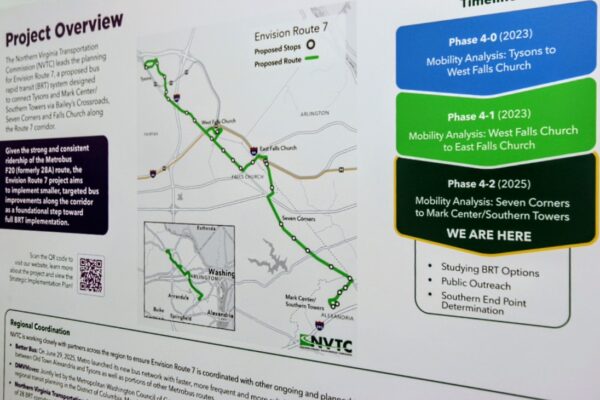
The future Route 7 BRT line would travel 14 miles and involve four jurisdictions — Fairfax County, Arlington, Alexandria and Falls Church.
Decision-making on the future transit line would involve those localities, the Virginia Department of Transportation (VDOT), Virginia Department of Rail and Public Transportation and Washington Metropolitan Area Transit Authority.
“Some stakeholders have more weight” than others, Sinha said, putting VDOT at the top of the list because it owns the roadway throughout most of the route.
The primary bus route throughout the corridor is Metro’s F20, which has the highest ridership of any single bus line in Virginia. NVTC’s survey also found that 88% of respondents want to prioritize transit stops near the entrances of key storefronts.
Planning for a future Route 7 BRT line has been ongoing for years, and currently is in the final stage of data analysis and public outreach before more intense planning takes place. Recent input sessions have taken place in Culmore and Alexandria.
Before getting to a long-term plan for a coordinated network, various incremental improvements, such as traffic signal tweaks, are taking place throughout the Route 7 corridor. NVTC officials aim to begin considering funding options for a more comprehensive upgrade to the corridor by 2028.
VDOT has also begun planning on projects to widen the Tysons portion of Route 7 in order to accommodate the BRT service without reducing the number of regular travel lanes.
Noting the lengthy gestation period for transit improvements in the corridor, Falls Church City Council member David Snyder said the time has come to push forward.
“I hope that this fall we can move from planning into implementation,” Snyder said.
