

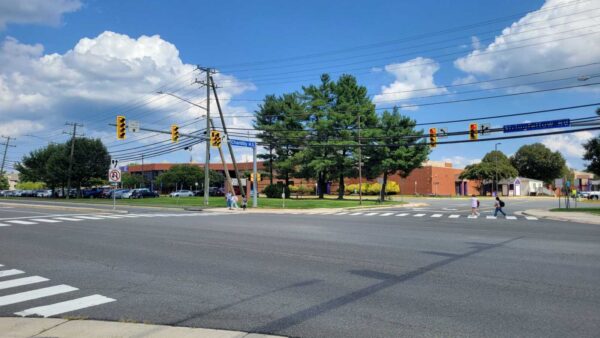
As many Fairfax County high school students drive or walk to school this fall, they’re arriving at a building without a dedicated crossing guard — and, only a few days into the new academic year, several elected officials say that absence is already creating problems.
This past spring, the Fairfax County Board of Supervisors eliminated funding for crossing guards at all public high schools, a move that was expected to save the county about $1.89 million in police staffing costs.
The move affected 10 schools this year: Annandale, Centreville, Chantilly, Edison, McLean, Oakton, South County, South Lakes, West Potomac and West Springfield. Secondary schools still have crossing guards, though vacancies may be filled by contractors in place of police.
Citing concerns that the removal of the crossing guards at high schools could create safety issues, especially as students and community members get accustomed to new traffic patterns early in the school year, the Board of Supervisors directed County Executive Bryan Hill yesterday (Tuesday) to work with Fairfax County Public Schools and the Fairfax County Police Department to identify if and how those issues can be mitigated.
“I remain very concerned with the Board of Supervisors’ April decision to eliminate high school crossing guards at all of our high schools,” Springfield District Supervisor Pat Herrity said in his request for information. “The Board has not received the information it requested on how bus and carpool traffic would be handled and the related impacts.”
The motion, which was backed by Franconia District Supervisor Rodney Lusk and Hunter Mill District’s Walter Alcorn, also requests that the county consider earmarking $400,000 as a placeholder to fund potential changes in its fiscal year 2026 carryover review process.
In addition to eliminating the 13 full-time crossing guard positions last spring, the board also decided to hire contractors to fill vacant elementary and middle school crossing guard positions instead of relying on uniformed police officers. The FCPD had said the move would free up officers, particularly during rush hour, to handle other calls.
Herrity also requested information to evaluate that program, including exactly how many positions formerly filled by police officers have been replaced by contractors.
While other supervisors agreed with the overall request for information, some cautioned against jumping to conclusions just two days into the school year.
“Certainly, you can submit [a] carryover review item, but we went through a lot of reductions, a lot of hard ones, and we’re probably going to have more coming forward in future budgets,” Board Chairman Jeff McKay said. “And if we draw conclusions on those reductions because of one day’s activities, it’s going to make tough decisions that much tougher as we move forward.”
McKay said the decision to eliminate the high school guards was data-driven, in line with other Northern Virginia jurisdictions, and recommended by the FCPD.
Fairfax County leaders first raised the possibility of privatizing the crossing guard program in 2024 after the FCPD reported struggling to fill those positions. The department had already dropped its coverage of schools in Herndon and Fort Belvoir, though objections from Vienna officials and residents resulted in crossing guards remaining there.
Hill’s office proposed removing crossing guards from high schools last year as part of the fiscal year 2026 budget, but the Board of Supervisors ultimately allocated enough funding to pay for 16 crossing guards for another year.
McKay added that education and infrastructure improvements on problematic streets could ultimately provide a more lasting, long-term solution.
Providence District Supervisor Dalia Palchik asked for “a friendly amendment for the police and the schools and [Fairfax County Department of Transportation] to come back jointly with a recommendation … having especially looked at areas of concern.”
“We do continue to use our limited resources in the best way possible, so I understand and appreciate the reason for this,” Palchik said. “I, like everybody else here, want to make sure that our kids are safe walking to school.”
The supervisors should receive the information by Sept. 15, when the board is scheduled to take action on the carryover package, which would reallocate money for FY 2027 that was budgeted but not spent in FY 2026. The county’s fiscal year begins annually on July 1 and ends the following June 30.
“Critical” concerns should be brought to the board before Sept. 15, McKay said.
‘Confusion’ reported at South Lakes High
While the county supervisors noted that Sept. 15 is a quick turnaround for staff, it may not be quick enough for some community members.
One South Lakes High School parent told FFXnow she’s concerned with traffic conditions at the Reston school, especially with congestion near the kiss-and-ride.
The parent says traffic around the school has “always seemed like a mess,” even with police around to assist. However, in lieu of a traffic light on South Lakes Drive, she sees having crossing guards to help direct traffic as “the minimum for some kind of safety for pedestrians and drivers.”
When dropping her son off for his first day of school on Monday (Aug. 24), she observed widespread confusion among drivers about when to yield and when it was their turn to enter or exit the kiss-and-ride lot behind the school.
“That’s the one where I’m seeing the most congestion, the most dangerous kind of confusion, ” the parent said of the kiss-and-ride access point off South Lakes Drive, “with turning cars, cars coming down one way, cars turning from the other way, and nobody knowing who to yield to whom or when, and students trying to walk from the back of the school building to the front, while all of that’s happening.”
Hunter Mill District School Board Representative Melanie Meren, who clashed with McKay earlier this year over the crossing guard changes and other budget cuts affecting FCPS, told FFXnow she’s very concerned about the situation at South Lakes and other high schools.
Meren said she’s observed the traffic situation during arrivals and dismissals three times, and all three times, “what I saw was danger.”
Students were “tentatively trying to figure out how to cross the road or very brazenly stepping in front and trying to go,” Meren said. “I saw traffic backed up. I heard cars honking at one another. I saw one argument of, seemingly, two parents about … moving faster through traffic. I saw cyclists weaving through traffic.”
“It really did impact the whole neighborhood,” Meren added. “The most harrowing thing I saw was at dismissal. You know, the students are leaving, and I saw a student driver come to a sudden stop right in front of other students in the crosswalk.”
For Meren, the conversation about the potential carryover funding is “not exactly too little, too late, because it will never be late to restore the crossing guards and do the right thing,” but she’s frustrated by years of cuts to the crossing guard program.
“I’m not aware of what data were used to make this decision,” Meren said. “So, I would personally love to see that data. Nor am I aware of any data around the driving habits and traffic habits pertaining to the start of the school year.”
Meren said people have been asking her what they can do, and she hopes they make their voices heard.
“I’m encouraging people to take a moment to capture what they’re seeing and share it with their elected officials, share with their communities,” she said. “Just start sharing what they’re seeing because people, once you see it, you will see that this is completely unacceptable.”

