

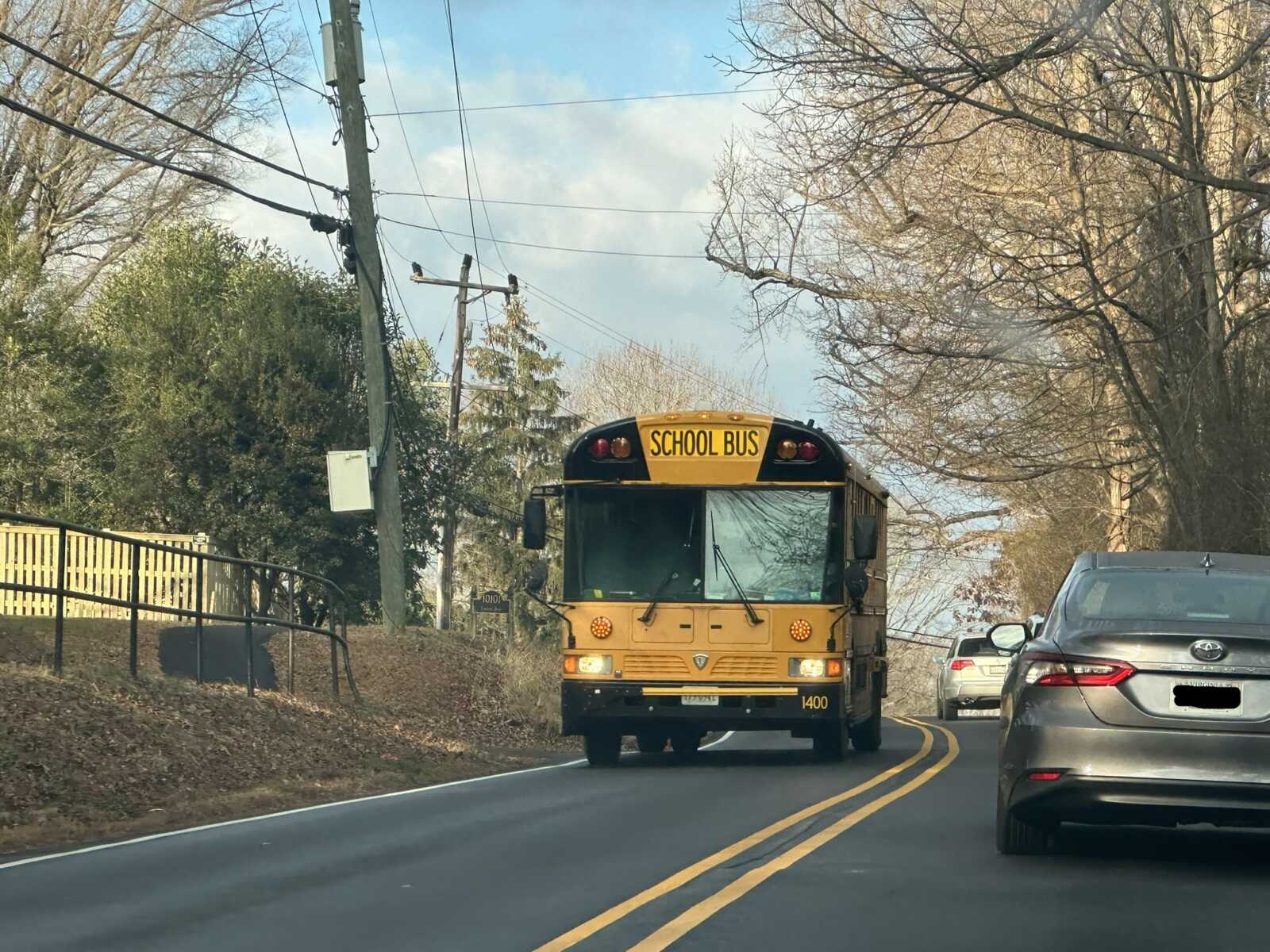

After approving new school attendance zone boundaries in January, the Fairfax County School Board opted to provide bus transportation to affected high school students, but not their elementary and middle school counterparts.
The school board voted 7-4 last Thursday (Feb. 26) to approve bus transportation for Fairfax County Public Schools high school students who have been drawn into new school boundaries but are eligible to remain in their current school.
School board members Ryan McElveen, Mateo Dunne, Ilryong Moon and Ricardy Anderson opposed the motion, which expanded on a recommendation from Superintendent Michelle Reid that would’ve only provided transportation to high school seniors but still left out redistricted elementary and middle school students.
Under the approved boundary changes, students in select grade levels have the choice to remain at their current school instead of switching to their newly assigned one. But Reid said there was no commitment to covering all transportation costs in the redistricting approval and that FCPS could face funding gaps in the upcoming budget.
According to the superintendent’s presentation, the cost of transportation for students who stay at their original schools would be $1.35 million. The cost for all school levels was estimated to be $3.1 million.
School boundary changes will impact about 1,700 FCPS students, including 911 who have the choice to remain in their current schools. The superintendent’s presentation noted a survey of the 911 impacted families found 81% need bus transportation.
Several school board members argued against leaving out elementary and middle school students of the bus plan.
Mason District Representative Anderson said only families who can provide their own transportation have a real choice when it comes to their student remaining in their current school under the new boundaries.
“I see this is akin a little bit to giving food to somebody who’s hungry, but yet we’re putting it in a tree 20 feet high, and unless they’re able to levitate themselves [or] they have a ladder, they cannot access this,” Anderson said.
Hunter Mill District Representative Melanie Meren said not providing buses for all eligible students conflicts with the school board’s July 2025 vote to give select current students a choice of schools to attend when phasing in boundary adjustments.
Meren said the school board did not receive enough options for reductions that could be made to FCPS’ budget so it can afford the $3.1 million needed for bussing all grade levels.
“This is just too much, and it’s unneeded stress on our families,” Meren said. “… We have the money — at least half the money — in the school board reserve.”
At-large representative Ilryong Moon suggested looking at savings from a projected decline of 5,000 enrollments next school year to bus the affected students.
“This is just [a] much smaller group of students who deserve the right to be educated at their schools,” Moon said. “They are exercising their right to stay there, but we are denying them.”
Dunne, who represents the Mount Vernon District, questioned why transportation funding wasn’t included in the redistricting proposal that the school board voted on in January.
“This is inextricably intertwined with school boundaries,” Dunne said. “I don’t understand how this could be separated out. It just reaffirms my decision to vote no on Jan. 22 because, as I described, I was not going to vote on an incomplete package.”
Faith Mekonen, a non-voting student representative from South County High School, spoke out against limiting the plan to high school students.
“Being able to stay in the pyramid since I’ve started … has helped me immensely,” Mekonen said. “I would be a much different person if I was redirected from South County Middle School to Hayfield or Lake Braddock [Secondary School] instead of South County. The opportunities that are unique to my school would be closed to me, as will the community I grew up around.”
Other members pointed to budget constraints that FCPS is facing even without the increased transportation costs.
“I agree with the comments that have been made about the strive for equity and the strive to plug gaps in equity and the strive to address that, but I also have to consider the fiscal reality in which we find ourselves,” at-large representative Kyle McDaniel said.
Vice Chair Robyn Lady, who represents the Dranesville District, said the limited funding should prioritize high school students, who are trying to meet graduation requirements and make post-graduation plans.
“We know that the bonds formed with teachers and peers are precious, and we don’t take the impact of these boundary changes lightly,” Lady said. “However, we are currently facing a $43 million budget gap between our needs and the projected funding from the state and our Board of Supervisors.”
The school board’s approval allows FCPS to use end-of-year funds if its transportation funds can’t cover the cost of bussing the eligible students.
“What we’re trying to do is route more creatively, and it’s still going to cost money,” Reid said. “We just are hopeful we can do it within the budget, as long as we have a certainty of the possibility of being able to backfill those funds.”
The school boundary changes will be implemented in the 2026-2027 school year, which is scheduled to begin on Aug. 24.
