

Fairfax County officials have started making preparations for what they anticipate will be another challenging budget season next spring.
“The low-hanging fruit is gone,” Philip Hagen, director of the county’s Department of Management and Budget, told the Board of Supervisors at its Budget Policy Committee meeting on Sept. 1.
Though largely focused on dispensing with the government’s carryover funds from fiscal year 2026, which ended June 30, the meeting also provided a glimpse ahead to next year’s budget environment, which appears likely to continue the recent trend of cuts.
Over the past couple of years, the county has trimmed funding for services from community centers and Fairfax Connector buses to middle school after school programs and school crossing guards, which have been restored at some sites for now after a community outcry.
County leaders will receive an updated financial forecast on Dec. 1, with County Executive Bryan Hill expected to deliver his draft fiscal 2028 budget to supervisors on March 2.
At the Sept. 1 meeting, Board Chair Jeff McKay was not optimistic that economic headwinds facing the region over the past year will soon dissipate.
“We’re in economically trying times,” he said.
Since President Donald Trump took office in January 2026, the D.C. region has been grappling with cuts to the federal workforce and their ripple effects across the area. Local governments are also facing reduced federal funding across a variety of service areas.
“We are trying our best to mitigate effects on our residents,” McKay said.
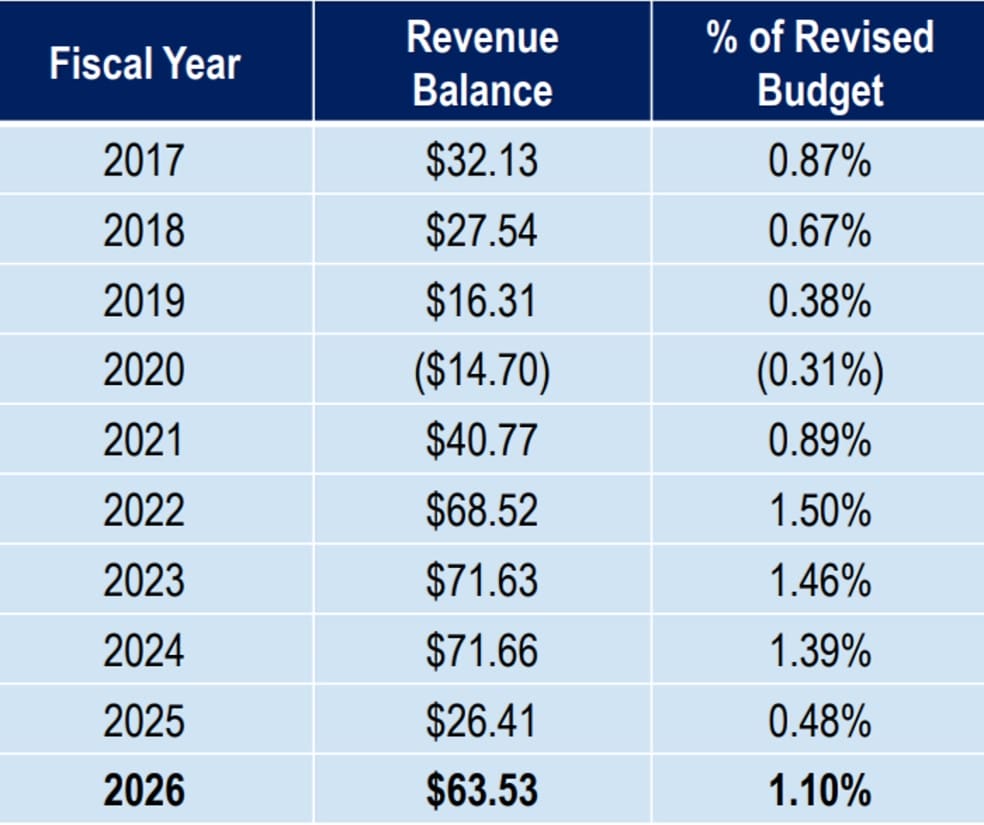
The county government ended FY 2026 on June 30 with a surplus of $65.53 million, or about 1.1% of the General Fund revenues.
Virginia localities are not legally allowed to run deficits, and must plan to end each fiscal year with small surpluses that can be carried over into the next one.
Since FY 2017, the annual fund balance has ranged from $16.3 million, or 0.38% of the budget, to $71.7 million (1.5%), according to data provided by county officials.
The outlier was fiscal year 2020, when the effects of Covid led the county to run a deficit of $14.7 million, or 0.3% of the budget. That funding was in part compensated by future federal pandemic relief and recovery funds.
Overall, the county government received just over $221 million in federal American Rescue Plan Act funding during the Covid era, Hagen said at the meeting. The money has been spent on projects ranging from public health programs and financial assistance for local businesses to eviction prevention and affordable housing developments.
About $1.5 million of that funding remains. It was allocated last year and will be spent by Dec. 31 to meet federal deadlines.
There were bright spots in Hagen’s fiscal year 2026 close-out report:
- Revenue from the newly imposed meals tax is running “slightly” ahead of projections, and the county has benefited from additional personal property taxes, owing largely to data centers
- An uptick in interest rates provided higher-than-expected interest income on the county’s investment portfolio
Rising interest rates are a double-edged sword for localities, which gain more on their investments but have to pay more when issuing new debt for capital projects.
