

The Metropolitan Washington Airports Authority (MWAA) anticipates its aviation-related revenues from Dulles International and Reagan National airports topping the $1 billion mark next year.
But during a Nov. 18 discussion of the authority’s fiscal year 2027 budget, economic and geopolitical warning signs were front and center.
“We’re in a very dynamic time. There’s a lot going on,” MWAA CEO Jack Potter said during a meeting of the authority’s finance committee.
In developing the calendar-year 2027 budget, “we’ve had to work very closely with the airlines,” he said.
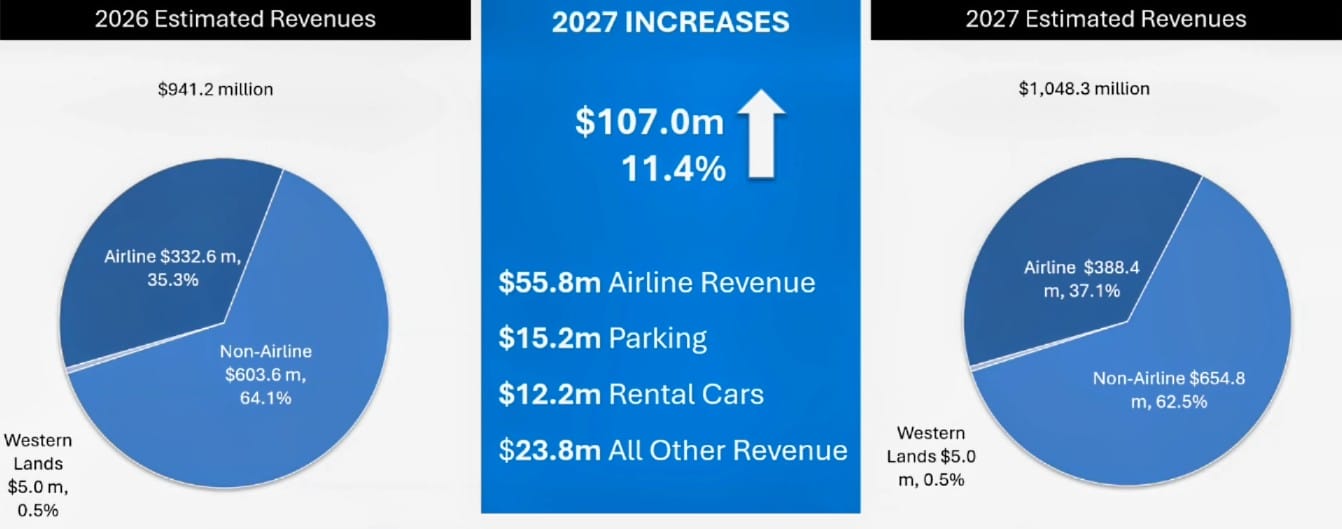
Later that afternoon, the MWAA board of directors voted unanimously to adopt the proposed budget, which anticipates aviation-related revenues totaling $1.05 billion for the coming year, up 11.4% from 2026.
Aviation-related expenses are budgeted at $976.8 million, up 9.8% from the current budget, including a 10.9% increase to $31.5 million in debt-service costs.
Direct revenue from airlines is expected to rise $56 million to $388 million, with non-airline revenue from parking, rental-car concessions and retail leases also expected to rise.
“This is the first time we’ve passed the billion-dollar mark,” said Andrew Rountree, the authority’s senior vice president for finance.
Both revenue and expenses could be impacted by a variety of factors, Potter told board members, including inflation, the labor market, retirement costs and the need to invest in cybersecurity protections.
Also rising is the lease payment from the authority to the federal government. Congress recently increased it from $7 million to $15 million annually.
“We should send them a thank-you note,” deadpanned Kate Hanley, a longtime Fairfax County leader who was attending her final meeting as an MWAA board member representing Virginia.
In addition to higher costs for operations, “you’re going to see a major increase in the [costs of the] capital program,” Potter said.
Capital spending has been driven recently by the construction of the now-open Concourse E at Dulles International Airport, and will continue to grow as the authority works on a redevelopment plan announced earlier this year.
All told, long-term capital spending is now estimated at $26.6 billion — $23.59 billion for Dulles and $3.01 billion for the National Airport in Arlington. The coming year’s capital spending is budgeted at $790 million at Dulles and $247 million at National.
Like any budget, figures for operating revenues and expenditures are informed estimates, but are not guaranteed to play out as expected. If revenues run below projections, MWAA has the ability to go back to the airlines and impose higher costs.
“We hope it doesn’t come to that,” said Potter, who plans to retire early next year from the post he has held since 2011. “We haven’t had to do that for a long time, [but] we have that ability.”
At the finance committee meeting, Potter noted operational variables on a number of fronts.
“There’s a potential for a lot of snow this coming season. Hopefully there’s progress on two wars,” he said, referring to the ongoing conflicts between the U.S. and Iran, and Russia and Ukraine. “We’ll see how it goes.”
Board members also expressed concern about a traveling public that might choose methods other than aviation, given the recent nationwide ground stop triggered by Federal Aviation Administration communication issues.
One board member said she hopes the budget includes “a little bit of wiggle room for the unknown.”
The budget anticipates a cost-per-enplanement of $10.96 at National and $15.80 at Dulles in 2027, up from this year’s rates of $10.41 at National and $12.77 at Dulles.
The cost per enplanement takes the total fees charged to airlines by MWAA and divides them by the total passenger count. The result is used to compare operating costs at airports nationally.
“When you bring on a capital program, you’re going to see cost-per-enplanement rise,” Rountree said. “These are still pretty reasonable … in relation to other airports.”
While rising from the current year, the projected $15.80 cost per enplanement at Dulles remains below the pre-Covid rate of $17 in 2017, despite inflationary and capital cost pressures.
“That was something we needed to highlight,” said Mark Uncapher, who was reelected as chair of the MWAA board at the Nov. 18 meeting.
Dulles should benefit from increasing enplanements due to expanded service from United Airlines, which long has been the dominant carrier at the airport. That should make up for shortfalls from what MWAA expected in 2026, when international service has taken a hit from the economy and global unrest.
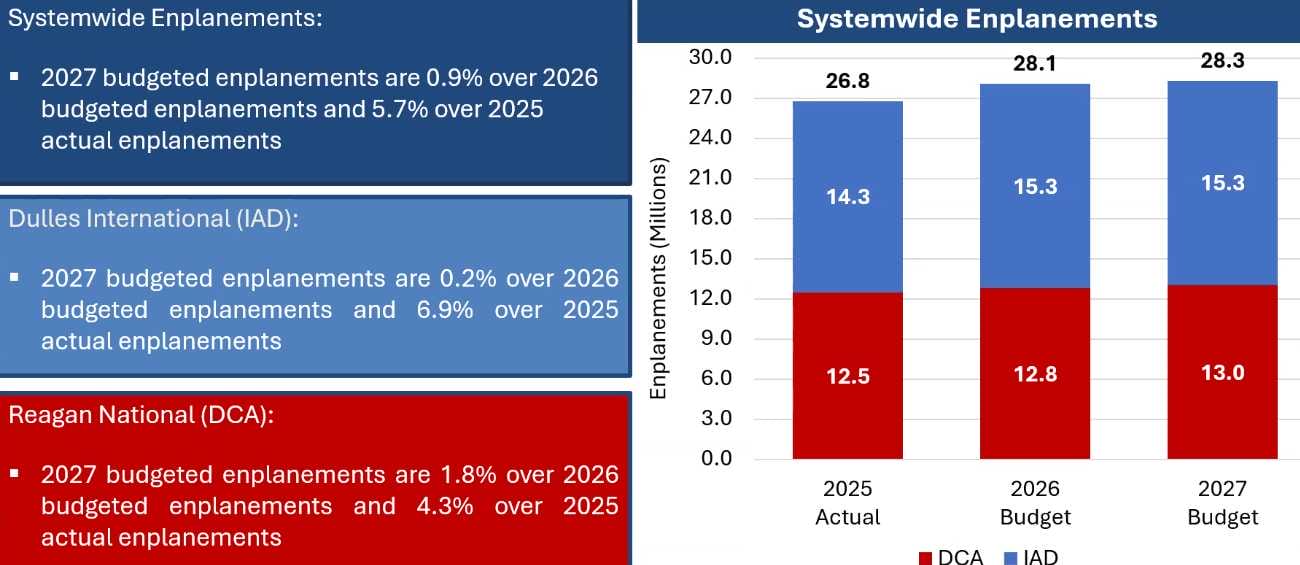
For 2027, the airports authority is estimating 15.3 million enplanements at Dulles, unchanged from 2026 estimates but up from the actual total in 2025. At National, the budget anticipates 13 million enplanements, up from 12.8 million estimated for 2026 and 12.5 million recorded in 2025.
The authority’s staff count for airport operations will rise by 54 people to 2,202 in the adopted budget.
MWAA is moving toward 2027 in relatively stable financial shape. For the year to date through October, revenue is running above the budgeted amount, led by a 4.9% increase in non-airline revenue.
Reagan National opened in 1941, with Dulles following in 1962. MWAA was created by Congress in 1987 to manage the two airports, which remain under federal ownership. Its operating lease runs through 2058.
In addition to the two airports, the authority operates the Dulles Toll Road under a contract with the Virginia Department of Transportation. Revenues and expenses for those operations are separate from the aviation budget.
