

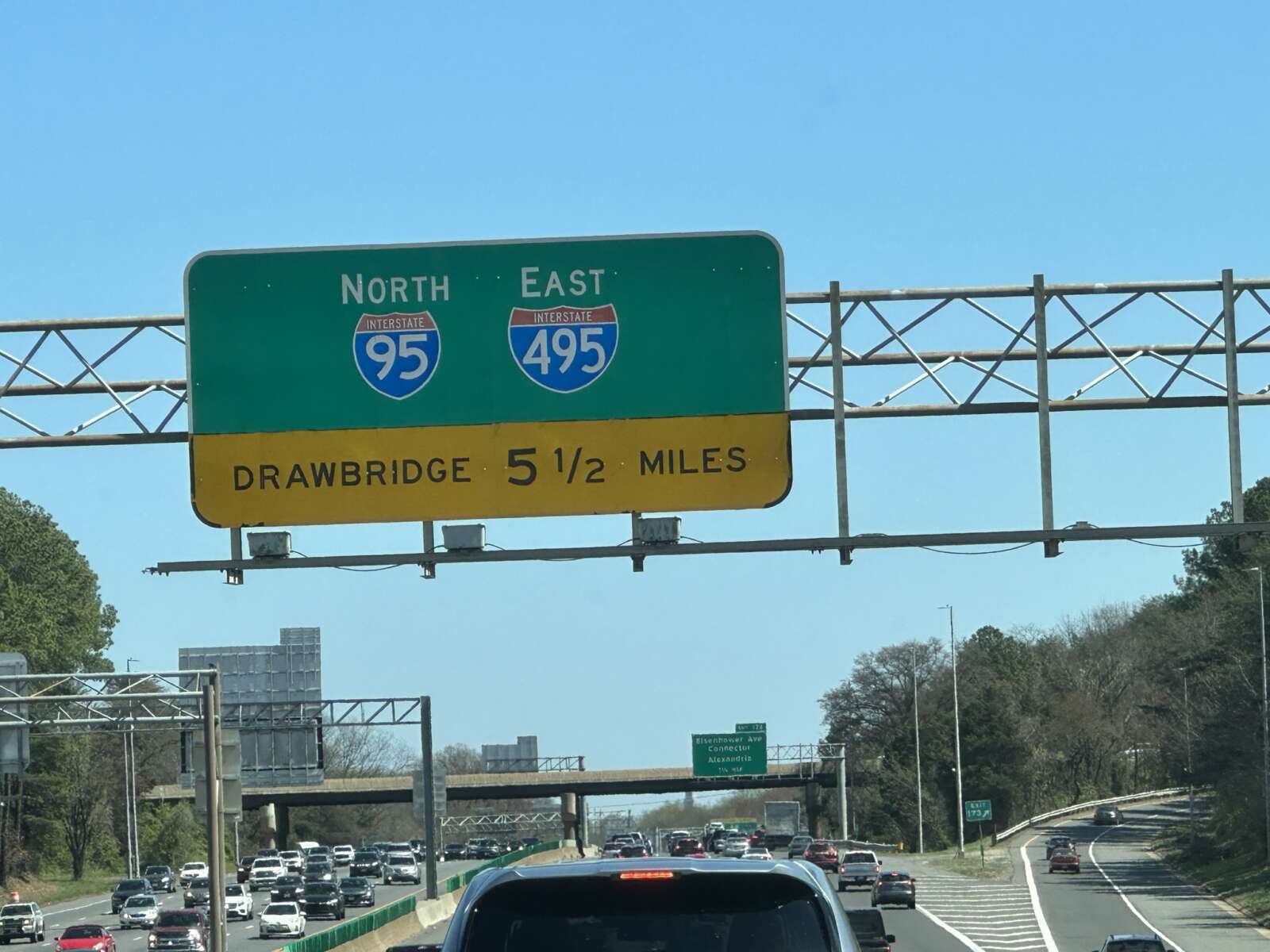
Any extension of the I-495 Express Lanes along the south side of the Capital Beltway should support additional transit options, Fairfax County leaders stressed in a recent letter to the Virginia Department of Transportation.
VDOT is currently studying options for completing the I-495 toll lanes by expanding them from the I-395/I-95 interchange in Springfield to Maryland Route 210 in Prince George’s County, an approximately 11-mile span that crosses the Woodrow Wilson Bridge in Alexandria.
At a meeting on Nov. 21, the Fairfax County Board of Supervisors approved a letter to Virginia Secretary of Transportation Sheppard Miller emphasizing the importance of accommodating transit in the project, which is intended to relieve congestion on what VDOT has said is the most heavily traveled segment of the Beltway.
“The County is appreciative that the Commonwealth is assessing solutions on the only interstate segment in Fairfax that does not have a transit benefit at this time,” the board’s letter said. “It is critical that additional travel choices are available in the Capital Beltway Corridor to move the most people as efficiently as possible in this region.”
VDOT staff presented several preliminary concepts at a public meeting on Sept. 12, including the addition of one or two general-purpose or express lanes in each direction or two reversible express lanes that would change direction with rush-hour traffic.
Staff said it has also explored adding a dedicated transit lane for buses and making adjustments that wouldn’t require new construction, such as supporting new bus routes or allowing the existing I-495 shoulders to be used as travel lanes during peak traffic periods. However, the congestion relief benefits would be limited without more space on the highway, according to the study team.
Taking a slightly more open stance than officials in Alexandria City, the Board of Supervisors didn’t comment on specific concepts, but it urged VDOT not to pursue any option that would rule out the possibility of future rail service over the Woodrow Wilson Bridge.
Opened to traffic in May 2008, the bridge was designed with a median to accommodate future transit, not with the expectation of toll lanes, Board of Supervisors Chairman Jeff McKay noted at the Nov. 21 meeting.
“From an equity standpoint, I do appreciate the fact that this is on the table, because this remains the only piece of interstate highway in Fairfax County that currently has no transit benefit whatsoever,” McKay said. “I acknowledge a failure of past efforts when projects were done to literally cut off this part of the county from the same types of transportation options that other parts of the county now have, including the communities that are sandwiched between the Springfield interchange project and the Woodrow Wilson project.”
According to the board’s letter, Fairfax County staff would support “an interim phase” without rail while Metro continues exploring how to increase capacity on its Blue, Orange and Silver lines, a study that has been underway since 2019 and could conclude by the end of this year.
The Virginia Department of Rail and Public Transportation completed a separate but coordinated study in April of possible “multimodal solutions” for improving the I-495 Southside corridor. Proposals included new bus routes between Tysons and Maryland and between Fairfax County and Alexandria.
A rail connection from Huntington to Maryland was also considered, but the study found that the demand “could be supported by the capacity provided by lower-cost bus modes,” adding that I-495 improvements still “should not preclude future rail alternatives across the Woodrow Wilson Bridge.”
The board also asked VDOT to evaluate noise impacts, coordinate its efforts with the plan to widen and add bus rapid transit service on Richmond Highway, and consider potential impacts on secondary streets, particularly at the Richmond Highway and South Van Dorn Street interchanges.
“Residents in the surrounding area of these interchanges have expressed traffic congestion concerns due to motorists entering and exiting the potential express lanes,” the letter said.
Mount Vernon District Supervisor Dan Storck, who introduced the letter, said it also urges VDOT “to hold additional meetings in the Huntington, Mount Vernon and Franconia district areas,” which will be the parts of the county most affected by any project.
Before the board voted to approve the letter, Springfield District Supervisor Pat Herrity cautioned that he wouldn’t want the hope for train service in the corridor to preclude the addition of toll lanes, which he said are “absolutely needed.”
“I would hate to see it not come to fruition because we’ve gotten some limiting factor that makes it too expensive to get to because we think we’re going to have rail sometime in the next 30 years in that corridor,” Herrity said. “I’m going to go ahead and support this, because I think that will get worked out in the long run.”
