

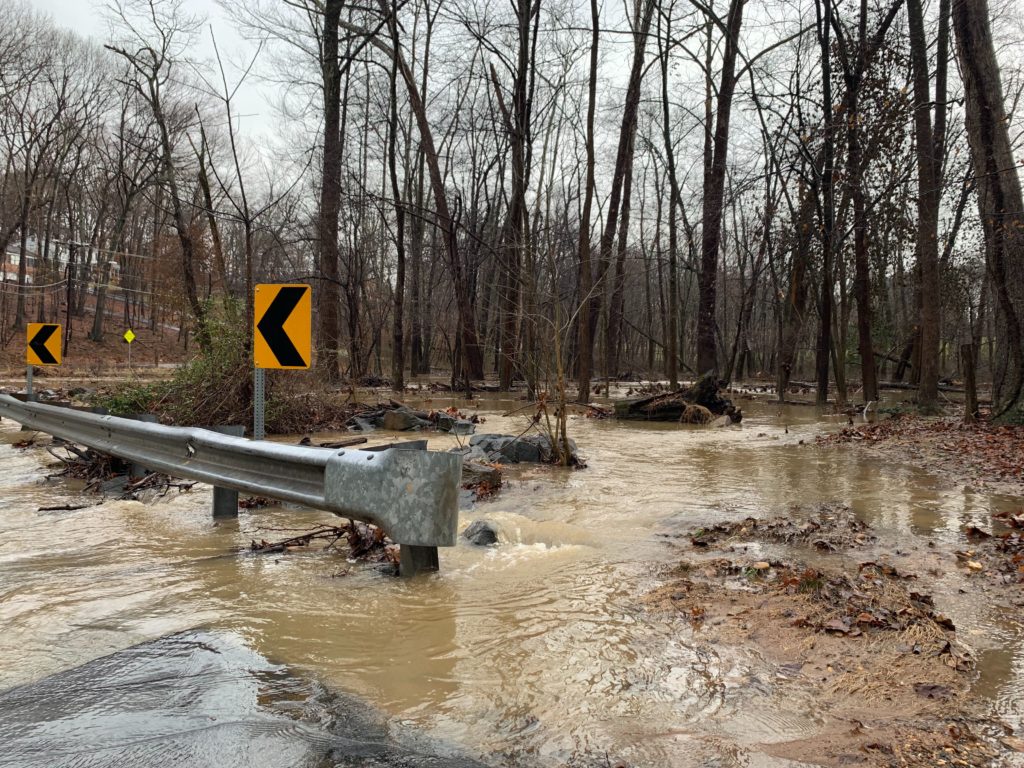
Fairfax County staff are seeking additional funding to hire more personnel who could help expedite ongoing and future flood mitigation projects across the county.
However, with the county facing increasing financial challenges, worsened by inflation and reduced commercial tax revenue, some members of the Board of Supervisors said at a recent land use committee meeting that they are reluctant to commit to expanding the budget’s list of indefinite expenditures.
“I have heartburn over [hiring more staff],” Board of Supervisors Chairman Jeff McKay said during the May 14 meeting. “I mean, we just mentioned earlier the budget that we just went through, and I gotta tell you, adding positions is really difficult, at least for this board member.”
The request from the Department of Public Works and Environmental Services is part of a broader set of recommendations aimed at helping to mitigate the county’s overall flood risk over the next several decades.
At the committee meeting, DPWES Deputy Director Eleanor Codding reported that the county has already invested nearly $100 million in flood-related projects through its capital improvement program, expected to be completed over the next 10 years.
Funded projects have included planned drainage improvements for Sunset Hills Road in Reston and improvements for the stormwater drainage system serving neighborhoods around Tucker Avenue in McLean.
However, Codding said an additional $600 million needs to be allocated over the next 70 years to effectively manage the flood risk for 570 buildings across the county with “confirmed structural flooding” — meaning water enters and damages them during heavy rain or storm events.
“When we look at the approximately 570 [structures with] unresolved structural flooding, not including coastal flooding…we estimate $600 [million] and 70 years to achieve that based on current staffing and budget,” she said.
Codding didn’t provide a detailed cost breakdown, but noted that much of the projected $600 million would support future flood mitigation projects and cover additional staff needed to analyze and address structural flooding cases.
“There are a number of things that come into play: one is risk, and you would start with the projects that would eliminate the greatest risk,” she said. “But the other truly is, as a project goes along, there are land acquisition and community considerations.”
Codding confirmed that there’s “no structural solution” to coastal flooding after the Belle View and River Towers neighborhoods in Belle Haven rejected a U.S. Army Corps proposal to build a flood wall. But the county can still take actions to address the unresolved structural flooding issues, with 570 confirmed cases reported, she said.
To do this, DPWES would need to hire 10 more staffers to handle community outreach, manage land acquisition and address significant issues, such as urgent dam repairs, flood protections for buildings, stormwater quality improvements, erosion control, and flooding in yards and on roads.
“One of the staff would need to focus on some of that community engagement and outreach because once you are in people’s yards, there is a community engagement piece of that, and one would need to be focused more on land acquisition,” Codding said. “The other eight would be divided among engineers and project managers.”
Warning of the risks of climate change, Codding emphasized that more staff and funding for other programs, such as a Flood Mitigation Assistance Program (FMAP) and a potential program to purchase properties at risk of flooding, are necessary to address some of the worst impacts of future severe flooding.
While supporting efforts to mitigate climate change, several supervisors hesitated on the $600 million investment, requesting further details on the county’s legal liability and staffing costs.
“I’d like for staff to talk with the county attorney’s office a little more about what is the liability…we are seeing as a result of any additional floods because I know there are some projects out there where there are known structural flooding, and…I think we need to understand [that number] before diving into any major financial jumps,” Hunter Mill District Supervisor Walter Alcorn said.
McKay asked Codding about more cost-effective ways to collect structural flooding data that wouldn’t require hiring additional staff.
“I’m just wondering if there’s any other technical way that we can get that data without necessarily the positions themselves,” he said.
