


Post-pandemic commuting trends appear to be stabilizing in the D.C. region, with workers spending more days at the office, but remote work remains prevalent.
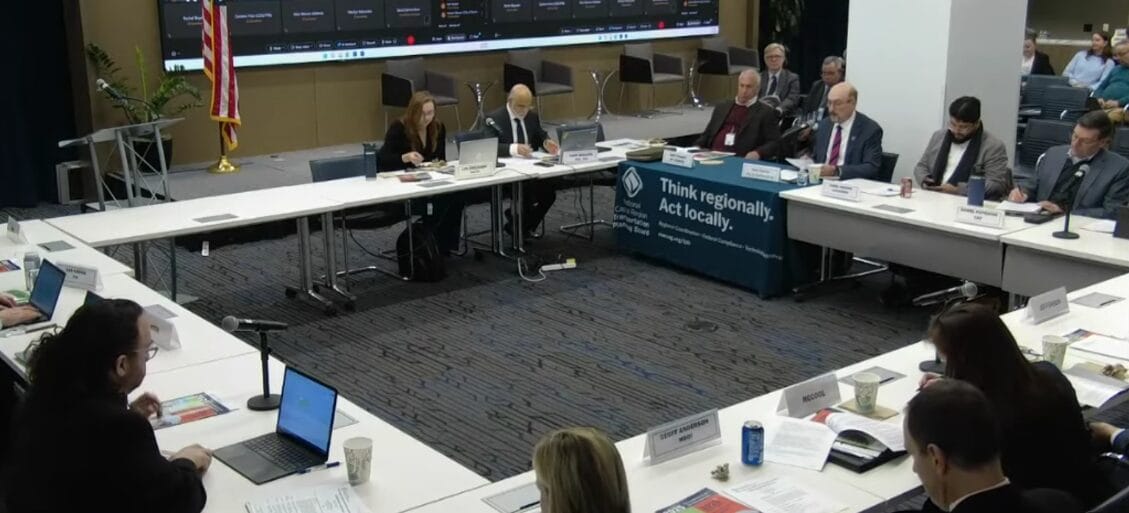
“We seem to be approaching a much more settled ‘new normal,'” Dan Sheehan, transportation operations program director for the Transportation Planning Board (TPB) said at a Jan. 21 meeting, where staff unveiled the new State of the Commute report.
The 164-page report is based on responses of more than 7,500 employed adults to surveys conducted across the region from March to June 2025.
Conducted every three years, the new report represents the first post-Covid look at local commuting patterns. It found that rates of telework are coming down, but likely to remain a fact of life going forward.
Nearly half — 48% — of respondents said they work from home at least one day per week. That’s a reduction from 65% in the 2022 report, but up from 34% in data collected in 2019.
Though down from 2022, teleworking has still eliminated an estimated 3.3 million daily work trips as of 2025, the report says.
That, in turn, “continues to play an important role in reducing congestion,” Sheehan told TPB members.
Though having fewer cars on the road offers environmental and quality-of-life benefits, the decline in office work has implications both for the economic success of local business corridors and transit ridership.
With many employees working from home Mondays and Fridays, Metro, Virginia Railway Express and local bus services are likely to see fewer riders on an annual basis than they did before the pandemic.
“It is very hard for transit systems to design and operate for three days a week. They have to be there all days a week,” said Kanthur Srikanth, deputy director for metropolitan planning at the Metropolitan Washington Council of Governments (COG).
Srikanth said not only does the reduction in office days seem permanent, but when employees do go to the office, they appear to spend less time there.
“More and more people are just coming into the office for just a few hours,” he said. “For transportation planners, these things matter.”
Still, while it hasn’t disappeared, telework is no longer the all-week-long norm for white-collar workers in the region, according to the 2025 State of the Commute report.
Only 35% of respondents who telework reported working away from the office three or more days per week, well down from 75% in 2022 — a decline driven in part by back-to-office edicts for federal workers announced at the start of 2025 by the Trump administration.
The 2025 data, collected after that requirement took effect, showed that only 23% of federal-worker respondents were teleworking at least part of the week, compared to 79% in 2022.
In the private sector, the rates for telework were 51% in 2025 compared to 62% in 2022, while for state and local governments the rates were 40% in 2025 and 48% in 2022.
The report captures data but also attempts to “look beyond how people travel and focus on what they experience on those trips,” Lindsay Haake of Commuter Connections — the consultant that compiled the report — told the TPB.
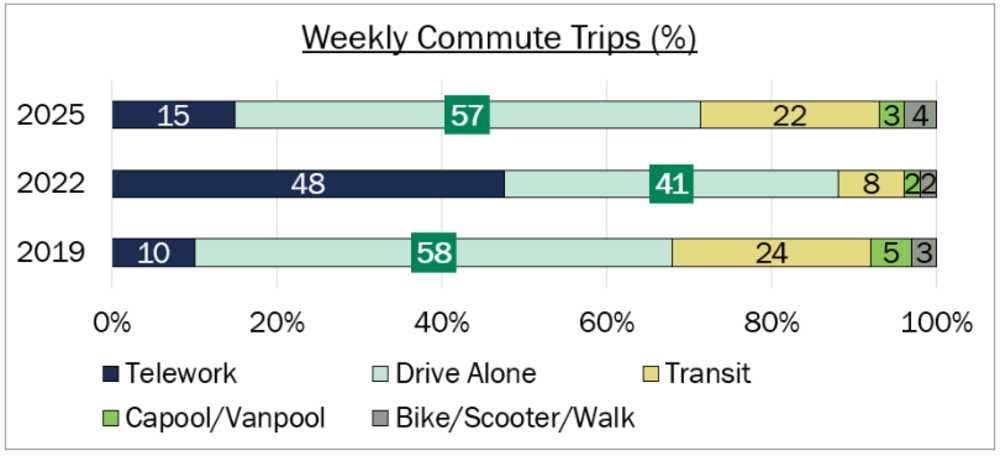
The analysis found that, during a given workweek:
- 57% of respondents drive to the office in personal vehicles, nearly identical to the 58% recorded in 2019
- 22% reported using transit, down from 24%
- 15% reported teleworking, up from 10%
- 4% walk or use bicycles or scooters, up from 3%
- 3% carpool or vanpool, down from 5%
Asked to rate satisfaction with their commuting method, 86% of pedestrians and bicyclists said they were pleased, followed by riders of Metrorail (62%) and commuter rail (58%).
Those in carpools/vanpools had a 51% satisfaction rate, followed by bus riders (50%). Solo drivers came in at the bottom of the ranking, at 44%.
That low rate of satisfaction among drivers gives regional leaders the opportunity to remind the public of other options, Haake said.
“Commuters emphasize comfort, predictability and stress reductions,” she said.
With facts and figures flying furiously during the briefing, TPB members had little time to absorb it all on the spot.
“A lot of data here, a lot to digest,” said Neil Harris, a member of the Greenbelt City Council who chaired the meeting.
Harris said one of his takeaways was the need to promote options “to get awareness back” among commuters who gave up on public transit in favor of driving during the initial pandemic rebound.
Srikanth said the report provided the backdrop for a “deep-dive’ analysis of the findings over the next year.
Individualized reports would be provided to leaders in member jurisdictions, he added.
