


Lower-income Fairfax County residents rely more on their own vehicles to get to and from work, and are less likely to be able to telework throughout the week, than those at the top of the income spectrum.
Though not necessarily surprising, the data from the 164-page 2025 State of the Commute report recently issued by the Metropolitan Washington Council of Governments (COG) does have public policy implications.
An FFXnow analysis of data from the report found that about 25.8% of days worked by those in the $250,000-and-higher income bracket were spent in a telework environment, compared to just 10% by those earning less than $80,000 per year.
In addition, 51.4% of working days of those in the highest income were spent commuting in a private vehicle, compared to 70.6% for those at income levels below $80,000.
Other commuting methods, from Metro to carpooling to biking/walking, showed some disparity among the highest and lowest earners, but the differences were less sizable than in the telework and single-occupant-vehicle categories.
Released Jan. 21 at a meeting of the Transportation Planning Board, the State of the Commute report was based on surveys of commuters conducted from March to June 2025, attracting approximately 7,500 responses. The survey is conducted every three years.
Daniel Sheehan, the director of commuter connections at COG, told FFXnow the patterns seen in Fairfax County are consistent with what was found across the region in the latest State of the Commute report as well as past reports.
“Surveys have consistently shown that telework is more common among higher‑income workers, largely because higher‑income occupations are more likely to involve office‑based, telework‑eligible job functions,” he said. “Similarly, the heavier reliance on driving alone among lower‑income commuters is also consistent with regional data.”
The disparities should be taken into account by local policymakers as they plan for future transportation needs, Sheehan said:
“If lower‑income workers in Fairfax County have fewer practical alternatives, whether due to transit availability, frequency, reliability, travel time or job location, driving alone may effectively be their only viable option. From a policy standpoint, that’s significant. The Transportation Planning Board prioritizes equitable access to high‑quality transportation options, and these findings underscore the importance of ensuring that lower‑income residents have transit options comparable in quality and convenience to those available to higher‑income commuters.”
He added that the report data doesn’t indicate “whether transit service gaps are driving the disparities in Fairfax County, but the results do suggest that improvements in reliability, frequency, and overall user experience (particularly in lower‑income communities) could help broaden access to non‑drive‑alone modes over time.”
Looking at all demographic and income groups across the county, the survey estimated that 52.82% of all commute-related trips for 2025 among county residents were in single-passenger vehicles, followed by trains (12.84%), buses (4.63%), carpools/vanpools (2.95%), bikes/scooters/walking (1.29%) and taxi/ride-share vehicles (0.71%)
Telework accounted for the remaining 24.77%.
Fairfax workers have relatively short commutes
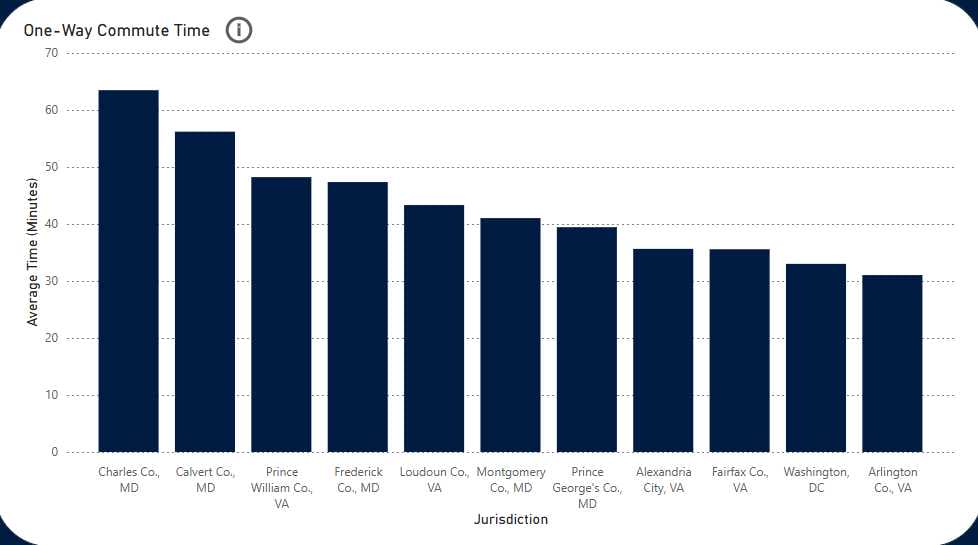
According to the State of the Commute report, Fairfax residents, on average, have the third shortest one-way commute across the D.C. region by time.
At 35.57 minutes, the average commute for county residents is only longer than those of residents of Arlington (31.04) and the District (33.01).
Alexandria residents have the fourth shortest average commute, at 35.64 minutes.
Two Maryland counties — Charles and Calvert — have the longest average commutes among the 11 major jurisdictions in the region, at 63.48 minutes and 56.2 minutes, respectively.
In terms of average commute distance, Fairfax (15.03 miles) ranked fourth at 15.03 miles, behind D.C. (8.33), Arlington (9.02) and Alexandria (11.21).
Calvert County had the longest distance, at 32.67 miles.
