

A network of about two dozen bus rapid transit (BRT) systems could be running through the local region in coming decades.
But the effort won’t succeed without buy-in from local governments, a top transit leader told the Fairfax County Board of Supervisors on June 16.
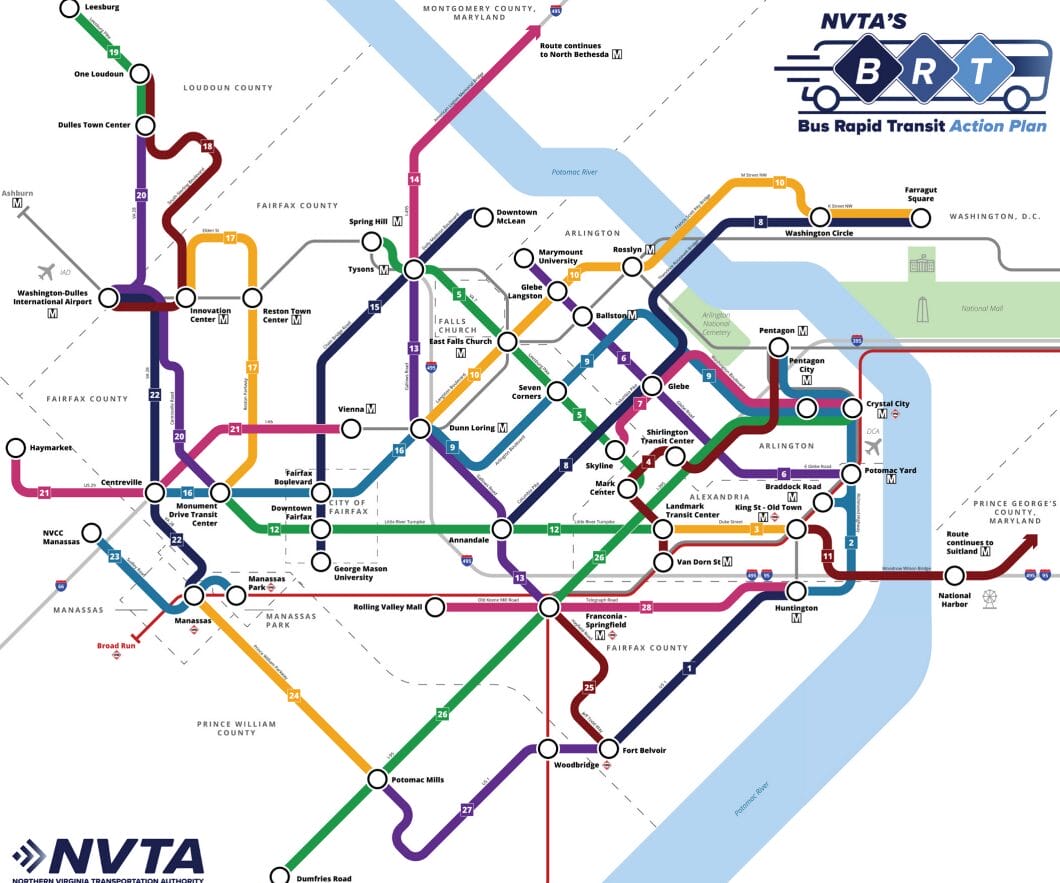
The Northern Virginia Transportation Authority (NVTA) sees potential for the region to support up to 28 BRT lines, including 22 in Fairfax County, according to CEO Monica Backmon, who presented “a blueprint of what we would like to see in the future” to the county board’s transportation committee.
Published in July 2025, NVTA’s Bus Rapid Transit Action Plan proposes a bus network that by 2045 could have 143,000 daily riders.
BRT systems give priority to bus service through dedicated lanes, enhanced bus stops, more frequency and signalization optimization. The goal of planners is to make local buses a viable option for riders, rather than a last resort.
NVTA’s planning effort is in its early stages. “We are nowhere near implementing, branding or anything of that nature,” Backmon said. “This is about getting planning in place.”
A few BRT lines currently are running in Alexandria and Arlington, but plans call for a major regional expansion. Routes in Fairfax County that are actively being planned and funded include service on Route 1 — where the line will be known as “The One” — and Route 7.
Because many of the proposed lines will span multiple jurisdictions, “the regional cooperation piece becomes really important — vitally important,” Board of Supervisors Chairman Jeff McKay said at the meeting.
NVTA is well-positioned to lead the discussion, said Hunter Mill District Supervisor Walter Alcorn.
“Somebody had to get the ball rolling,” he said.
“These [proposed route] lines are going to change,” Alcorn said, but the plan represents “a very, very important step to get us there.”
Backmon said her organization wants to promote a “seamless and efficient” BRT network in coordination with local, state and federal governments, the Northern Virginia Transportation Commission (NVTC) and the Washington Metropolitan Area Transit Authority.
“It is a true partnership,” she said.
McKay said officials need to make sure all those collaborators are working toward the same goal, rather than duplicating each other’s planning efforts.
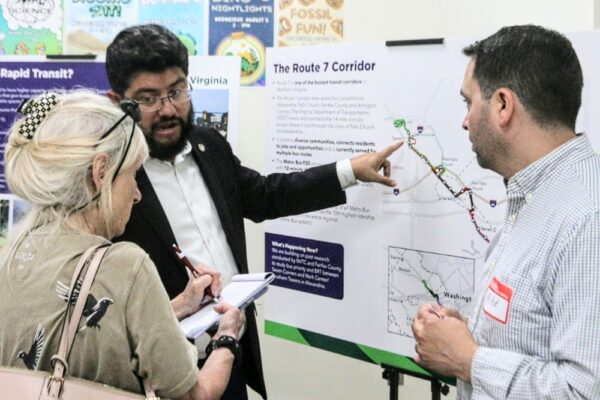
Earlier this month, NVTC hosted an open house in Alexandria to promote the planned BRT system along the Route 7 corridor from Tysons east to the Mark Center in the city.
A survey of riders and the community along the route, conducted last year, found increased frequency was the most common desire of respondents, followed by priority travel lanes for the buses and expanded operating hours.
At the June 7 event, NVTC executive director Kate Mattice said Virginia Gov. Abigail Spanberger’s administration has shown interest in the project.
“You’re going to start seeing some momentum,” she predicted at that event.
To assist the overall transit planning effort, Fairfax supervisors Jimmy Bierman (Dranesville District) and Andres Jimenez (Mason) recently spent time lobbying congressional leaders in D.C. BRT support was one of the issues they touted.
“We can’t forget about the federal piece” of funding, Jimenez said, “as well as our state partners.”
In addition to The One, major potential BRT corridors across Fairfax County include Gallows Road, West Ox Road, Old Keene Mill Road and Fort Belvoir, according to the NVTA plan. The West Ox Road line could include service on Elden Street in Herndon.
It will be up to the region’s localities to determine how to proceed, who should operate service in the BRT corridors and how to alter land use plans to guide development around them, Backmon said.
“We are not here to tell you how to plan for your community,” she said.
“Every BRT route is going to be unique,” Providence District Supervisor Dalia Palchik said. “Let’s figure it out together.”
