

Apartment rents dipped year over year across most of Fairfax County in April, according to new data.
Seven of eight different geographic corridors of the county posted declines of between 0.8% and 2.9%, according to figures reported yesterday (Tuesday) by Apartment List.
The dips align with national conditions. The median rental rate in April was $1,370, down 1.7% year-over-year even after increasing for three straight months following six months of drops.
“We are now entering the time of year when the bulk of moves take place, and as such, we’ll likely see continued price increases through the summer, in line with typical seasonal patterns,” Apartment List analysts said. “Prices generally soften as fewer renters move during the fall and winter, and then gradually begin to increase as we get closer to the peak moving summer season.”
The lone area of the county with upward movement was Lorton, where median apartment rates grew 1.2% year-over-year. Median rates there stood at $2,204 for one-bedroom units, $2,672 for two bedrooms and $2,721 for all units.
Among other corridors of Fairfax county reported by Apartment List:
- Annandale: Median April rental rates were $1,857 for one-bedroom units, $2,118 for two bedrooms and $2,141 for all units, down 5.2% year-over-year
- Centreville: Rates were $2,096/$2,434/$2,479, down 0.8%
- Fair Oaks: Rates were $2,240/$2,504/$2,456, down 2.1%
- Fairfax: Rates were $1,911/$2,186/$2,275, down 2.9%
- Herndon: Rates were $1,820/$2,184/$2,211, down 2.2%
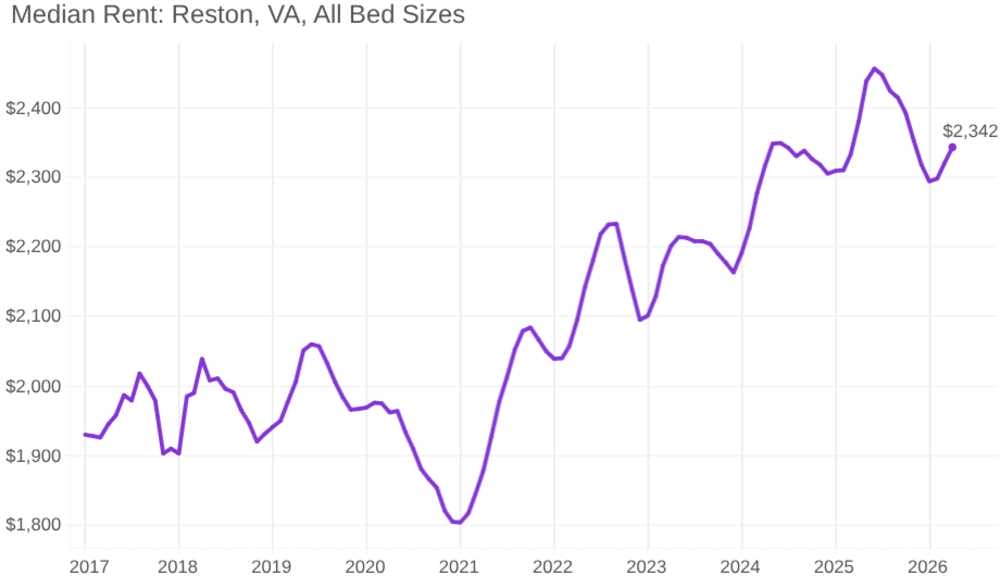
- Reston: Rates were $2,171/$2,299/$2,342, down 1.5%
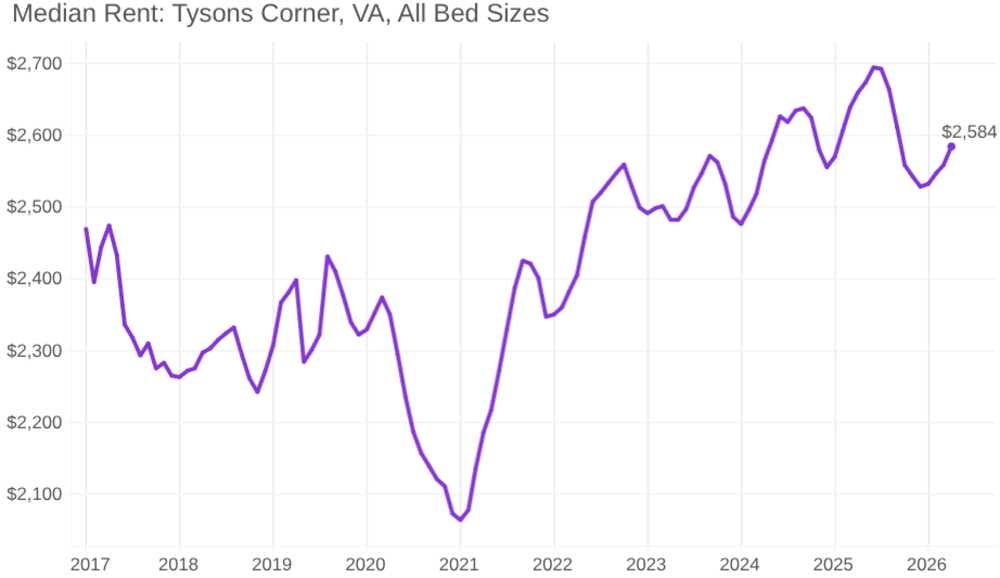
- Tysons: Rates were $2,350/$2,817/$2,584, down 2.8%
Among Fairfax County’s neighbors, the median rental rate in Alexandria was $2,040 for one-bedroom units, $2,506 for two bedrooms and $2,224 for all units, down 3% year-over-year. In Arlington, rates were $2,455/$2,966/$2,607, down 1.4%
Despite the decline, Arlington rents were the fifth highest among 100 urban areas tracked by Apartment List. Four California localities were more expensive: San Francisco ($3,324 median apartment rent), Irvine ($3,057), San Jose ($2,964) and Fremont ($2,847).
On the other end of the spectrum, the lowest monthly rents were recorded in Toledo ($881), Wichita ($1,027), Tucson ($1,029), Cleveland ($1,034) and Detroit ($1,036).
In terms of year-over-year appreciation, Virginia Beach (+5.2%) topped the 100 urban areas tracked by Apartment List, with Austin (-5.7%) at the bottom.
National rental market still volatile post-pandemic
Since Covid, there have been some variations to the cyclical ups and downs of rental rates, Apartment List analysis said:
“The broad contours of this seasonal pattern are consistent, but in recent years we’ve seen sharper winter dips and more modest summer bumps as the market has gone through a soft spell amid a wave of new multifamily construction. In addition to steeper winter declines since 2022, we have also observed a slight shift in the timing of rental market seasonality.”
“Whereas May used to be the annual peak for rent growth, over the past three years March has been the hottest month, with rent growth slowing down during what were, prior to the pandemic, the months when prices would increase most quickly. This year again, we saw rent growth stall out in April, with month-over-month growth coming in just a hair below the March reading.”
National apartment rental costs peaked in mid-2022 after a year and a half of skyrocketing growth. Since then, the nationwide median rent has gradually drifted down and has fallen from that peak by a total of 5 percent, or $72 per month.
Despite the pullback in prices, today’s rent levels remain 20% higher than they were at the start of 2021, as urban areas began to recover from Covid-era freefalls.
Nationally, unoccupied units are taking an average of 35 days to get leased after being listed, five days longer than one year ago and nearly twice as long as it took units to turn over when the market was at its hottest in mid-2021.
Apartment List’s national vacancy index recently hit a peak of 7.3%, marking the highest level since at least 2017, but declined to 7.2% in the April report.
“That said, this month’s decline was modest, and the vacancy rate remains elevated above its long-run average,” analysts said. “And with mixed news on the labor market combined with renewed inflation concerns, there is reason to think that demand could be sluggish headed into the peak moving season. It’s possible that the vacancy rate will simply plateau at this elevated rate, rather than continuing to decline in a meaningful way.”
Zumper, another data-analytics firm that tracks apartment rents, also released April data this week.
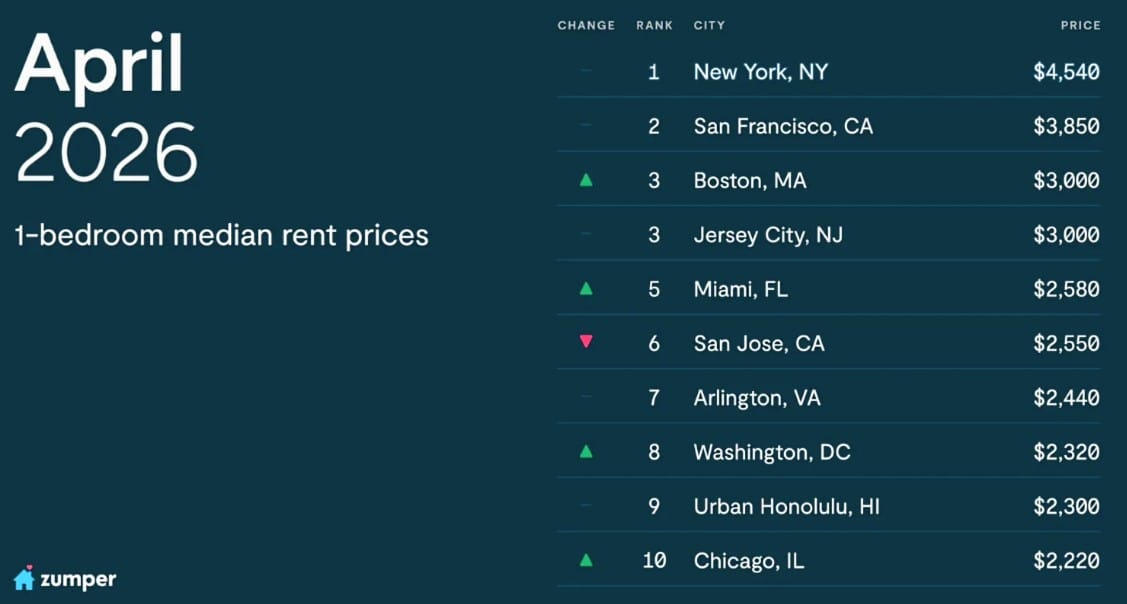
Leading the pack in its report, price-wise, in its report was Manhattan (median rental rate for a one-bedroom unit of $4,540), San Francisco ($3,850) and Boston and Jersey City ($3,000 each). Arlington and D.C. ranked seventh and eighth, respectively.
Nationally, median apartment rates in the Zumper survey were $1,508 for one-bedroom units and $1,895 for two bedrooms.
According to Zumper analyst Crystal Chen, year-over-year declines in rental costs are becoming a thing of the past as the national market recalibrates:
“Annual rent changes remain negative for the 10th straight month, but declines have nearly disappeared, with one-bedrooms down just 0.6% and two-bedrooms down 0.3%. With one-bedrooms just 2% below their December 2024 peak price of $1,538 and two-bedrooms nearing their August 2024 high of $1,915, national record rents could be challenged before summer ends if momentum holds.”
But not all markets are reacting the same, according to Zumper CEO Shawn Mullahy:
“Underneath the national averages, the rental market is splitting in two. Expensive coastal cities are seeing rents spike as supply remains constrained, while markets in the Sun Belt and Mountain States are still working through a significant inventory overhang that could take another year or two to fully absorb. What looks like a national recovery is increasingly just a handful of markets doing the heavy lifting.”
Chicago re-entered the top 10 for the first time in nearly two years with the third-highest annual growth rate in the nation for one-bedrooms, up 8.3% to $2,220 monthly.
For the first time in Zumper’s reporting, Los Angeles fell out of the 10 most expensive markets, now ranking as the 11th priciest city in the nation at a median $2,210 for a one-bedroom unit.
