

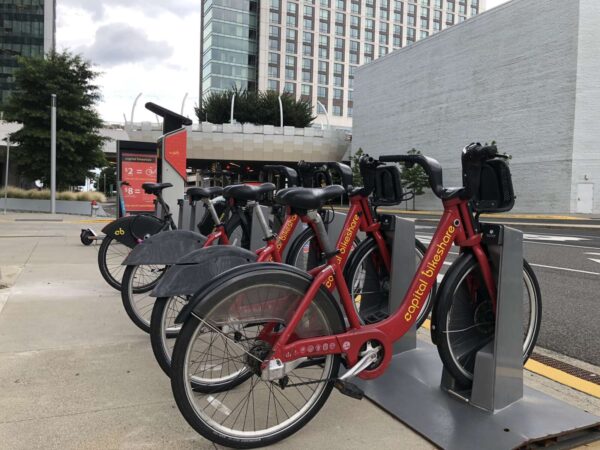
Fairfax County officials are working on ways to reduce financial subsidies required to support Capital Bikeshare — with finding a countywide or regional sponsor as one potential option.
That would make the local rental bicycle and e-bike service more like Citi Bike in New York City, which is able to run without taxpayer subsidies thanks to high volume, somewhat higher rider costs and a financial partner in Citigroup.
Capital Bikeshare operations in Fairfax County, in contrast, require an annual subsidy of about $1 million, as user fees account for only about $220,000 of the $1.27 million annual operating cost — or 17% of the total.
“We do expect the fare change in August [2025] is going to drive that ratio up,” Zack DesJardins, the Capital Bikeshare manager for the Fairfax County Department of Transportation (FCDOT), told the Board of Supervisors’ Transportation Committee this morning (Tuesday).
Capital Bikeshare hiked up prices for memberships and day passes last year to support “unprecedented” growth in ridership that started in May 2024.

Even with higher fares, which contributed to a 38% increase in revenue through December, Fairfax County transportation officials are only expecting a bump up to approximately 20% fare recovery in the coming year. That could make finding a corporate partner more enticing for county leaders facing another tight budget year.
“You would only have to add one word,” said Dranesville District Supervisor Jimmy Bierman, who chairs the transportation panel.
Bierman left that comment dangling, but he may have been referring to Capital Bikeshare becoming “Capital One Bikeshare” if the Tysons-based financial giant could be enticed to provide some backing.
Citigroup has agreed to fund its share of Citi Bike operations through at least 2034, giving the New York City program some stability.
But partnerships can be a double-edged sword. In 2023, the Nice Ride Bikeshare program in Minneapolis closed after 13 years when a major sponsor — Blue Cross and Blue Shield of Minnesota — ended its annual sponsorship and no replacement could be found.
Mount Vernon District Supervisor Dan Storck suggested at the Feb. 24 meeting that the county could consider other ways to cut the subsidy.
While county transportation staff has been gung-ho about expanding Capital Bikeshare over the years, “I’ve always been more cautious,” he said.
Storck pressed for more evaluation of how similar programs operate elsewhere, and how to get usage up to levels where economies of scale would kick in, as they do in New York City.
“The issue for me is utilization,” Storck said.

FCDOT is currently drafting a Capital Bikeshare development plan, which would guide growth for the next five to 10 years.
Supervisors asked for creativity, with Bierman expressing an interest in more docking stations in residential communities and Braddock District Supervisor Rachna Sizemore Heizer seeking stations at Northern Virginia Community College’s Annandale campus.
Currently operated by Lyft, Capital Bikeshare started operations in 2010 in Arlington and D.C. It debuted in Fairfax County in 2016 and now has 96 docking stations in the county that are expected to grow to 126 by the end of this year. Planned additions include the Town of Vienna’s first five stations, which are on track to launch this summer.
The introduction of electric bikes to the Capital Bikeshare fleet has proven popular. DesJardins said e-bikes total just 17% of the overall fleet in Fairfax, but account for 49% of trips taken.
“E-bikes have absolutely changed the game,” Sizemore Heizer said.
Because Capital Bikeshare e-bikes use global-positioning technology, county transportation officials can pinpoint usage trends more easily than they can with the more traditional bikes.
A typical e-bike rider uses the equipment for rides averaging 15 minutes, slightly less time than with traditional Capital Bikeshare equipment. The typical length of an e-bike journey is about 2.2 miles, DesJardins said.
The county uses revenue from its commercial and industrial real estate tax surcharge to subsidize the network’s operating costs. Most capital costs are covered by grants, with a “very little bit” of local funding, DesJardins said.
In Fairfax County, there were approximately 39,500 Capital Bikeshare trips in 2025, essentially flat from 2024 despite an increase in docking stations.
The fare increase in August was one of the reasons for the flatlining of usage, DesJardins told supervisors.
