

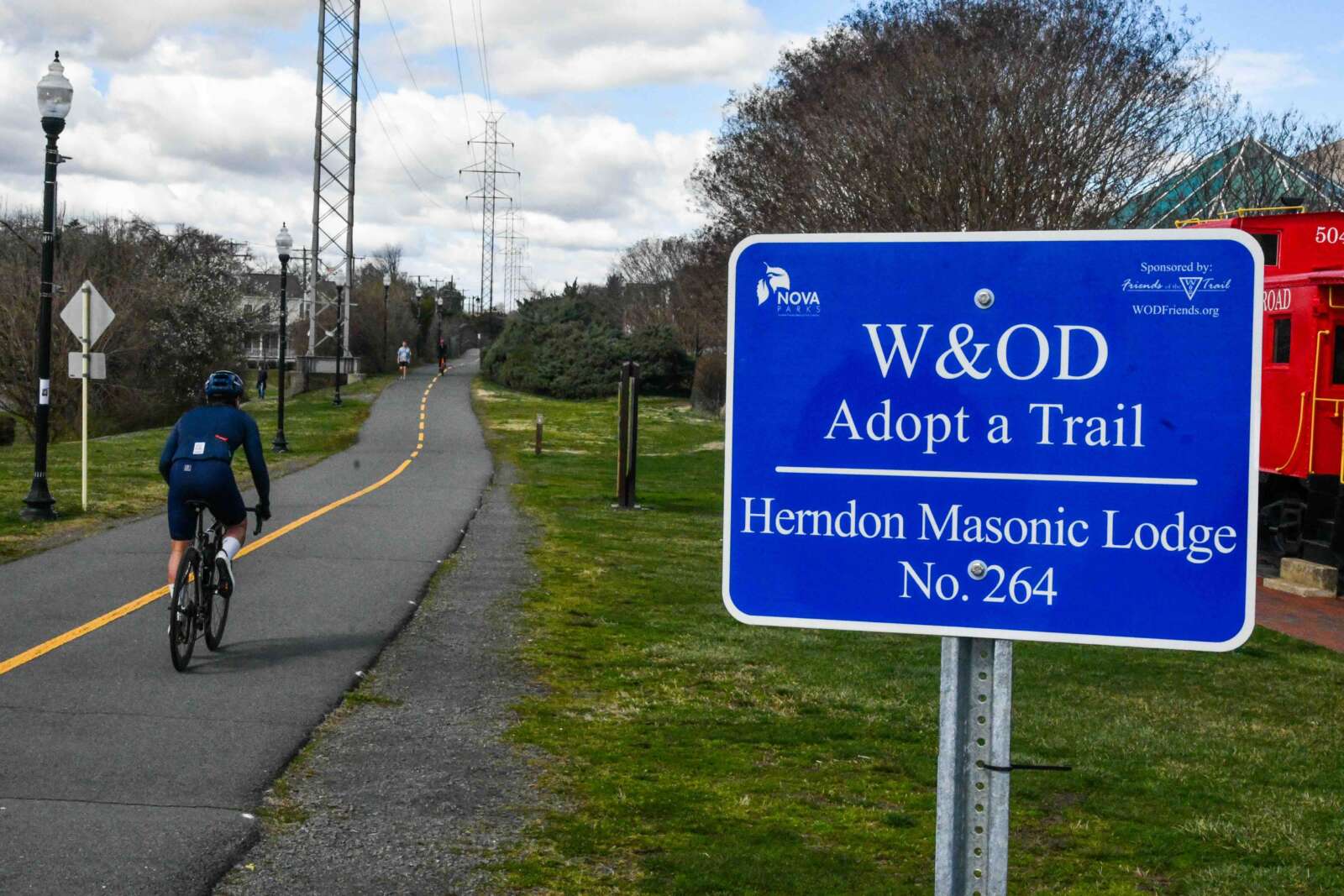
After two years of meticulous data collection and analysis, Fairfax County’s Department of Transportation (FCDOT) is moving into the second phase of its ActiveFairfax Transportation Plan.
Starting today (Tuesday) at 6 p.m. at the Graham Road Community Center in West Falls Church, FCDOT will host a series of in-person and virtual open houses throughout the fall to gather input from residents on enhancing the county’s extensive network of pedestrian trails and bicycle pathways.
The plan aims to make it safer and easier for people to get around by constructing dedicated bike paths separate from road traffic and improving the connectivity of walking trails that link neighborhoods with schools, parks and commercial areas.
The in-person meetings will help staff collect community feedback on a proposed network of paths and bicycle lanes, including any missing links or key spots that got overlooked and the style of trail or bike lane, ActiveFairfax Transportation Planner Nicole Wynands says.
The ultimatel goal is to ensure all roads in Fairfax County accommodate bicycles and pedestrians without taking a “one-size-fits-all approach,” she told FFXnow.
“The community knows their needs and their network, their barriers best, so we want to take a micro-look at your surroundings, your destinations, the way to go every day and make sure those are covered and included in the plan,” she said.
How Fairfax’s transportation plans have changed
According to Wynands, Fairfax County’s approach to non-motorized or active transportation planning has evolved dramatically over the decades.
The county first created a comprehensive trails plan in the 1970s that prioritized separated, off-street facilities for pedestrians and cyclists. It was seen as the gold standard of the time, says Wynands.
However, in the 1980s and 1990s, the county started following national trends towards on-street facilities that integrated cyclists in particular with vehicular traffic.
By the early 2000s, Wynands says it became evident that this approach was less effective, as on-street bike lanes failed to attract the expected number of cyclists, leading to a resurgence in appreciation for the original model of separated, off-street facilities.
“As a nation, we realized that the approach from the ’70s was the way to go to provide those separated, safe facilities that really appeal to a broader segment of the population,” she said.
Although Fairfax County’s approach to planning has changed over the years, Wynands says officials never entirely abandoned the original vision of expanding its trail network, which now covers over 600 miles.
“Other communities are just starting to now develop trails, because now that’s the shiny new thing that everyone needs to have, and we already have it, which is a great place to start,” she said.
The county adopted a new bicycle master plan and trails plan in 2014, but they still had significant gaps in connectivity and accessibility that needed to be addressed, Wynands says.
FCDOT released an initial draft of ActiveFairfax’s vision statement and goals in summer 2021, outlining a strategy to combine the bicycle and trails plans into one comprehensive plan.
After finishing phase one in 2022, including recommendations for a Safe Streets for All program focused on addressing safety issues, Wynands and her team have been merging and refining data from the existing bicycle master plan and trails network.
“We had to look at where have developments occurred that have precluded trails that weren’t implemented, where new roads were built that weren’t there 30 to 40 years ago,” Wynands said. “So, [we] just clean up basically the network to fit into current conditions and planned road network that the county has in the comprehensive plan, as well as the special area plans.”
Making paths work for everyone
One of the main issues ActiveFairfax has attempted to tackle is linking neighborhoods to schools, parks and commercial hubs.
In the past, Wynands says the county’s efforts have focused on meeting the needs of people with disabilities and commuters. But she argues it’s time to move beyond these minimal requirements and develop a network that genuinely serves the diverse needs of all pedestrians.
“We’re taking a more universal [approach]…to make sure we meet the needs of other users, like a caregiver pushing a stroller or a child riding a bike,” Wynands said. “They have very different needs from previous design users.”
The draft plan calls for wider sidewalks so two people with strollers can pass each other comfortably without stepping into the grass or the road. It also emphasizes crosswalks and intersections with features like improved lighting and signaling to increase pedestrian safety and visibility.
Wynands and her team worked closely with the county’s park authority and Department of Public Works and Environmental Services to ensure the pedestrian improvements aren’t tacked on, but are thoughtfully integrated into the overall active transportation network.
“So, [the plan] enhances the facilities to make them a lot more comfortable to walk on, bike on versus a more basic accommodation,” she said.
Additionally, the plan proposes off-street bicycle facilities to provide greater physical separation from cars, making bicycling a safer and more comfortable option.
“We now realize that the majority of our population prefer separation from vehicular traffic,” Wynands said. “A lot of the recommendation is moving from an on-street facility to an off-street facility, which will help the community get around where they want to be safely and more comfortably, particularly folks that may not be able to drive yet or don’t want to drive.”
Plan will be implemented over time
While the ActiveFairfax team has yet to determine the exact cost, Wynands estimates the improvements could run into the billions and take several decades to implement fully. Building just one mile of sidewalk or trail can cost anywhere between $10 to $15 million.
“Luckily, we have a lot [of infrastructure] already, and upgrading an existing facility is a lot more affordable, but building a brand new facility can be quite expensive, unfortunately,” Wynands said.
The county will draw from various sources for funding, including federal grants, state programs and local budget allocations. In 2021, the Board of Supervisors set a goal of dedicating around $100 million to active transportation improvements over the next six years.
However, that funding is intended for smaller-scale, spot improvements, rather than the larger, more costly projects outlined in the new comprehensive plan.
“There’s only so much federal funding to go around, but we do put in our applications on projects that we feel are most competitive,” Wynands said.
Once the ActiveFairfax proposal is finalized, likely by 2025, the FCDOT team will focus on prioritizing projects in critical areas, including high-density zones like retail hubs and transit stations, lower-income neighborhoods that depend on active transportation, high-risk areas for pedestrians and cyclists, and links between activity centers and more scenic, less dense areas.
“Those are the four pillars we’re looking at when we prioritize the limited funding that we have in order to start implementing this network where it…benefits most people in the community,” Wynands said. “But filling out the entire network would be a long-term effort.”
