


New buildings are still going up in Tysons, as anyone who has passed the Indigo at McLean Station, Exchange at Spring Hill and Flats at Tysons construction sites can attest.
But 16 years into Fairfax County’s plan to remake Tysons into a downtown community by 2050, developers behind some of the area’s more established neighborhoods have started to focus less on expanding their properties than on bolstering what they’ve already built.
Tysons Corner Center, for instance, has recently prioritized attracting entertainment options, both permanent venues like Level99 and the Escape Game and temporary pop-ups, such as the delayed Hershey Super Sweet Adventure.
The strategy has apparently paid off for the mall, which drew around 15 million visitors last year — a 10% increase from 2024 and a step up from pre-pandemic levels in 2019, according to the Tysons Community Alliance’s (TCA) 2025 market report.
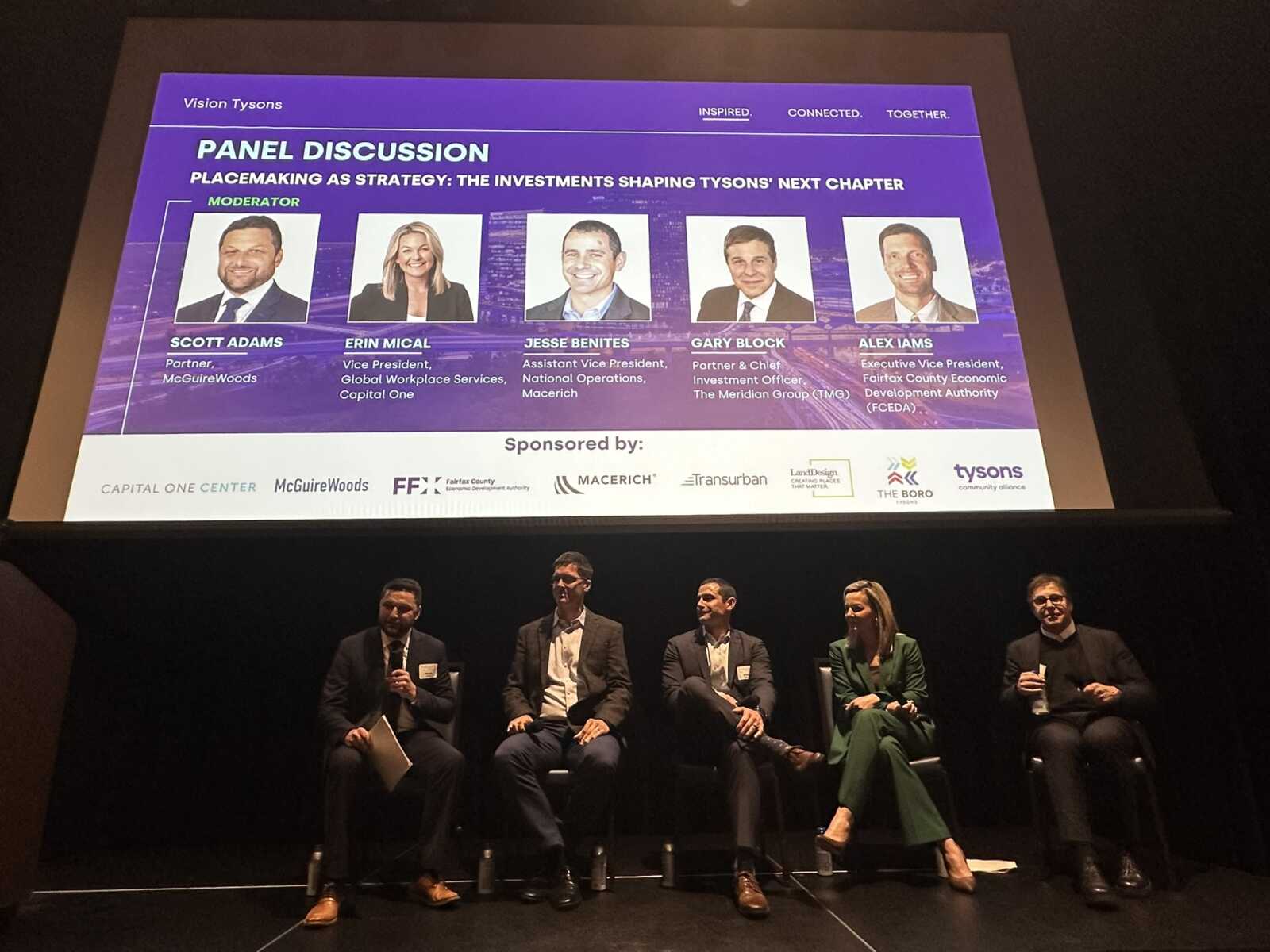
“We’re seeing kind of an evolution of what we’re seeing at the shopping center,” Macerich Assistant Vice President of National Operations Jesse Benites said during a panel discussion at the TCA’s Vision Tysons summit last Thursday (March 12).
Benites didn’t mention the status of Macerich’s plans for more office and residential development at the mall, but last month’s reveal that Dick’s House of Sport — a sporting goods retail/recreation concept — will move into the former Lord & Taylor store suggests they’re now on the backburner.
Even though Tysons Corner Center hasn’t been literally breaking ground of late, its post-pandemic growth in sales and visitors has been fueled by investments in the property by its owner as well as individual tenants, Benites said.
The mall has seen 32 remodels and relocations over the past couple of years by existing businesses, including Barnes & Noble, Uniqlo, Apple and American Girl. In addition, Macerich has committed millions of dollars to refreshing the mall’s common areas, bathrooms and parking garages.
“If you drive the property now, you’ll see beautiful parking garages, fresh paint, murals all over the place,” Benites said. “… All of these developments, while they might not be ground-up projects, it’s really an investment into what’s already working for us.”

At Capital One Center, where the Vision Tysons summit was held, rising Watermark Hotel bookings and ticket sales for shows at Capital One Hall point to a “slow and steady growth of interest” in a development that started with a single office building opened in 2001, according to fellow panelist Erin Mical, the vice president of global workplaces services for Capital One.
Seeing an opportunity to expand its headquarters with Metro’s Silver Line coming in, the banking company initially focused on adding collaborative spaces and amenities for its workers, but it also saw a “yearning” in Fairfax County and Northern Virginia for more cultural venues and green spaces.
“It turns out, when you build a beer garden, it attracts a lot of people,” Mical said, referring to Starr Hill Biergarten, which opened in August 2021 as the anchor for Capital One Center’s new elevated park, The Perch.
Later expanded with food trucks and a mini golf course, The Perch was the first community-oriented component of the development to fall into place, followed quickly by Watermark Hotel and Capital One Hall.
According to Mical, Capital One Center is concentrating now on providing more street-level attractions. On top of hoping to welcome “several additions” to its retail offerings by this time next year, including the just-announced Mediterranean restaurant La Omri, the development will open pickleball courts “in a couple weeks” to replace the ice skating rink at the new Metro Park adjacent to the McLean Metro station.
“That connection to the Metro makes it easier for all of our neighbors and community alike to come and visit us, and makes it more accessible to come to our project,” she said. “So, we are continuing to be really thrilled and excited to add those types of activations.”

Construction slows on high-rise buildings
Hosting events and activities to draw out residents, employees and visitors from the surrounding community has also been key to the success of The Boro, which now offers over 100 events a year, according to Meridian Group Chief Investment Officer Gary Block, who was also on the Vision Tysons panel.
Despite finishing construction in March 2020, right as the pandemic forced its new movie theater and retailers to temporarily close, The Boro thrived with its new office building, Boro Tower, quickly leasing up and the Verse condominiums selling out, Block said.
The presence of both office workers and residents has buoyed the development’s retail, which has centered on restaurants and “experiential” offerings and will soon expand with Fava Pot and Game Show Battle Rooms opening later this month.
“Retail benefits from a robust daytime and nighttime population,” Block said, adding that The Boro “finally” gave people in Tysons “a place to shop and entertain outside the mall.”
Though demand for space at Boro Tower remains strong — so much so that the Meridian Group bought the struggling Tysons Central office building, now called Boro Central, last summer — Block acknowledged that the “monster flight-to-quality” trend among office tenants has presented challenges for older buildings in the area.
Per the TCA’s 2025 market report, the overall office vacancy rate in Tysons held steady at 20% — roughly in line with the national average — for a fifth consecutive quarter at the end of the year, but among trophy offices, it’s 14%. With approximately 92,000 workers total, 65,000 of them office users, Tysons is the D.C. region’s second largest employment center, surpassed only by the District’s downtown.
With almost no new office under construction, businesses are competing for new, flexible spaces that offer modern amenities and accessibility to transit, dining and other attractions that have become key to enticing workers back to the office, Fairfax County Economic Development Authority Executive Vice President Alex Iams said during the Vision Tysons panel.
That trend was epitomized by consultant Booz Allen Hamilton’s announcement in November that it will leave its longtime corporate headquarters at 8283 Greensboro Drive in the EastBoro complex for Comstock Companies’ new Reston Row neighborhood near the Wiehle Metro station in fall 2027.
“Reston is formidable, no doubt about it,” Block said.

He sees Booz Allen Hamilton’s impending departure as an opportunity to rethink the future of the EastBoro office buildings, whose tenants also include Alarm.com and 22nd Century Technologies. The Meridian Group had floated a proposal to Fairfax County in 2022 to allow housing on the property, but no official development plans have come forward since then.
Block indicated that, with an economic market that has grown wary of investing in multifamily projects, additional development is unlikely to come in the immediate future, either in EastBoro or the expansion area north of Westpark Drive that has mostly gone quiet since The Trillium, a senior living community, opened in 2024.
“To be totally frank, very few construction projects pencil at all,” he said. “High-rise office construction doesn’t pencil. High-rise residential construction doesn’t pencil, but wood-frame, lower-density housing does potentially pencil, and that’s what Tysons needs. Tysons needs more residents to allow for more retailers, which will bring in more office and so on and so on.”
Given the Tysons Comprehensive Plan’s recommendations that the highest-density development be concentrated near Metro stations, it’s unclear whether Fairfax County leaders would be open to allowing townhouses or other lower-density projects on land as prized as The Boro, even if they’re more viable at the moment.
A study released in December by the TCA estimated that Tysons will need more than 10,000 new homes by 2040 to accommodate its projected population growth. The Indigo and Exchange projects will deliver 972 committed-affordable units, and more could be in the works after the Fairfax County Redevelopment and Housing Authority acquired a Tysons Central property just outside The Boro for affordable housing.
Block called the ongoing affordable housing projects “amazing,” but noted that not all residents will fall in the income range to qualify for those units.
“So, we need attainable housing, and that’s the low-rise. That’s essential to continue to keep Tysons’ momentum,” he said.
This story initially said Capital One’s headquarters campus was developed in the 1980s. While the land was acquired in 1988 and 1989, the company’s original office tower didn’t open until 2001, a spokesperson says.
